

Snowflake
Snowflake AIM vs Redshift Migration: Cost & Risk Framework
Explore Snowflake AIM vs AWS Redshift migration, including costs, risks, and key factors to consider before making a decision.
Snowflake AIM is an AI-powered migration agent that automates moving data warehouses (including Redshift) to Snowflake. AWS offers a parallel path through Redshift Serverless, RA3 optimization, and native AI services like Bedrock and SageMaker. Neither is automatically cheaper more than 80% of data migrations run over budget regardless of destination. For a CFO, the decision requires a workload-specific total cost of ownership (TCO) model comparing both paths before any budget is approved.
What Is Snowflake AIM?
Snowflake AIM unifies SnowConvert AI and Snowpark Migration Accelerator into a single workflow. It connects to source systems (Oracle, Teradata, SQL Server, Redshift, BigQuery, Databricks), converts SQL and procedural code, migrates data and objects in waves, and validates outcomes at each stage. For Redshift customers, this is the first fully automated, AI-assisted exit path actively marketed by a competing vendor, which doesn't make migration right for your organization, but it does mean the conversation needs to start from an actual cost model, not a vendor comparison deck.
The Real Cost of Data Warehouse Migration
Research consistently shows the overrun pattern regardless of destination:
- Bloor Group: 80%+ of migrations exceed budget or timeline; average overruns ~30%, schedule slippage 30–41%
- Gartner: Only 17% of data migrations complete within budget and schedule
- CloudBees DevOps Migration Index (2025): Average cost of migration problems = $315,000 per project, driven by timeline overruns and tool sprawl, not the migration tool itself
- Enterprise-scale migrations (2025–2026): ~$1.2M average cost across 8 months; projects stretching past 12 months see 30%+ cost inflation
The takeaway: the deciding factor is rarely the platform. It's whether your organization builds a disciplined, workload-specific cost model before committing budget, or commits based on vendor messaging and hopes the numbers hold.
Comparing Paths: AWS Modernize-in-Place vs. Snowflake Migration
AWS-Native Path (Stay on Redshift, modernize incrementally):
- Redshift Serverless or RA3 reserved instances for compute optimization
- Redshift ML and zero-ETL for AI capability without data movement
- Direct connections to Bedrock or SageMaker for generative AI and ML workloads
- Avoids migration risk entirely; carries forward existing technical debt
Snowflake AIM Path (Automate migration):
- Reduces manual SQL rewriting; increases validation cycles
- Still requires dependency mapping, BI cutover, change management
- Cost is shifted in composition, not guaranteed to reduce total cost
The Right Comparison:
A CFO should request a cost model for both paths over either:
- 36-month horizon for full steady-state comparison, OR
- 3-month intensive proof-of-concept (PoC) model if your organization wants to validate technical feasibility and cost assumptions before full commitment
Both should include identical assumptions: compute/storage, professional services, dual-running costs, and retraining spend.
Hidden Costs That Blow Up Budgets
- Dual-running both platforms during validation and cutover (2–4 months longer than planned)
- Data egress fees from AWS, scaling with volume
- Team retraining on new platform tools and SQL dialects
- Compliance re-certification of audit controls and access governance
- Contract exit costs (unused AWS Reserved Instances, RA3 commitments)
- BI and reporting re-pointing (dashboards, validation, stakeholder sign-off)
- Opportunity cost (analytics roadmap stalls while engineers migrate)
Risk Scoring Framework: Six Dimensions CFOs Should Evaluate
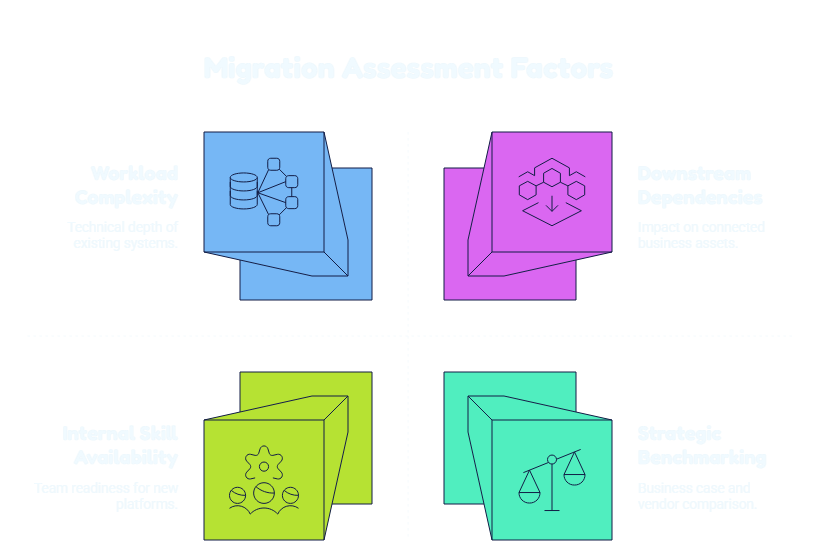
Before approving budget, score each dimension on a high/medium/low scale:
- Workload Complexity: Number of database objects, stored procedures, custom ETL logic
- Downstream Dependencies: BI dashboards, embedded analytics, ML models requiring re-validation
- Internal Skill Availability: Does your team already know the target platform, or is this also a hiring/training problem?
- Reversibility: What would it cost and disrupt to roll back partway through?
- Time-to-Value: Does the business case require completion within one fiscal year, or can this be phased?
- Vendor Benchmarking: How does cost/risk/capability compare against your current platform benchmark? (Compare Redshift's current performance, cost-per-query, and AI capability gaps against Snowflake's projected equivalent, not against Snowflake's marketing claims)
This structured score, completed before the technical team presents a recommendation, keeps the budget conversation anchored to risk, not enthusiasm for a new platform.
India-Based Enterprises & Global Capability Centers: What Changes
A few factors shift the calculus:
- Data Residency: India's DPDP Act (2023) requires compliance review for any migration changing processing location. AWS India availability zones and Snowflake's India regions have different regulatory implications.
- Talent: AWS skills (Redshift, Bedrock, SageMaker) are broadly available across India's GCC hubs, including Hyderabad. Snowflake-specific talent is growing but smaller, price this premium explicitly into labor estimates.
- Cost Arbitrage: India-based delivery can reduce professional services costs meaningfully, but platform consumption costs (AWS or Snowflake credits) are largely currency-equivalent globally.
CFO Pre-Approval Checklist
Before signing off on migration budget in either direction, require:
.png)
The Real Decision: Model Before Committing
Whichever direction your team leans, the cost difference between "stay and modernize" and "migrate" rarely shows up until someone builds the model against your actual environment—your object count, BI dependencies, existing AWS commitments.
Info Services works with finance and data leadership to build that model before a single migration step is taken, with workload-specific TCO comparisons and risk scoring.