

AWS
Amazon MSK vs. Kinesis: How to Make the Right Streaming Architecture Decision
Compare scalability, portability, cost, operations, and AWS integration before you commit.
Amazon MSK (Managed Streaming for Apache Kafka) and Amazon Kinesis Data Streams are both real-time data streaming services on AWS, but they are built for different teams, different workloads, and different architectural philosophies. Kinesis wins when you need a fully managed, serverless-friendly, AWS-native stream that ships fast. MSK wins when you need Kafka's ecosystem compatibility, fine-grained consumer control, high-throughput partitioning, or portability beyond AWS. Most organisations with mature data platforms end up running both.
The decision looked straightforward in the planning meeting. You need real-time data streaming. AWS offers two credible options. Pick one, move forward.
Six months into production, one of two problems has typically appeared.
The team that chose Kinesis for a high-throughput, multi-consumer workload is hitting shard limits, managing complex resharding operations, and discovering that the simplicity they bought upfront is costing them engineering hours at scale.
The team that chose MSK for a simple event notification pipeline is managing Kafka brokers, monitoring ZooKeeper, tuning retention configurations, and asking why they are running infrastructure operations for a use case that Kinesis would have handled in an afternoon.
Both services are excellent. Both are wrong for the other's job.
This guide draws the line precisely, with the architectural logic, the decision signals, and the framework that CTOs and VPs of Engineering need before committing to either.
What Is Amazon MSK?
Amazon MSK is AWS's fully managed Apache Kafka service. You get the full Kafka ecosystem, producers, consumers, topics, partitions, consumer groups, connectors, and the complete Kafka API surface, without managing the underlying broker infrastructure yourself. AWS handles broker provisioning, patching, availability, and storage scaling. You handle the Kafka configuration, topic design, consumer group management, and application logic.
Think of MSK as Kafka with the operational ceiling raised. You still need to know Kafka. You just no longer need to manage the servers it runs on.
MSK supports Apache Kafka versions through 3.x, offers MSK Serverless for variable workloads without manual capacity planning, and integrates with MSK Connect for managed Kafka connector deployments, including sources and sinks for S3, Redshift, OpenSearch, and DynamoDB.
What Is Amazon Kinesis Data Streams?
Amazon Kinesis Data Streams is AWS's proprietary, serverless-first real-time streaming service. It is purpose-built for the AWS ecosystem, native integrations with Lambda, Firehose, Analytics, S3, Redshift, and Bedrock require minimal configuration. You provision shards (or use on-demand capacity), write records, and consume them. There is no Kafka API, no broker management, no ZooKeeper, and no connector ecosystem to configure.
Think of Kinesis as streaming infrastructure that disappears into your AWS architecture. You never see the engine, you only interact with the stream.
Kinesis on-demand mode eliminates the need to manually manage shard capacity, making it genuinely serverless for most workloads. Enhanced fan-out allows multiple consumers to read at full throughput simultaneously, addressing one of the historic limitations of the service.
The Real Difference in One Sentence
MSK is the Kafka ecosystem on AWS. Kinesis is AWS's native streaming primitive.
Every architectural decision, team skill requirements, consumer model, throughput ceiling, portability needs, operational overhead, flows from that distinction. If your organisation lives in the Kafka world or needs to, MSK is your service. If your organisation lives in the AWS world and wants streaming without operational complexity, Kinesis is your service.
For organisations building AI pipelines that consume real-time data streams, feeding Bedrock inference endpoints, SageMaker training jobs, or RAG knowledge base updates, the streaming layer choice directly affects the architecture of the AI stack. Our AWS Generative AI Implementation Guide 2026 covers how the data layer connects to the AI inference layer in a complete AWS architecture.
When Your Architecture Actually Needs MSK
Five clear signals. If two or more apply to your situation, you are an MSK candidate.
Signal 1: You Are Already Running Kafka Anywhere in Your Stack
If your organisation runs Kafka on-premises, in another cloud, or in a separate AWS environment, MSK is the natural AWS extension of that infrastructure. Your existing producers, consumers, schemas, and connector configurations are portable to MSK with minimal rework. Migrating those workloads to Kinesis would require rewriting producers and consumers against a proprietary API, a significant engineering investment for zero architectural gain.
Signal 2: You Have Multiple Independent Consumer Groups Reading the Same Stream
Kafka's consumer group model allows multiple independent applications to consume the same topic at their own pace, with independent offset management. Each consumer group maintains its own position in the log one group can be real-time, another can be hours behind for batch processing, a third can be replaying historical data for a new service. Kinesis enhanced fan-out allows multiple consumers at full throughput, but the offset management model is less flexible than Kafka's consumer group architecture for complex multi-consumer topologies.
Signal 3: You Need Message Retention Beyond Seven Days
Kinesis Data Streams retains data for a maximum of 365 days, but the default is 24 hours and extended retention carries additional cost and operational consideration. MSK retains data on disk for as long as your storage allows days, weeks, or indefinitely for compacted topics. For use cases where consumers need to replay large historical windows event sourcing architectures, audit log systems, regulatory compliance streams MSK's retention model is structurally more appropriate.
Signal 4: You Need to Run Kafka Connect or Kafka Streams
Kafka's connector ecosystem through Kafka Connect gives MSK access to hundreds of pre-built source and sink connectors covering databases, SaaS platforms, data warehouses, and search engines. MSK Connect manages these connectors as a fully managed service. Kafka Streams enables stream processing logic embedded directly in the consumer application. Neither is available natively on Kinesis equivalent functionality requires AWS Glue, Lambda, or Kinesis Data Analytics, each of which introduces additional architectural complexity and cost.
Signal 5: Your Architecture Needs to Be Cloud-Portable
If your organisation has a multi-cloud strategy, is operating under contractual flexibility requirements, or is building a platform that may need to run outside AWS in the future, MSK's Kafka API compatibility is a strategic asset. A workload built on MSK can migrate to a Kafka deployment on GCP, Azure, or on-premises with application-layer changes only. A workload built on Kinesis is AWS-native by design portability requires a rewrite.
When Kinesis Is the Right Call
Resist the instinct to reach for Kafka familiarity when Kinesis already solves the problem better. For the majority of AWS-native streaming workloads in 2026, Kinesis is the faster, lower-overhead choice.
Kinesis wins decisively when:
You need to be in production in days, not weeks. Kinesis stream setup takes minutes. MSK cluster provisioning, broker sizing, topic configuration, and consumer group setup takes days at minimum and weeks for production-hardened configurations. If time-to-value matters more than ecosystem compatibility, Kinesis removes the operational runway entirely.
Your primary consumers are AWS-native services. Lambda functions triggering on stream records, Firehose delivering to S3 or Redshift, Kinesis Data Analytics running SQL on the stream all of these are native Kinesis integrations that require no connector configuration, no schema registry, and no broker management. If your entire consumer topology lives inside AWS, Kinesis's native integration density is a significant operational advantage.
Your team does not have Kafka expertise. MSK manages the broker infrastructure, it does not manage the Kafka configuration. Topic design, partition strategy, consumer group management, offset commit tuning, and rebalancing behaviour all require Kafka knowledge. Without at least one engineer with production Kafka experience, MSK's managed infrastructure still generates significant operational overhead. Kinesis was designed to abstract all of that.
Your workload is variable or unpredictable. Kinesis on-demand mode scales automatically with traffic volume no shard management, no capacity planning, no resharding operations during traffic spikes. For event-driven applications, seasonal workloads, or early-stage pipelines where volume is uncertain, Kinesis on-demand removes the capacity planning burden entirely.
You are building a real-time AI data pipeline on AWS. For teams feeding real-time data into AWS AI services streaming events into a Bedrock knowledge base, triggering SageMaker inference on new records, or building event-driven RAG pipelines, Kinesis's native integrations with the AWS AI service layer significantly reduce the integration engineering required. Our AWS Bedrock Chatbot Architecture Guide covers how real-time data ingestion connects to Bedrock-powered applications in production.
The Architectural Comparison That Drives Real Decisions
The critical insight from this table: MSK gives you more control and more compatibility. Kinesis gives you less friction and more AWS integration. Which matters more depends entirely on your team's Kafka maturity and your architecture's AWS dependency.
The Hybrid Pattern Emerging
As with SageMaker and Bedrock, mature data platforms are not making a binary choice between MSK and Kinesis. They are routing workloads to the service that handles each job most efficiently.
Kinesis at the edge:
- Application event streams from web and mobile
- Real-time clickstream and user behaviour data
- AWS Lambda triggers and serverless event processing
- Firehose delivery pipelines to S3 and Redshift
- AI inference triggers feeding Bedrock or SageMaker endpoints
MSK in the core:
- Cross-service event backbone for microservices
- Multi-consumer data distribution with independent offset management
- Long-retention audit and compliance streams
- Kafka Streams processing applications
- Data pipelines connecting to non-AWS systems via Kafka Connect
A lightweight routing decision at the architecture layer — typically made at the producer level determines which stream a given workload target. This pattern allows organisations to use Kinesis's simplicity for AWS-native workloads while preserving Kafka's ecosystem power for the workloads that genuinely need it.
For organisations planning the full AWS data and AI stack — including how streaming fits into the broader implementation sequence, the AWS AI Implementation Playbook 2026 covers the architecture decision sequence from data ingestion through AI inference.
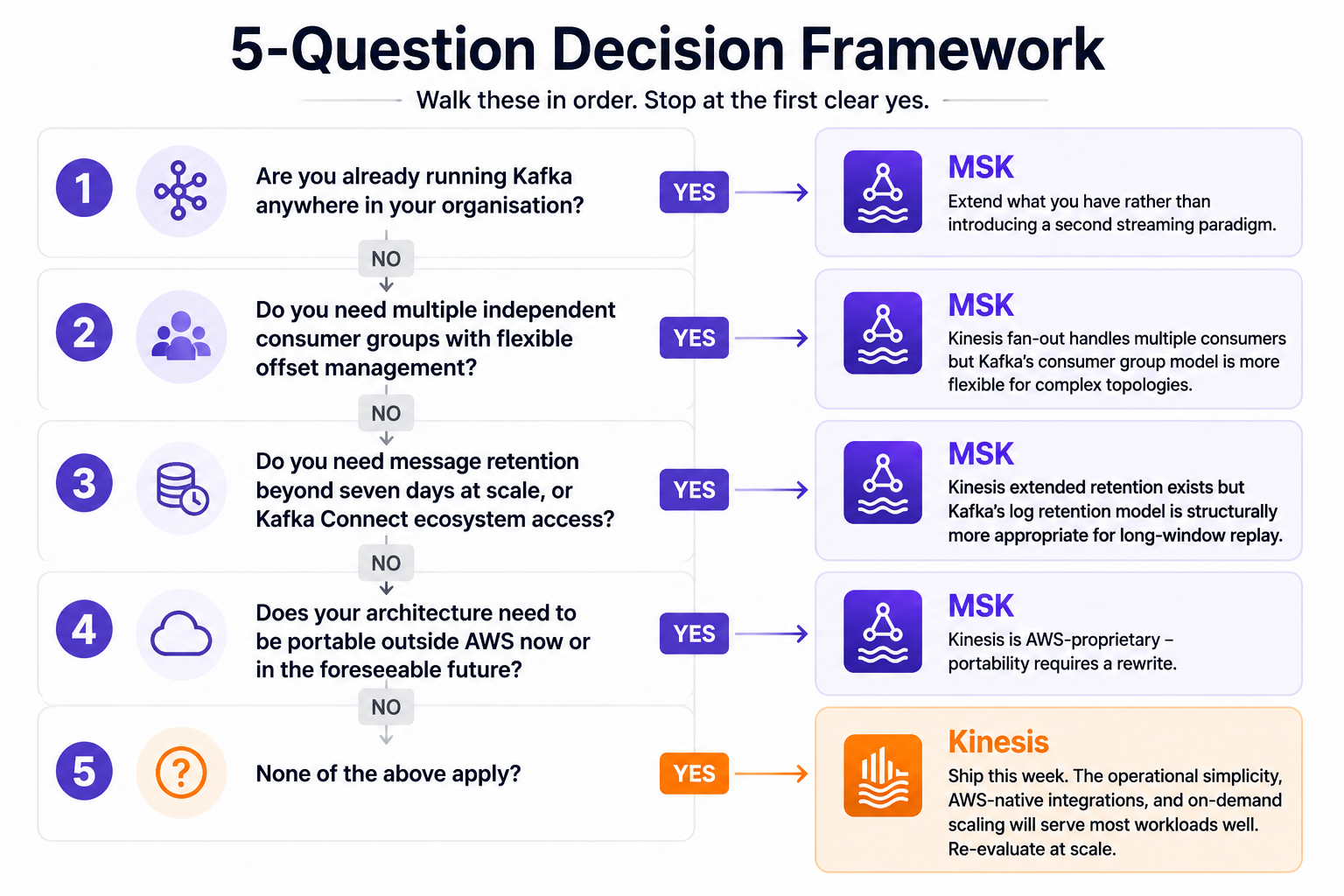
A 5-Question Decision Framework
Walk these in order. Stop at the first clear yes.
1. Are you already running Kafka anywhere in your organisation?
MSK. Extend what you have rather than introducing a second streaming paradigm.
2. Do you need multiple independent consumer groups with flexible offset management?
MSK. Kinesis fan-out handles multiple consumers but Kafka's consumer group model is more flexible for complex topologies.
3. Do you need message retention beyond seven days at scale, or Kafka Connect ecosystem access?
MSK. Kinesis extended retention exists but Kafka's log retention model is structurally more appropriate for long-window replay.
4. Does your architecture need to be portable outside AWS now or in the foreseeable future? MSK. Kinesis is AWS-proprietary - portability requires a rewrite.
5. None of the above apply?
Kinesis. Ship this week. The operational simplicity, AWS-native integrations, and on-demand scaling will serve most workloads well. Re-evaluate at scale.
What Changed in 2026 That Affects This Decision
MSK Serverless maturity. MSK Serverless moved from preview to production-grade in 2025 and is now a credible option for variable Kafka workloads without manual broker sizing. This addresses the most common objection to MSK, capacity planning complexity, for teams that need Kafka compatibility without infrastructure management.
Kinesis on-demand general availability. Kinesis on-demand capacity mode is now the default recommendation for new stream creation in most AWS documentation. It eliminates shard management entirely for workloads below Kinesis's throughput ceiling, removing the resharding complexity that historically made Kinesis painful at variable load.
MSK Connect ecosystem expansion. The number of certified MSK Connect connectors has grown significantly covering more SaaS sources, database change data capture systems, and data warehouse sinks. For organisations building cross-platform data pipelines, MSK's connector density in 2026 is meaningfully higher than it was in 2024.
Bedrock and Kinesis native integration. AWS has deepened the native integration between Kinesis Data Streams and Amazon Bedrock, including direct stream-to-knowledge-base ingestion paths and event-driven inference triggers. For teams building real-time AI applications on Bedrock, Kinesis has become a more natural architectural partner than it was twelve months ago.
Net effect: Both services have become easier to operate at the edges of their complexity curve. MSK Serverless makes Kafka more accessible. Kinesis on-demand makes AWS streaming more flexible. The use-case differentiation between them has not narrowed, but the operational barrier to choosing either has.
The Architecture Decision Most Teams Delay Too Long
The MSK-vs-Kinesis decision is most commonly deferred with the reasoning that "we can migrate later." In practice, migrating streaming infrastructure after consumers and producers are in production is significantly more complex than making the right choice upfront, because every downstream consumer needs to be updated simultaneously, and streaming workloads rarely have clean maintenance windows.
The time to make this decision is before the first producer writes to production. The time to review it is at meaningful scale milestones — when throughput, consumer topology, or retention requirements have changed materially from the original design assumptions.
If your current streaming architecture is generating unexpected operational overhead or cost — whether on MSK or Kinesis — the same cost governance principles that apply to AWS AI workloads apply here. Our AWS AI Cost Optimisation guide covers the structured review approach that identifies and resolves the most common post-deployment inefficiencies across AWS services.
Ready to Get the Streaming Architecture Decision Right?
Info Services has designed and delivered production data streaming architectures on both MSK and Kinesis, standalone and in combination, across financial services, healthtech, retail, and enterprise SaaS. We know where the throughput ceilings appear, where the consumer group complexity creates operational debt, and how to structure a streaming layer that serves the AI and analytics stack above it.
Book a AWS streaming architecture review →
In 45 minutes, we will assess your current or planned streaming workload, identify the right service architecture, and give you a clear recommendation with the reasoning behind it, not just the answer.