

AWS
How to Cut AWS AI Costs After Implementation
AWS AI Cost Leaks Draining Your Budget After Implementation and the Structured Fixes for Each One
Quick Answer: Businesses overspend on AWS AI by 40–60% in the first year after implementation. The five primary causes are idle SageMaker inference endpoints, unoptimized token consumption in Bedrock, wrong model tier selected for routine tasks, absence of cost allocation tagging, and untracked data transfer and embedding fees. Each is fixable without rebuilding your architecture.
Picture this. Six months ago, your team shipped an AWS AI implementation you were proud of. The demo worked. Stakeholders were impressed. The use case was real.
Then the monthly AWS invoice arrived.
The number was not catastrophic. But it was noticeably uncomfortably higher than the projection that got this project approved. And it has been climbing every month since.
Nobody sabotaged the project. Nobody made a reckless decision. The cost drift happened because AWS AI cost management after implementation is a discipline almost no implementation guide talks about and almost no business plans for until the bill is already too high.
This is the guide that fills that gap.
Why Do AWS AI Costs Spike After Implementation?
The pattern is consistent enough across businesses of every size that it has identifiable causes — not vague ones. Here are the five structural reasons AWS AI bills grow faster than expected after go-live, ranked by frequency.
1. SageMaker Inference Endpoints Left Running 24/7
SageMaker real-time endpoints charge by the hour regardless of whether they are handling requests or sitting idle. An ml.g4dn.xlarge endpoint costs approximately $0.736/hour that is $530/month for zero throughput if your team spun it up during a pilot and never decommissioned it.
In most implementations, there are two to four such endpoints. The developer who spun them up moved on to the next task. No one was assigned to audit them. The meter ran.
Fix: Run a monthly endpoint audit using AWS Cost Explorer filtered by SageMaker. Any endpoint with consistently low Invocations PerInstance should be evaluated for deletion or migration to SageMaker Serverless Inference, which charges only for actual compute used during inference not idle time.
2. Token Consumption Running 2–4x Higher Than Projected
Pre-implementation token estimates are almost always built on average query assumptions. Real-world usage breaks those assumptions in three ways: users write longer prompts than expected, multi-turn conversations accumulate context on every turn, and conversation history is passed without truncation logic so a 10-message conversation passes all 10 messages to the model on message 11.
For a Bedrock deployment handling 10,000 conversations per day, the difference between projected token usage and actual token usage is often $8,000–$20,000 per month.
Fix: Implement conversation history truncation keep the last three to five turns, not the full thread. Set per-session token budgets using API Gateway usage plans. Add token consumption monitoring via Amazon CloudWatch with budget alerts at 60%, 80%, and 95% of monthly allocation.
If you built your Bedrock chatbot without these controls in place, our AWS Bedrock Chatbot Architecture Guide includes the cost-conscious architecture decisions that prevent this drift before it compounds.
3. Premium Model Doing Commodity Tasks
Claude 3 Opus processes complex multi-step reasoning beautifully. It also costs approximately 15x more per token than Claude 3 Haiku. If your internal FAQ bot, product description summariser, or document classification workflow is running on Opus because that is what your team tested with during the proof of concept, you are paying enterprise-grade inference costs for commodity-grade tasks.
This is not a failure of the model. It is a failure of model routing.
Fix: Build a task classification layer either rule-based or a lightweight classifier that routes incoming requests by complexity. Complex analytical queries go to your premium model. Routine Q&A, short summarisation, and simple extraction go to your cost-efficient model tier. This single architectural change typically reduces total model inference costs by 40–55% with no degradation on the tasks users care most about.
For a complete decision framework on when each AWS AI service including which Bedrock model tier is appropriate for your workload, the SageMaker vs Bedrock guide maps this out in full.
4. No Cost Allocation Tagging — So No One Owns the Bill
Without granular AWS resource tagging by team, product line, or use case, your AWS AI costs appear as a single line in Cost Explorer. Finance can see the total. No individual team owns it. No one is incentivised to reduce what they are not accountable for.
This is governance debt and it is extremely common. Most implementations prioritise getting the application live. Cost attribution is treated as a post-launch nice-to-have. By the time the bill becomes a problem, six months of untagged usage have made root-cause analysis difficult.
Fix: Enforce mandatory cost allocation tags before any AI resource is provisioned. Minimum tag set: project, team, environment (dev/staging/prod), and use-case. Configure Cost Explorer cost allocation reports by tag. Assign a named budget owner for each use case. Review attribution monthly in your engineering leadership meeting not quarterly when the damage is already done.
5. Embedding Costs and Data Transfer Fees Treated as Zero
When businesses model AWS AI costs pre-implementation, they typically account for model inference. They routinely miss three categories that add meaningful expense at scale: embedding generation fees (charged per token on Amazon Titan Embeddings every time a document is processed or a RAG query runs), cross-region data transfer fees (billed per GB when your application and your AI service are in different AWS regions), and Amazon OpenSearch vector storage fees (charged on provisioned capacity, not query volume).
For implementations with large knowledge bases refreshed frequently, embedding costs alone can reach $3,000–$8,000/month a number that appears nowhere in most initial cost models.
Fix: Audit your embedding pipeline. Cache embeddings for static documents rather than regenerating on every query cycle. Ensure your application, Bedrock endpoint, and OpenSearch cluster are all deployed in the same AWS region. Right-size your OpenSearch domain based on actual vector count, not anticipated future scale.
What Does a Structured AWS AI Cost Optimisation Look Like?
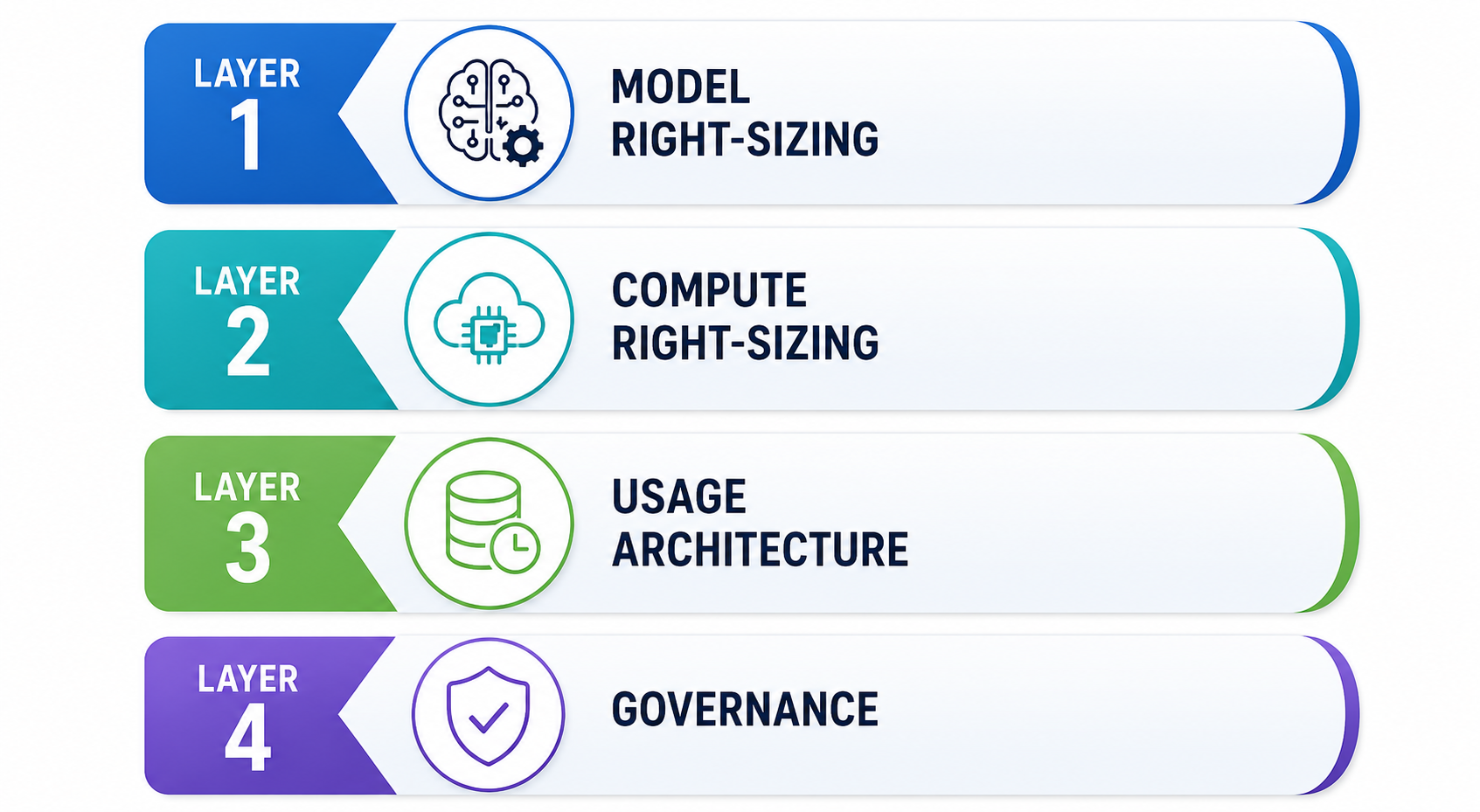
An ad hoc cost reduction effort where someone looks at the bill, makes a few changes, and checks again next month produces inconsistent results. A structured optimisation engagement works across four layers simultaneously:
Layer 1 - Model Right-Sizing: Audit every AI workload against the model it is using. Reclassify tasks by complexity. Implement model routing. Target: 40–55% reduction in inference cost.
Layer 2 - Compute Right-Sizing: Audit all SageMaker endpoints. Migrate idle or bursty workloads to Serverless Inference. Decommission any endpoint that is not mapped to an active production use case. Target: eliminate 100% of idle endpoint spend.
Layer 3 - Usage Architecture: Implement prompt caching using Amazon ElastiCache for repeated query patterns. Add conversation history truncation to all chatbot applications. Set token budgets per session and per team. Target: 20–30% reduction in total API call volume.
Layer 4 - Governance: Enforce cost allocation tagging. Configure monthly budget alerts. Assign use-case budget owners. Implement a monthly AWS AI cost review as a standing agenda item in engineering leadership. Target: full cost attribution within 30 days, enabling ongoing accountability.
Businesses running $15,000–$50,000/month in AWS AI spend and applying all four layers typically achieve $6,000–$25,000 in monthly savings within 60–90 days with no reduction in capability and no architectural rebuild required.
How Do AWS AI Costs Scale as Usage Grows?
This is the question that matters more than the current bill. AWS AI costs do not scale linearly with usage they scale according to your architecture. A well-architected deployment becomes more cost-efficient at scale because caching hit rates improve, model routing handles more volume, and reserved compute pricing applies. A poorly architected deployment becomes more expensive at scale because every inefficiency compounds.
The businesses that optimise their AWS AI cost structure at $15,000/month are the same businesses operating competitively at $150,000/month. The businesses that accept cost drift at $15,000/month hit a wall when the CFO questions the ROI at $80,000/month.
If you are currently in the planning or early implementation phase, the time to embed cost governance is before go-live not after the first inflated invoice. Our AWS AI Implementation Playbook 2026 includes cost governance checkpoints at every phase of the implementation process, the sections most implementation guides skip entirely.
And if you are considering your first AWS Generative AI implementation and want the full picture of what it builds, what it costs, and how long it takes before committing, our AWS Generative AI Implementation Guide 2026 is the right starting point.
The One Number That Changes Every Cost Conversation
Here is what most AWS AI cost discussions miss: the cost per outcome, not the cost per month.
A Bedrock-powered support chatbot costing $12,000/month that deflects 8,000 support tickets per month has a cost per resolution of $1.50. If your average human support resolution costs $12–$18, the AI is cheaper by a factor of eight to twelve and the $12,000/month number looks entirely different.
The businesses that frame AWS AI cost purely as a line-item expense lose the ROI argument. The businesses that frame it as cost-per-outcome win it and they win it because they built the measurement layer to demonstrate it.
Forrester confirms measure AI by outcome, not by spend, and the ROI argument makes itself.
Optimisation is not about spending less on AWS AI. It is about getting more outcome per dollar of AWS AI spend. Those are different goals with different strategies, and conflating them leads to the wrong cuts.
According to the official Amazon Bedrock documentation, Bedrock provides fully managed access to leading foundation models with no infrastructure overhead for the teams consuming them.
Is Your AWS AI Architecture Currently Costing You More Than It Should?
If you implemented AWS AI in the last 12 months without a formal post-deployment cost review, there is a high probability that at least two of the five cost drivers above are active in your deployment right now.
The right next step is a structured cost audit not a vendor proposal, not a platform migration, not a rebuild. A focused review of your current Bedrock and SageMaker usage patterns, your cost attribution status, your model selection logic, and your endpoint inventory takes two to three weeks and produces a prioritised list of remediations with estimated savings per item.

Talk to an AWS AI Cost Specialist
We will review your current AWS AI architecture, identify your top cost drivers, and give you a clear remediation roadmap no obligation, and no generic proposal.