

AWS
How Graviton-Powered Nodes Cut Analytics Costs by 30% While Unifying Your Data Lake
AWS's new Graviton-powered RG instances deliver up to 30% lower cost than RA3 nodes with equal or better query performance
.png)
Amazon Redshift's new Graviton-powered RG instances deliver up to 30% lower cost than legacy RA3 nodes while offering measurably better query performance. For businesses running SQL analytics across both a data warehouse and a data lake, RG instances represent the most significant cost-performance shift in Redshift's history and a compelling reason to migrate now.
What Are Amazon Redshift RG Instances and Why Do They Matter Right Now?
If your organization is running analytics workloads on Amazon Redshift RA3 nodes, you're likely paying more than you need to. In 2025, AWS introduced its Graviton-powered RG instance family for Redshift and the benchmark results are hard to ignore.
RG instances are built on AWS Graviton processors, the same ARM-based chip architecture that has already delivered dramatic cost and performance improvements across EC2, RDS, and EKS workloads. Applied to Redshift, Graviton unlocks a combination that was historically difficult to achieve simultaneously: lower cost and higher throughput on the same SQL analytics infrastructure.
The headline number: 30% lower cost than RA3 nodes at comparable or better performance levels.
But the cost reduction is only half the story.
How Do Amazon Redshift RG Instances Compare to RA3 Nodes?
This is the question every cloud architect and FinOps leader is asking. Here's a structured comparison:
The architectural difference matters beyond pricing. RA3 nodes separated compute and storage through Redshift Managed Storage. RG instances take this further by enabling unified SQL analytics meaning your teams can query data across your managed data warehouse and your S3-based data lake from a single SQL interface, without needing separate tooling, data movement, or Spectrum configuration.
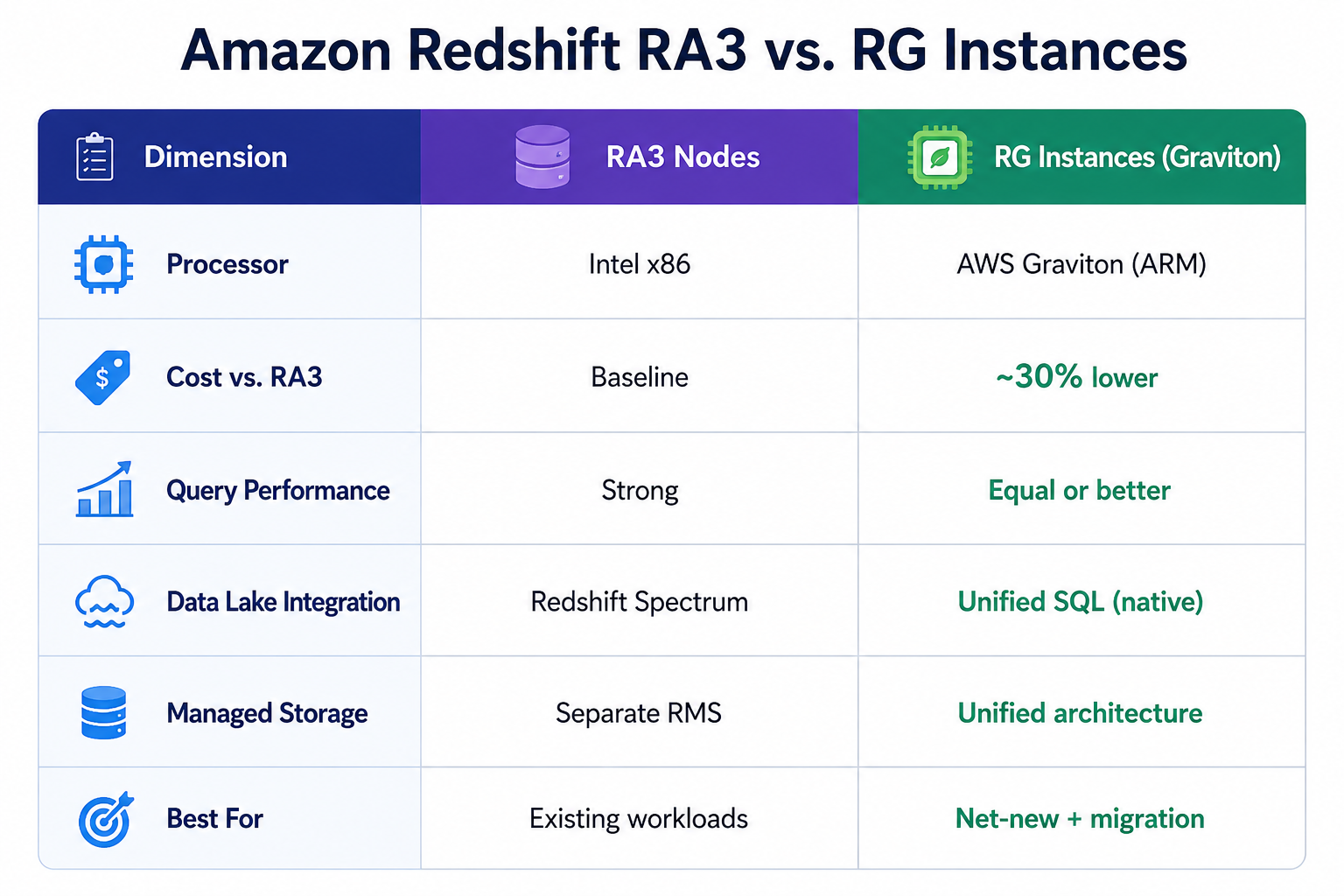
What Does "Unified SQL Analytics Across Data Warehouse and Data Lake" Actually Mean?
This phrase gets used a lot in AWS announcements, but it has practical implications your engineering team needs to understand before migration planning.
In the traditional Redshift architecture:
- Structured, frequently queried data lived in your warehouse (RA3 compute + Redshift Managed Storage)
- Semi-structured or historical data sat in S3, queried via Redshift Spectrum a separate, billed-per-query service
- Teams often duplicated data or built pipelines to bridge the two
With RG instances and the unified architecture:
- Your data lake (S3) and data warehouse tables are accessible through a single query layer
- No separate Spectrum billing model
- Query optimization spans both environments automatically
- Engineers write one SQL query; Redshift's engine decides where to pull from
For organizations running hybrid analytics some data in the warehouse for speed, more data in S3 for cost this removes a significant operational and billing complexity.
How Much Can You Actually Save Moving from RA3 to Redshift RG Instances?
Let's make this concrete. Consider a mid-scale enterprise running:
- 4× ra3.4xlarge nodes
- ~$3.26/node/hour (on-demand)
- Running 720 hours/month
- Total monthly compute: ~$9,388
At 30% lower cost with equivalent RG sizing:
- Estimated monthly compute: ~$6,572
- Monthly savings: ~$2,816
- Annual savings: ~$33,792
At larger scale (ra3.16xlarge clusters), the savings compound significantly. And when you factor in the elimination of Redshift Spectrum per-query charges for data lake access, total cost of ownership drops further,For a broader look at AWS cost optimization strategies beyond Redshift, see our guide on cutting AWS AI costs.
Important: Always validate node-to-node sizing equivalents in your specific workload before committing to migration. RG instance types map differently than a 1:1 replacement of RA3, and AWS benchmark results reflect specific query patterns.
What Are the Real Performance Benchmarks for Redshift RG Instances?
AWS and early customers have shared benchmark insights (further live results are expected at the official webinar)
- Query execution times on complex aggregation workloads improved 10–25% on RG vs. RA3 at equivalent vCPU configurations
- Graviton's memory bandwidth improvements particularly benefit scan-heavy analytical queries common in financial reporting, logistics analytics, and BI workloads
- Concurrency scaling performance under heavy multi-user load showed consistent improvements over RA3
Early customer results reported by AWS engineering teams indicate that organizations with mixed warehouse + data lake queries saw the largest relative gains, given the unified query optimization layer.
Who Should Migrate to Redshift RG Instances? (And Who Should Wait?)
Strong migration candidates:
- Teams running RA3 clusters for standard SQL analytics on structured data
- Organizations with significant Redshift Spectrum usage for S3 data lake queries
- FinOps-driven teams under pressure to reduce cloud spend without sacrificing query SLAs
- Net-new Redshift deployments - RG should be the default choice in 2026
Evaluate carefully before migrating:
- Workloads with deep dependencies on specific RA3 node storage behavior (test equivalence first)
- Clusters where architecture has not been reviewed in 12+ months (modernize the architecture first, then migrate node type)
- Teams mid-way through a Snowflake or BigQuery evaluation (complete the vendor decision before node migrations)
Step-by-Step: How to Migrate from RA3 to Amazon Redshift RG Instances
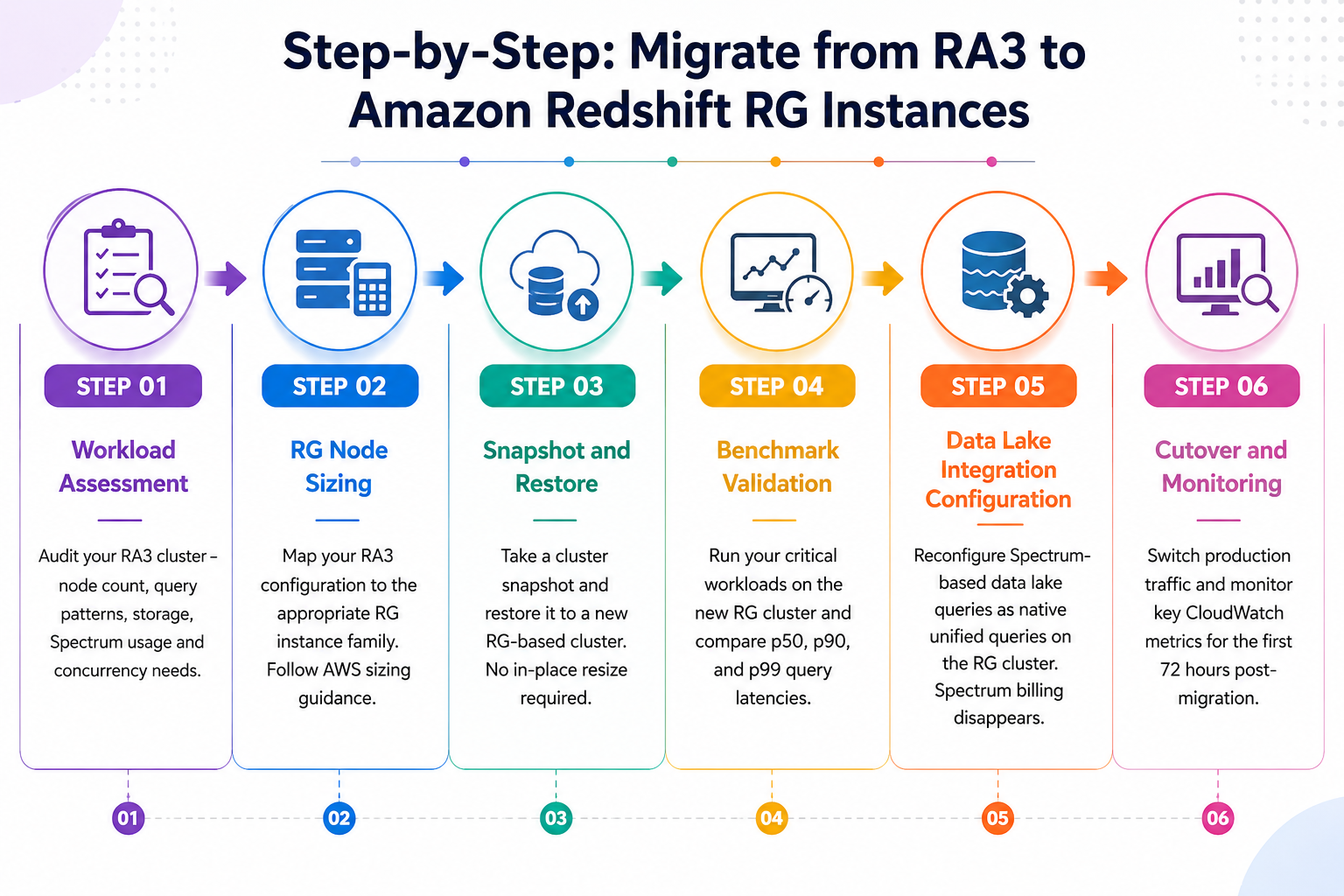
Migration guidance shared by the Redshift product and engineering team (and expanded at the live webinar) follows this general path:
Step 1 — Workload assessment Audit your current RA3 cluster: node count, query patterns, storage utilization, Spectrum usage, and concurrency requirements. This is your baseline.
Step 2 — RG node sizing Map your RA3 configuration to the appropriate RG instance family. AWS provides a sizing guide do not assume a 1:1 node count mapping.
Step 3 — Snapshot and restore The migration path uses Redshift's snapshot-and-restore capability. Take a cluster snapshot, restore to a new RG-based cluster. No in-place resize is required.
Step 4 — Benchmark validation Run your critical query workloads on the new RG cluster before switching production traffic. Compare p50, p90, and p99 query latencies against your RA3 baseline.
Step 5 — Data lake integration configuration If you're migrating from Spectrum-based data lake queries, reconfigure these as native unified queries on the RG cluster. This is where you'll begin to see Spectrum billing disappear.
Step 6 — Cutover and monitoring Switch production traffic. Monitor CloudWatch metrics particularly QueryDuration, ReadIOPS, and QueryQueueTime for the first 72 hours post-migration.
How Does Amazon Redshift RG Compare to Snowflake
This is a question that comes up in every cloud analytics evaluation. Here's an honest framework:
Redshift RG instances strengthen the AWS case when:
- Your data already lives in S3 (native integration is a genuine architectural advantage)
- Your team is AWS-native and benefits from IAM, VPC, and CloudWatch consistency
- You're optimizing for total cost of ownership, Redshift on RG is structurally cheaper than Snowflake's compute credits at equivalent scale
- You need tight integration with AWS Glue, Kinesis, or SageMaker for ML-driven analytics
Snowflake may still win when:
- Your organization is truly multi-cloud (Azure + GCP data sources alongside AWS)
- You need Snowflake Marketplace data sharing for third-party data sets
- Your analytics team is already deeply invested in Snowflake's ecosystem
For AWS-native organizations, the RG instance update materially improves Redshift's competitive position particularly on cost.
How Amazon Redshift RG Instances Affect Your AI and ML Analytics Pipeline
For organizations using Amazon SageMaker, Bedrock, or custom ML pipelines alongside Redshift, the RG architecture has an underappreciated impact:
- Faster query execution means feature engineering on Redshift data completes sooner, reducing SageMaker training job wait times
- Unified data lake access allows ML pipelines to pull from the same Redshift SQL layer that BI tools use eliminating separate S3 data prep jobs
- Lower compute cost means you can afford to run more exploratory analytics queries without FinOps pushback, improving the iteration speed of data science teams
If you're on a path toward AI implementation on AWS, modernizing your Redshift layer to RG instances is the foundation that makes downstream ML workloads more efficient.