

End-to-End Enterprise IoT Architecture: From Device Provisioning to Secure Cloud

Why Modern IoT Architecture Is More Than Firmware
Most engineers start embedded development by writing drivers, blinking LEDs, or sending telemetry over UART. But enterprise IoT platforms operate at a completely different scale.
A modern Embedded Systems Architect is expected to design:
- Secure manufacturing workflows
- Hardware-rooted device identity
- PKI-based authentication
- Mutual TLS connectivity
- Azure IoT onboarding
- Fleet-scale OTA updates
- Secure boot chains
- Certificate lifecycle management
- Device-to-cloud reliability at scale
This article explains the complete enterprise-grade device lifecycle — from manufacturing to secure cloud connectivity.
Enterprise IoT Architecture Overview
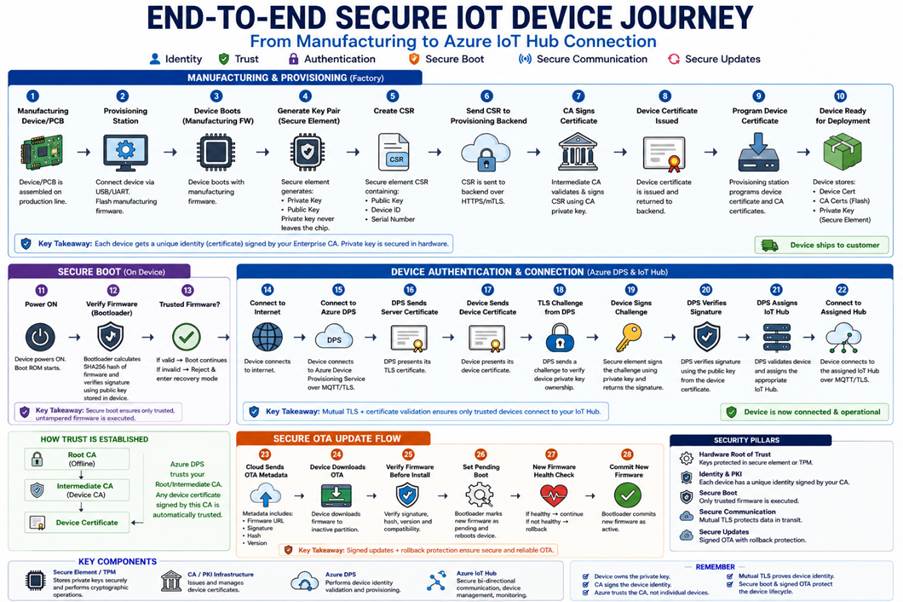
A production-grade IoT system typically includes:
The Core Security Principle
The entire system is built on one foundational concept:
Devices must prove cryptographically that they are trusted before they can execute firmware or communicate with cloud services.
That trust is established using:
- Hardware-backed keys
- Certificates
- PKI
- Digital signatures
- Mutual TLS
- Secure boot
Manufacturing Phase: Device Identity Creation
The lifecycle begins in the factory.
Step 1 — Device Arrives on Manufacturing Line
A new PCB is connected to a provisioning station using:
- USB
- UART
- SWD/JTAG
The provisioning station is usually:
- an industrial Linux PC
- automated manufacturing fixture
- factory programming tool
Step 2 — Manufacturing Firmware Is Flashed
The provisioning station installs initial firmware:
west flash
or via:
- OpenOCD
- STM32CubeProgrammer
- J-Link
- pyOCD
This firmware contains:
- secure provisioning logic
- key generation routines
- manufacturing diagnostics
Hardware-Rooted Identity
Step 3 — Secure Element Generates Keypair
The firmware communicates with a secure element such as:
- ATECC608
- TPM
- EdgeLock
- SE050
The secure element generates:
- Private Key
- Public Key
Critical security rule:
The private key NEVER leaves the secure element.
This becomes the device's permanent cryptographic identity.
Certificate Signing Request (CSR)
Step 4 — Device Creates CSR
The device creates a CSR containing:
- Public key
- Device serial number
- Device metadata
- Subject name
Example:
CN=device-1001.company.com
The CSR does NOT contain the private key.
Enterprise PKI Architecture
What Is a Certificate Authority (CA)?
A CA is a trusted entity that signs device certificates.
Think of it as a cryptographic passport authority.
Typical enterprise PKI hierarchy:
Offline Root CA
↓
Intermediate Device CA
↓
Device Certificates
Why Intermediate CAs Exist
Root CAs are:
- highly protected
- usually offline
- rarely used directly
Intermediate CAs perform operational signing.
This limits blast radius if compromised.
Provisioning Backend Workflow
Step 5 — Factory Station Sends CSR to Backend
The provisioning station calls an enterprise provisioning API:
POST /api/provision-device
Payload:
{
"serialNumber": "ABC123",
"csr": "-----BEGIN CSR-----"
}
Step 6 — Backend Validates Request
The provisioning backend verifies:
- factory authorization
- serial number validity
- production batch approval
- duplicate enrollment
This prevents rogue manufacturing activity.
Step 7 — CA Signs Device Certificate
The backend submits the CSR to the Intermediate CA.
The CA:
- validates policy
- signs the CSR
- creates an X.509 device certificate
Result:
Device Certificate
Issuer: Company-Device-CA
Final Device Identity State
After provisioning:
Secure Element Contains
- Private Key
Flash Storage Contains
- Device Certificate
- Root CA
- Intermediate CA chain
The device is now cryptographically trusted.
Secure Boot Architecture
Before cloud connectivity, the device must trust its own firmware.
Step 8 — Bootloader Verifies Firmware
At power-on:
Boot ROM
↓
Bootloader
↓
Application Firmware
The bootloader performs:
- Hash verification
- Signature verification
- Anti-rollback checks
Firmware Signing Process
CI/CD pipeline builds firmware:
app.bin
Then signs it:
SHA256(app.bin)
The signing server uses a private signing key.
The device stores only the public verification key.
Secure Boot Verification
Bootloader verifies:
Verify(
firmware_hash,
firmware_signature,
public_key
)
If validation fails:
- boot is rejected
- recovery mode entered
This creates a cryptographic chain of trust.
Azure DPS Provisioning Flow
Once installed at customer site, the device powers on.
Step 9 — Device Connects to Azure DPS
The device opens:
- TCP
- TLS
- MQTT
connection to Azure Device Provisioning Service (DPS).
Mutual TLS Authentication
This is where enterprise-grade identity verification occurs.
Step 10 — Device Verifies Azure
Azure sends its server certificate.
The device validates:
- certificate chain
- trusted Microsoft root
- expiration
- hostname
This prevents man-in-the-middle attacks.
Step 11 — Azure Verifies Device
The device sends:
- device certificate
Azure DPS verifies:
- certificate signed by trusted CA
- certificate not revoked
- enrollment policy valid
Step 12 — TLS Challenge Signing
Azure sends a TLS authentication challenge.
The secure element signs the challenge using the private key.
Important:
The private key never leaves hardware.
Azure verifies the signature using:
- public key from certificate
If valid:
Device identity proven
Why Mutual TLS Matters
Mutual TLS establishes:
- device trust
- cloud trust
- encrypted communication
- enterprise authentication
This is significantly stronger than:
- passwords
- static tokens
- shared secrets
DPS Assigns IoT Hub
After authentication:
Azure DPS assigns the correct:
- Azure IoT Hub
- region
- tenant
- provisioning policy
The device now becomes operational.
Operational Device Lifecycle
Once connected:
- telemetry flows
- commands received
- device twin synchronized
- monitoring enabled
- diagnostics collected
This is the production operational phase.
OTA (Over-the-Air) Firmware Updates
Firmware updates are one of the highest-risk operations in IoT systems.
A poorly designed OTA system can brick millions of devices.
OTA Deployment Flow
Cloud Sends
- firmware URL
- version
- signature
- hash
- metadata
Device Downloads OTA Package
Firmware is stored in:
- inactive partition
- staging area
Never overwrite active firmware directly.
Verification Before Installation
The device validates:
- firmware signature
- SHA256 hash
- signer trust
- version monotonicity
- compatibility
Only trusted firmware is installed.
A/B Partition Strategy
Enterprise devices typically use:
Partition A → Running
Partition B → Update Candidate
If update fails:
- rollback occurs automatically
This dramatically improves reliability.
Certificate Lifecycle Management and SCEP
Certificates expire.
At enterprise scale, manual renewal is impossible.
This is where SCEP becomes important.
What Is SCEP?
SCEP (Simple Certificate Enrollment Protocol) automates:
- certificate issuance
- renewal
- rotation
Devices dynamically request certificates from enterprise PKI infrastructure.
Why SCEP Matters
Without automated lifecycle management:
- fleets fail when certs expire
- manual reprovisioning becomes impossible
SCEP enables:
- zero-touch certificate rotation
- long-term fleet sustainability
Common Enterprise Security Pitfalls
1. Storing Private Keys in Flash
Leads to:
- device cloning
- identity theft
Use secure elements instead.
2. No Certificate Rotation
Causes mass outages when certificates expire.
3. Unsigned OTA Updates
Allows malware injection.
Always require signed firmware.
4. No Rollback Protection
Attackers may install older vulnerable firmware.
5. Exposed Debug Interfaces
JTAG/SWD should be locked in production.
Architect-Level Design Principles
Strong IoT architects optimize across:
- security
- memory
- reliability
- scalability
- provisioning complexity
- operational maintainability
The goal is not just "connecting devices."
The goal is:
- trusted identity
- secure lifecycle management
- fleet-scale automation
- resilient updates
- operational governance
Final Thoughts
Enterprise IoT systems are fundamentally trust systems.
Every layer:
- manufacturing
- firmware
- provisioning
- networking
- OTA
- cloud onboarding
must participate in establishing and maintaining cryptographic trust.
The future of embedded systems is no longer isolated firmware engineering.
It is end-to-end secure distributed systems architecture.
And that is where modern Embedded Systems Architects create the most impact.