

XOps
Why Your LLM Bill Doesn't Match Your LLM Value: A Guide to AI Cost Optimization
Understanding the Real Cost of Large Language Models
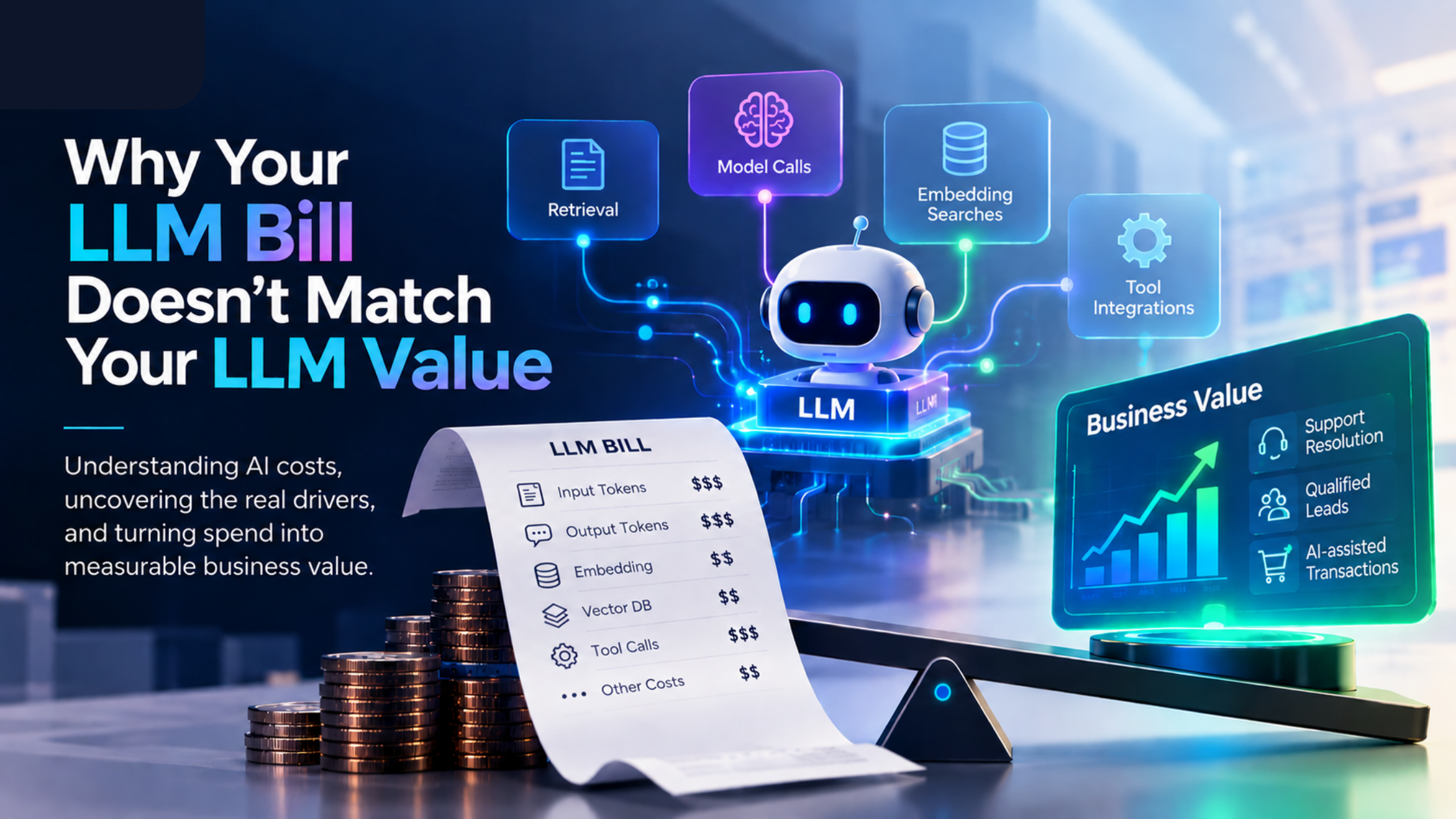
A few months ago, during a budget review, someone from finance asked a simple question that many enterprise organizations now face: "What does it cost, on average, when a customer interacts with our AI assistant?" The engineering lead didn't have a clear answer. He had the monthly bill from the LLM provider and a general idea that AI usage was increasing, but there was no way to connect the two into a meaningful cost-per-interaction figure.
This challenge with LLM billing and understanding AI infrastructure costs is becoming increasingly familiar to organizations implementing machine learning cost management strategies.
The LLM Cost Problem: Why Traditional FinOps Falls Short
Traditional cloud cost management was relatively predictable. Teams could estimate the cost of running a VM or database based on resources and usage. FinOps for cloud infrastructure evolved around this model of straightforward infrastructure costs. However, with LLM-based applications and AI workload optimization, predictability has become significantly more difficult.
Why Your AI Bill Is Unpredictable
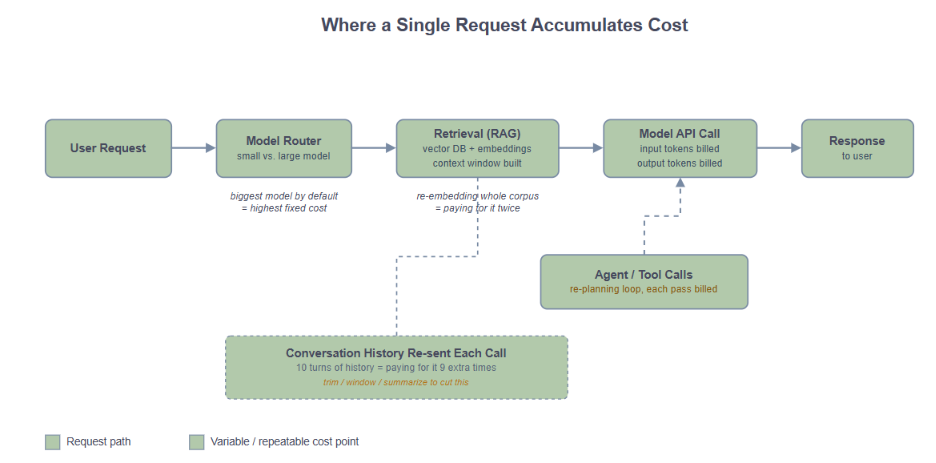
A single AI request can trigger several components:
- Retrieval mechanisms
- Multiple model calls (requiring token usage optimization)
- Embedding searches and vector operations
- External tool integrations
Each component may have different LLM pricing models and even different vendors. Tracking LLM costs purely by computing resources and runtime hours no longer provides enough visibility into actual model inference costs.
The real challenge isn't simply, "How do we reduce LLM costs?" It's first to understand exactly where the money is being spent at a level of detail sufficient to make informed AI cost control decisions.
Where a Single Request Accumulates Cost: The LLM Cost Breakdown
This multi-layered cost structure is why how to calculate cost per AI interaction has become essential.
Why the Usual Cost Playbook Doesn't Quite Work Here: Key Differences in AI Pricing
Traditional FinOps often assumes a fairly predictable relationship between usage and cost: more requests mean more compute and a higher bill. AI workloads can behave very differently, making how to manage AI infrastructure costs more complex.
An AI agent might make five model calls for one task or twenty, depending on how many steps it take to complete a request. In a RAG pipeline, embedding costs depend on the amount of content, while query costs depend on usage. Even two similar requests can have very different costs depending on the amount of conversation history or context included.
The situation isn't impossible to manage. It simply requires looking at different cost drivers unique to AI pricing strategy.
7 Strategies for LLM Cost Optimization: Best Practices for AI Cost Control
1. Start With Tokens, Not Just Requests: Token Usage Optimization
Input and output tokens are often priced differently, with output tokens typically costing more than input tokens. This fundamental difference in token pricing models makes decisions such as sending an entire document versus only the relevant section directly relevant to your LLM costs.
How to optimize token usage:
- Track cost per token separately
- Segment input token costs vs. output token costs
- Identify which features consume the most tokens
- Implement token budgeting at the feature level
Instead of tracking only the total AI API spend, break it down by input and output tokens. This gives a much clearer picture of where your LLM billing comes from and where cost-saving opportunities exist.
Quick win: A 30% reduction in token consumption can translate directly to a 30% reduction in inference spend.
2. Don't Default to the Largest Model: Smart Model Routing
It's easy to choose the most capable model during development and continue using it in production. But many tasks such as classification, simple extraction, and basic summarization can often be handled by smaller and less expensive models, reducing your overall LLM costs.
Model routing strategies:
- Use lightweight models for classification and extraction
- Reserve premium model inference for complex reasoning tasks
- A/B test different models for the same use case
- Implement cost-aware routing logic in your application
Model routing can help: use lighter models for simple requests and reserve larger models for tasks that genuinely need them. This can reduce AI infrastructure costs and model inference costs without compromising quality or changing the model used for more complex requests.
Industry data: Companies implementing smart model routing for cost reduction report 20-40% savings in LLM API costs.
3. Keep an Eye on Conversation History: Managing Chat Context
Chat history is sent again with subsequent requests in conversational AI systems, which means longer conversations can increase token usage significantly. Understanding conversation length impact on costs is critical for applications like chatbots and virtual assistants.
Conversation management tactics:
- Summarize older messages after a certain point
- Trim unnecessary context from previous turns
- Implement sliding windows to limit history
- Use efficient serialization for conversation state
What looks like a small AI engineering optimization can have a direct impact on your monthly AI bill. A conversation that grows from 10 turns to 50 turns can increase token costs by 5x if history is included with every request.
4. Make RAG Costs Visible: Understanding Total RAG Pipeline Costs
RAG (Retrieval-Augmented Generation) introduces additional costs beyond the model API, including:
- Vector database storage costs
- Embedding generation and re-embedding expenses
- Query operations and retrieval overhead
- Potential costs from knowledge base management
These RAG pipeline costs can easily be overlooked when monitoring only model usage, making RAG cost optimization essential.
For example: Re-embedding an entire knowledge base whenever a few documents change can create unnecessary spend and inflate your AI infrastructure costs. Updating only new or modified content can make the process more efficient and reduce embedding costs significantly.
Hidden RAG costs to track:
- Embedding API calls (often charged per embedding)
- Vector storage and indexing
- Query latency costs on vector databases
- Knowledge base synchronization overhead
5. Put Limits on Agent Loops: Controlling Agentic AI Costs
Agentic workflows and autonomous AI agents can be one of the most unpredictable areas of AI spending and LLM cost management. A task may require several cycles of planning, action, and observation, and an unexpected loop can quickly increase model inference costs.
Agent cost controls:
- Set maximum tool calls per task (hard limits)
- Implement token budgets per agent session
- Configure execution timeouts that kill stuck loops
- Monitor agent loop iterations and flag outliers
Set practical limits such as maximum agent tool calls, token budgets, and execution timeouts. Treat these controls much like rate limits for a traditional API, they're essential safeguards for unpredictable AI costs.
Real-world impact: One enterprise reduced agent-based cost variance by 60% by implementing loop limits.
6. If You're Self-Hosting, GPU Utilization Matters: On-Premise LLM Costs
For teams running their own models, GPU costs can become a major part of your total cost of ownership for AI infrastructure. How to manage self-hosted LLM costs requires attention to utilization metrics.
GPU cost optimization:
- Monitor actual GPU utilization vs. provisioned capacity
- Right-size infrastructure to match peak workload demand
- Batch workloads where possible to improve GPU efficiency
- Consider spot instances for workloads that can tolerate interruptions
- Track cost per GPU hour and idle time
The important part is to track actual GPU utilization rather than assuming your infrastructure is being used efficiently. Many organizations pay for compute capacity they never fully leverage.
7. Connect AI Spend to Business Outcomes: ROI-Driven AI Cost Management
The more useful question is not simply, "How much does our AI cost each month?" or "Why is my LLM bill so high?"
Instead, ask questions that connect LLM costs to business impact:
- What does it cost to resolve a support ticket using AI? (Cost per ticket resolution)
- What is the cost per qualified lead generated by AI-assisted outreach?
- What does each AI-assisted transaction cost in revenue-generating workflows?
- What's our cost per prediction in ML-powered systems?
Outcome-driven cost metrics:
- Cost per customer interaction
- Cost per business outcome (leads, sales, resolutions)
- ROI of each AI feature or workload
- Payback period for AI infrastructure investment
Answering these questions requires connecting request-level cost data with business metrics. It takes some additional engineering effort for AI cost tracking, but it turns AI cost management from a billing exercise into a strategic business decision.
Strategic advantage: Companies that link AI costs to business outcomes make better infrastructure and feature investment decisions, often reducing overall operational costs by 25-35%.
Making Informed AI Cost Decisions
The goal isn't simply to spend less on AI—some use cases may genuinely require larger models and higher costs. The important thing is understanding:
- Which workloads need that level of investment
- Being able to explain the cost with data rather than assumptions
- Implementing safeguards against unpredictable cost growth
- Tying spend back to business value
This data-driven approach to enterprise AI cost management is becoming table stakes for organizations with significant AI infrastructure investments.