

AWS
Amazon SageMaker vs Bedrock in 2026: When Your Business Needs Each One
Discover where each service excels and how to make the right decision in 2026.
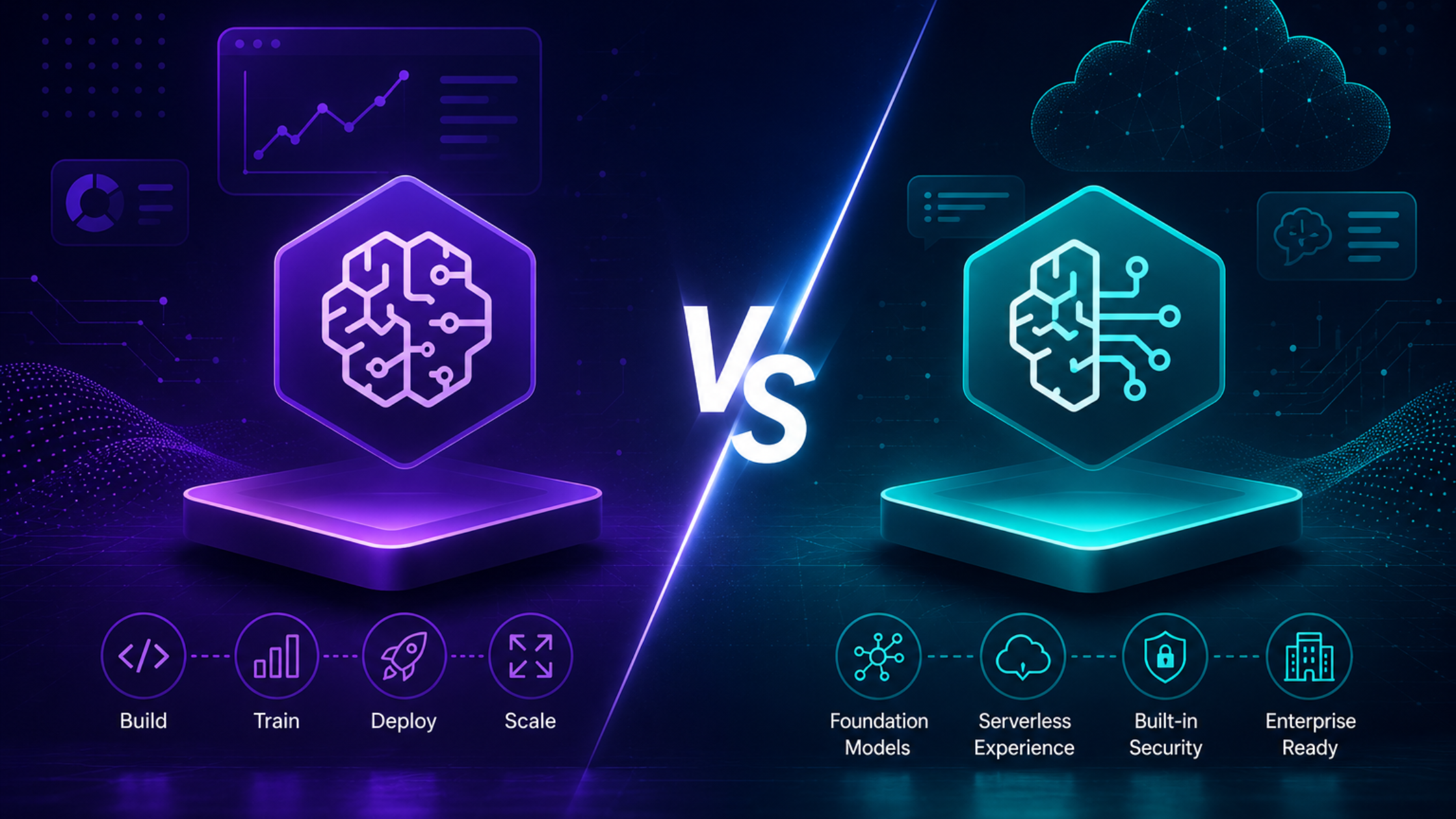
Amazon SageMaker vs Bedrock in 2026: When Your Business Needs Each One
Quick Answer: Amazon Bedrock is the right starting point for most businesses in 2026, it provides serverless, API-first access to leading foundation models with zero infrastructure to manage. Amazon SageMaker becomes the right choice when your token volume is high and predictable, when compliance requires complete VPC data isolation, when your use case demands a custom-trained model, or when AI is your core product rather than a supporting feature. Most mature AWS AI deployments use both.
A Series A health tech company recently discovered they had been significantly overspending on AWS AI — nearly all of it avoidable. They had launched on Bedrock a year earlier because it was the faster path, kept scaling their usage, and never revisited the architecture. A workload review revealed that a substantial portion of their inference volume could have moved to dedicated SageMaker infrastructure at a fraction of the per-token cost. That gap between "we'll figure it out later" and a properly reviewed architecture, was hiding in plain sight for twelve months.
This story is playing out across hundreds of businesses right now.
Bedrock has become the default. SageMaker has become the service teams avoid because it sounds harder. And in between, businesses are either overpaying for token-based inference at volumes where dedicated infrastructure would be more efficient or over-engineering with SageMaker when Bedrock would have shipped the same outcome in days.
This guide settles the question properly. With the 2026 feature set, the architectural logic, and the decision framework that actually drives the right call not the easy one
What Is Amazon SageMaker? One Clear Definition
Amazon SageMaker is AWS's full-stack machine learning platform. You own the infrastructure end-to-end: data preparation, model training, fine-tuning, deployment, and monitoring. Think of it as renting a professional kitchen, you bring the recipes, you choose the equipment, you plate the dish. Every decision is yours.
In 2026, SageMaker added serverless customization workflows that eliminate the need to manually select and size compute instances, alongside reinforcement learning techniques RLVR, RLAIF, and DPO, baked directly into the training workflow. The historic objection that "SageMaker is too complex" is weaker than it was twelve months ago
According to Gartner, generative AI is the fastest-growing enterprise technology category in 2026 making the choice of which AWS service powers your implementation one of the most consequential infrastructure decisions a business can make this year.
What Is Amazon Bedrock? One Clear Definition
Amazon Bedrock is AWS's serverless, API-first generative AI service. You do not train models. You do not manage GPUs or inference servers. You call an API endpoint, pay per token consumed, and ship the feature. As of 2026, Bedrock provides access to close to 100 foundation models, including Claude, Amazon Nova 2, Llama, Mistral Large 3, Gemma 3, Titan, and Cohere Command, alongside managed services for Agents, AgentCore, Knowledge Bases, and Guardrails.
Think of it as a restaurant. You order from the menu, you receive the output, you move on. You never need to see or manage the kitchen.
The Real Difference in One Sentence
SageMaker is ML infrastructure. Bedrock is model access.
Every other decision, team skill requirements, time-to-market, compliance posture, architecture complexity — flows from that single distinction. If you are building and owning models, SageMaker is your platform. If you are consuming and orchestrating models, Bedrock is your platform.
For the broader AWS AI architecture context, how Bedrock, SageMaker, Amazon Q, and the purpose-built AI services fit together as a unified stack, the AWS AI Implementation Playbook 2026 is the right starting point before making platform commitments.
When Your Business Actually Needs SageMaker
Six honest signals. If two or more apply clearly to your situation, you are a SageMaker candidate. If none apply, the remainder of this section is not for you, stay on Bedrock and revisit in six months.
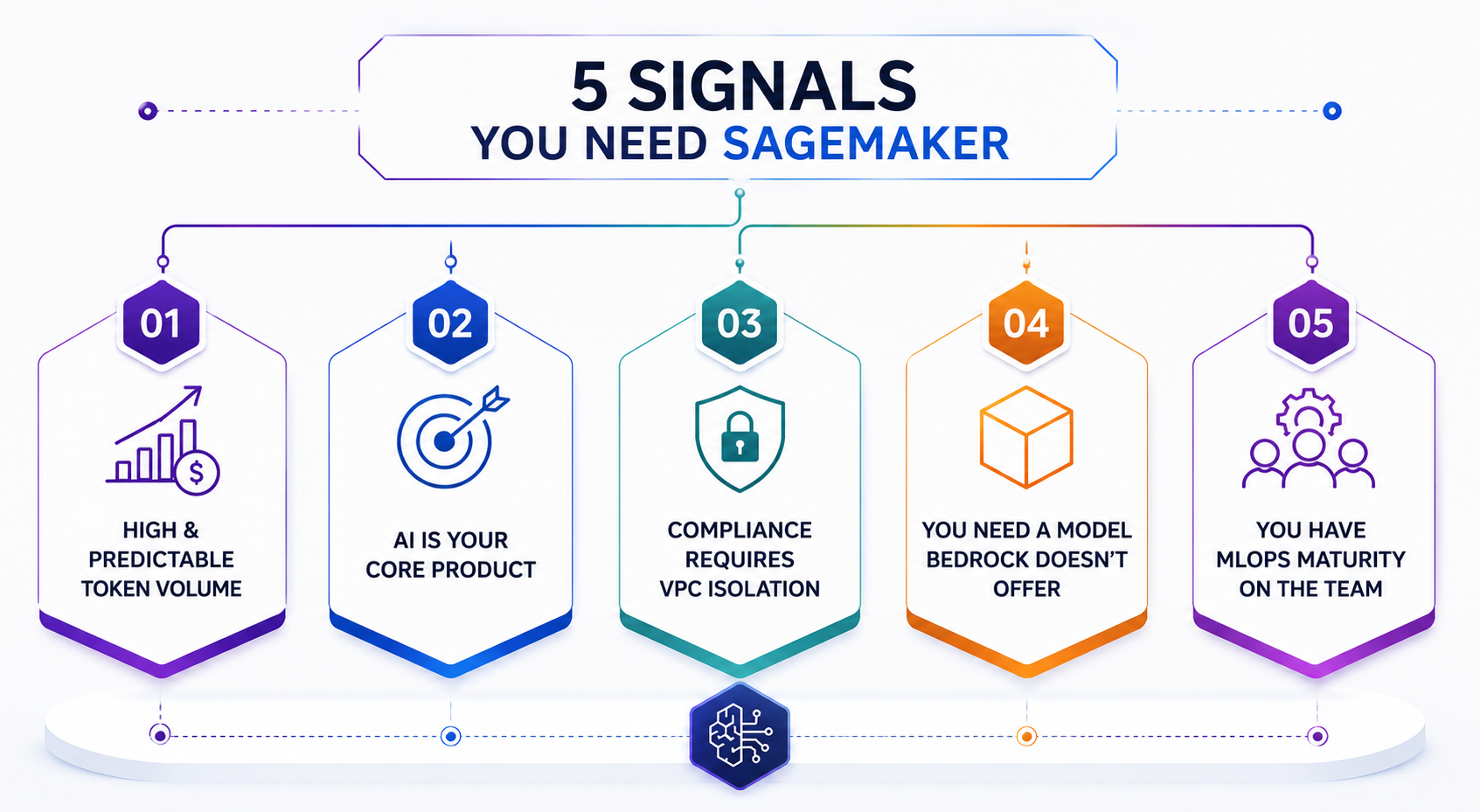
Signal 1: Your Token Volume Is High and Predictable
Bedrock's pay-per-token pricing model scales linearly, every additional token costs the same as the first. At low-to-moderate volumes, this is economical and flexible. At high, predictable volumes, dedicated SageMaker inference infrastructure becomes meaningfully more efficient because you are paying for provisioned compute capacity rather than per-unit consumption. The crossover point varies by model and instance type, but for most production workloads, organisations running tens of millions of tokens per month at consistent daily volume should evaluate whether dedicated infrastructure offers better economics. The key qualifier: you also need the MLOps capacity to manage that infrastructure. Without it, the efficiency gains disappear into engineering overhead.
Signal 2: AI Is Your Core Product — Not a Feature
If your competitive advantage is a model trained on your proprietary data, fraud detection built on years of your transaction history, clinical NLP fine-tuned on your patient data, computer vision trained on your manufacturing line imagery, you need to own the model weights and the training process. Bedrock does not offer that level of model ownership for custom architectures. SageMaker is the only path when the model itself is the moat.
Signal 3: Compliance Requires Data to Stay Inside Your VPC
Regulated industries, financial services, healthcare, defence, government, frequently operate under data residency requirements that prevent sensitive data from passing through shared managed infrastructure. SageMaker runs inference inside a private VPC with complete data isolation. Bedrock routes requests through AWS-managed endpoints, which for some regulatory frameworks is not permissible. If your compliance team has flagged this, it is a non-negotiable SageMaker signal.
Signal 4: You Need a Model That Bedrock Does Not Offer
A specific open-weight coding model. A domain-specialised Hugging Face variant your research team fine-tuned. A model architecture that no managed service provides. SageMaker allows you to containerise and deploy any model from any source. Bedrock is limited to the models available through the AWS marketplace. If your use case requires a specific model that is not in Bedrock's catalogue, SageMaker is the only AWS-native option.
Signal 5: Your Use Case Is Classical ML — Not Generative AI
Computer vision. Time-series forecasting. Recommendation engines. Anomaly detection. Credit risk scoring. These are not generative AI use cases, they are predictive ML workloads, and Bedrock was not built for them. SageMaker was. If your primary AI workload falls into this category, you were never a Bedrock candidate.
Signal 6: You Have MLOps Maturity on the Team
This signal is underrated and frequently overlooked. SageMaker without MLOps competence becomes a cost centre within ninety days, idle notebooks, oversized training instances, abandoned model versions, and cost leaks that are difficult to diagnose. If you have at least one engineer with a track record of shipping production ML models and managing inference infrastructure, SageMaker's power is accessible. Without that, SageMaker's complexity is a liability.
When Bedrock Is Genuinely Enough
Resist the instinct to "upgrade" to SageMaker when Bedrock already solves the problem. Complexity is not sophistication , and for the majority of business AI use cases in 2026, Bedrock is the more appropriate platform.
Bedrock wins decisively when:
You need to ship in under two weeks. A RAG-powered knowledge assistant, an internal Q&A tool, a customer-facing support chatbot, a marketing content generator — Bedrock gets all of these to production in days, not months. If speed-to-value matters more than infrastructure ownership, Bedrock is structurally faster.
Your traffic is unpredictable or spiky. Bedrock costs scale down to zero between API calls. A SageMaker real-time endpoint keeps the meter running regardless of whether it is serving requests. For bursty or seasonal workloads high traffic on weekdays, quiet on weekends, volume spikes around product launches, Bedrock's serverless pricing model is structurally cheaper.
You need Claude or another proprietary model. Anthropic's Claude models are not available as open weights. There is no way to self-host Claude on SageMaker, Bedrock is the only AWS path to Claude inference. The same applies to other proprietary models in Bedrock's catalogue.
You are building agentic workflows. Bedrock Agents and AgentCore provide goal-based reasoning, persistent memory, multi-step task execution, and Cedar-based policy controls as managed services. Building equivalent agentic infrastructure on SageMaker requires significantly more custom engineering.
You are a lean team without dedicated ML engineering. Bedrock was designed for product engineers who want to embed AI without becoming AI researchers. If your team's strength is software engineering rather than ML operations, Bedrock removes the operational overhead that would otherwise consume disproportionate time.
For businesses starting with Bedrock, particularly for chatbot and RAG use cases, our AWS Bedrock Chatbot Architecture Guide covers model selection, prompt architecture, knowledge base design, and the cost-conscious implementation decisions that prevent the most common post-launch issues.
The Architectural Comparison That Actually Matters
Rather than a pricing table, which becomes outdated, here is the architectural reality of both platforms across the dimensions that drive real decisions:
| Decision Dimension | Amazon Bedrock | Amazon SageMaker |
|---|---|---|
| Pricing structure | Per token consumed | Per instance-hour provisioned |
| Cost behaviour at low volume | Efficient — pay only for usage | Inefficient — idle infrastructure tax |
| Cost behaviour at high volume | Scales linearly — can become expensive | Efficient — fixed compute handles more volume |
| Infrastructure management | Zero — fully managed | Significant — you own the stack |
| Model ownership | AWS-hosted foundation models | Full ownership of weights and training |
| Time to first deployment | Hours to days | Weeks to months |
| MLOps headcount required | Zero | Minimum one experienced ML engineer |
| Cold-start exposure | None | Real — idle endpoints still bill |
| Compliance / VPC isolation | Shared managed infrastructure | Full private VPC isolation available |
| Custom model support | Limited (fine-tune select models) | Full — deploy any containerized model |
| Classical ML support | No | Yes — built for it |
| Agentic workflow support | Native (Bedrock Agents, AgentCore) | Requires custom engineering |
| Best discount lever | Volume commitment tiers | Savings Plans (significant discount available) |
The critical insight from this table: Bedrock has a low floor and a rising ceiling. SageMaker has a high floor and a flat ceiling. Which is better depends entirely on where your usage volume sits and how predictable it is.
The Hybrid Architecture That Has Become the 2026 Standard
Mature AWS AI deployments in 2026 are not making a binary choice. They are running both services simultaneously, routing workloads to the platform that handles each job most efficiently.
Bedrock handles the front layer:
- User-facing chatbots and conversational agents
- Variable-traffic or unpredictable-volume features
- General-purpose content generation and summarisation
- RAG retrieval and reasoning workflows
- Any workload requiring Claude, Nova 2, or other proprietary models
- Agentic orchestration via Bedrock Agents and AgentCore
SageMaker handles the engine layer:
- Custom fine-tuned models trained on proprietary data
- Classical ML workloads, vision, forecasting, fraud, recommendations
- High-volume batch inference at predictable load
- Workloads requiring complete VPC data isolation
- Real-time inference at scale where dedicated infrastructure is economical
A lightweight routing layer in between, often Bedrock Agents or a thin orchestration service determines which request goes where based on workload type and volume. This pattern consistently reduces total AWS AI spend relative to running everything on the higher-cost service for a given workload type. The trick is drawing the architectural line before you scale, not after the cost structure becomes difficult to unwind.
For a complete picture of how this stack fits into a full AWS AI implementation, including the governance and cost monitoring layer that prevents the drift described in the opening story, the AWS Generative AI Implementation Guide 2026 maps the full architecture decision sequence.
A 5-Question Decision Framework: Use This Before Any Architecture Meeting
Walk these in order. Stop at the first clear yes.
1. Does compliance require your data to stay inside a private VPC?
SageMaker. Non-negotiable for regulated workloads.
2. Is your primary AI use case classical ML — vision, forecasting, fraud scoring, or recommendations?
SageMaker. Bedrock was not designed for these workloads.
3. Is your token volume high, load predictable, and do you have MLOps capacity on the team? SageMaker, or a hybrid architecture. Evaluate the economics at your specific volume.
4. Do you need a specific model that Bedrock's catalogue does not include?
SageMaker. Only option for non-catalogue models on AWS.
5. None of the above apply?
Bedrock. Ship this week. Re-evaluate the architecture in six months when you have real usage data.
This framework resolves the majority of SageMaker-vs-Bedrock debates because most teams get stuck on "maybe." If you cannot confidently answer yes to questions one through four, the correct answer is Bedrock.
What Changed in 2026 That Affects This Decision
The product lines have converged more in the last twelve months than in the previous three years combined. Four developments matter for the SageMaker-vs-Bedrock decision:
Bedrock Reinforcement Fine-Tuning (RFT) now allows model tuning using outcome feedback rather than labelled data. This makes Bedrock viable for customisation use cases that previously required SageMaker. Documented accuracy improvements on Amazon Nova 2 Lite using RFT have been significant, reducing the gap between Bedrock's out-of-the-box performance and SageMaker's custom-trained output for many domain-specific tasks.
SageMaker Serverless Customisation eliminates the need to manually select and manage compute instances for training runs. This directly addresses the most common objection to SageMaker, infrastructure complexity, and makes the platform more accessible to teams without deep MLOps experience.
SageMaker Unified Studio merges the Bedrock and SageMaker interfaces into a single development environment. The product boundary between the two services is now a routing decision, not an interface change. Teams can work across both from one IDE.
Amazon Nova 2 on Bedrock brought extended thinking, million-token context windows, and three capability tiers to the managed service. For most enterprise use cases that previously required custom-trained models for reasoning depth, Nova 2 Pro on Bedrock now handles the workload without touching SageMaker.
Net effect: Bedrock has expanded its addressable use case territory upward into what was previously SageMaker's domain. Use cases that demanded SageMaker in 2024 frequently work well on Bedrock in 2026. The right architecture question is no longer "which service?" but "which service for which workload within our stack?"
The Architecture Review That Most Teams Skip
The health tech company in the opening story did not make a bad decision when they chose Bedrock. They made an appropriate decision for their stage, and then never revisited it as the business scaled. That is the architecture error: not the initial choice, but the absence of a structured review at meaningful scale milestones.
If your AWS AI deployment has been running for six months or more without a formal architecture and cost review, the probability that your workload mix has changed enough to warrant a service routing reassessment is high.
Ready to Get the Architecture Decision Right the First Time?
Info Services has designed and delivered production AWS AI architectures across financial services, healthcare, retail, and enterprise SaaS, on Bedrock, on SageMaker, and on hybrid stacks. We know where the cost leaks hide, where the compliance requirements create hard constraints, and how to structure a deployment that serves your business now and scales without requiring a rebuild.
Book a free AWS AI architecture review →

In 45 minutes, we will assess your current or planned workload, identify the right service architecture, and give you a clear recommendation, with the reasoning, not just the answer.