

Snowflake Schema in DataHub
The Rise of the Agentic Enterprise: Salesforce's New Vision for Business
AI redefining enterprise.
Introduction: The Beginning of a New Era
Salesforce has long defined how enterprises manage relationships, data, and digital experiences. With each evolution—from CRM to cloud, from analytics to AI-it has expanded what business technology can achieve.
Now, Salesforce introduces its next major transformation: The Agentic Enterprise.
Traditional automation breaks under scale, multidimensional data, and multi-system complexity. The Agentic Enterprise solves this by enabling decisions to happen continuously and contextually, not sequentially.
First introduced in late 2025, this concept extends Salesforce's earlier innovation, Agentforce, into a larger ecosystem of interconnected AI agents working together to run the enterprise.
Agentforce vs. Agentic Enterprise
| Layer | Agentforce | Agentic Enterprise |
|---|---|---|
| Purpose | Build individual AI agents | Run the enterprise through interconnected agents |
| Scope | Task-level autonomy | End-to-end autonomous workflows |
| Data | App-level access | Enterprise-wide via Data Cloud |
| Coordination | Human-triggered | Agent-to-agent + human-supervised |
| Governance | Agent-level rules | Cross-agent governance, compliance, trust |
From Automation to Agency: A Strategic Shift
The Agentic Enterprise represents a departure from traditional automation. Instead of static workflows, it empowers a network of autonomous agents capable of reasoning, adapting, and collaborating.
These agents don't just follow instructions—they learn, decide, and act in real time, guided by human intent and enterprise policy. The result is a living ecosystem of humans and machines co-operating dynamically to drive outcomes.
Building on Salesforce Agentforce
Salesforce's Agentic Enterprise vision builds directly upon Agentforce, the first large-scale framework for creating and deploying AI agents inside the Salesforce platform.
When Agentforce was introduced, it redefined AI in the enterprise—from rule-based automation to intelligent digital teammates that could understand language, access data, and complete tasks.
(For a deeper look into this evolution, read Building Smarter with Salesforce Agentforce: The Future of AI-Driven Development.)
The Agentic Enterprise expands that foundation from departmental AI to organization-wide orchestration, allowing multiple agents to coordinate actions, share insights, and deliver outcomes that were previously unachievable with isolated automation.
What Makes an Enterprise "Agentic"?
- Autonomous Collaboration — AI agents cooperate across departments, guided by unified governance.
- Contextual Intelligence — Real-time data from Salesforce Data Cloud ensures decisions are personalized and accurate.
- Human-AI Partnership — Humans define intent and strategy; agents execute and optimize in the background.
This balanced model of automation and oversight ensures agility with accountability.
The Agentic Maturity Journey
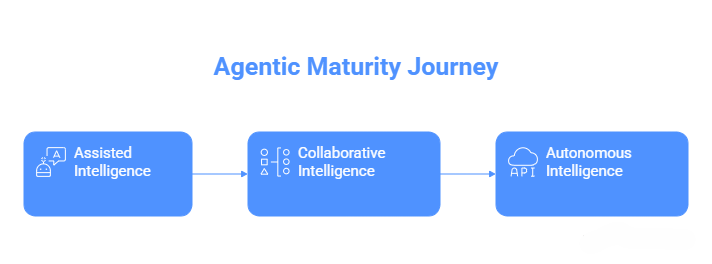
Salesforce defines the Agentic Enterprise as the highest stage of maturity in the AI adoption journey.
- Stage 1: Assisted Intelligence — AI assists with suggestions; humans retain full control.
- Stage 2: Collaborative Intelligence — AI agents execute within supervised workflows.
- Stage 3: Autonomous Intelligence — AI executes end-to-end operations with guided oversight.
(For detailed insights, refer to Advancing Through the Salesforce Agentic Maturity Model.)
This structured path allows enterprises to evolve responsibly, ensuring that trust, data quality, and governance scale along with autonomy.
The Architecture of the Agentic Enterprise
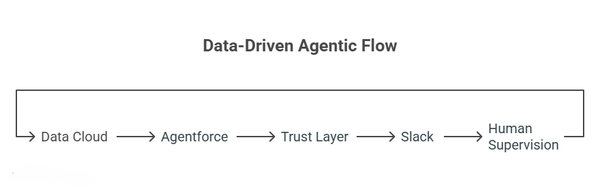
The Agentic Enterprise runs on Salesforce's connected architecture blending data, AI, collaboration, and governance. Together, these components form a continuous loop of intelligence and feedback.
Mini Flow: Data Cloud â†' Agentforce â†' Trust Layer â†' Slack â†' Human Supervision â†' back to Data Cloud
Key Components
- Data Cloud: Centralizes data from all systems, creating a unified source of truth.
- Agentforce: Deploys and manages AI agents across business functions.
- Trust Layer: Protects enterprise data, filters model output, and ensures compliance.
- Slack Integration: Provides real-time interaction between humans and agents for task coordination.
- Human Supervision: Allows monitoring, exception handling, and continuous improvement of agent behavior.
This loop ensures the enterprise learns, adapts, and evolves with every interaction—turning data into decisions at scale.
Why It Matters: Business Impact and Strategy
Reimagining Productivity
AI agents can autonomously manage routine processes—reducing workload and enabling teams to focus on creativity, innovation, and relationships.
Data-Driven Decisions
With Data Cloud as the foundation, every business decision is informed by complete, contextual intelligence, eliminating guesswork.
Scalability with Control
Agentic systems scale operations efficiently while maintaining strict compliance and oversight.
Customer-Centric Experiences
Agents orchestrate seamless, personalized customer journeys across marketing, service, and commerce, maintaining consistency and empathy.
Transparent Governance
Every action is tracked through Salesforce's trust mechanisms, ensuring accountability and explainability.
Industry Use Cases
Manufacturing & Automotive
AI agents manage dealer communication, parts tracking, and recall management—reducing resolution time from hours to minutes.
Healthcare & Life Sciences
Agents coordinate appointments, insurance claims, and patient engagement through Health Cloud, ensuring secure, compliant automation.
Financial Services
Agents verify transactions, detect anomalies, and escalate risks to compliance teams—combining speed with regulatory assurance.
Retail & Consumer Goods
From real-time inventory balancing to automated returns, agents power responsive, customer-first operations.
Governance: Keeping Autonomy Accountable
The Agentic Enterprise operates on supervised autonomy, balancing independence with oversight. Governance is not optional—it is embedded at every layer of Salesforce's ecosystem.
Governance Components
- Instruction Adherence Score: Measures how closely AI agents follow human-defined protocols.
- AI Policy Center: Centralizes all AI governance policies—permissions, compliance standards, and ethical boundaries.
- Audit Trail Generation: Logs every agent action for transparency and regulatory verification.
- Prompt Shielding: Protects sensitive enterprise data and instructions from exposure during AI interactions.
These capabilities make governance measurable, scalable, and consistent—ensuring AI-driven autonomy remains accountable.
Challenges to Anticipate
While transformative, the journey toward an Agentic Enterprise requires new thinking:
- Change Management: Redefining team roles and workflows to include AI collaboration.
- Data Preparedness: Ensuring data integrity before full automation.
- Skill Development: Training AI supervisors and policy architects.
- Ethical Oversight: Embedding responsible AI practices from day one.
Organizations that address these factors proactively will unlock faster adoption and higher returns.
The Road Ahead: Salesforce's Vision of the Agentic Future
Salesforce envisions enterprises where intelligent agents are as common as employees—collaborating, learning, and executing autonomously across ecosystems.
Expect these developments in the coming years:
- Multi-Agent Collaboration: Teams of agents handling complex, cross-domain workflows.
- Voice & Multimodal Interfaces: Conversational AI agents using voice, image, and contextual understanding.
- Integrated Compliance: Real-time governance through built-in AI Policy Centers.
- Trust-Driven AI: Every prediction or action traceable via audit trails.
The Agentic Enterprise thus becomes not just a technological shift, but a philosophical one—an enterprise that evolves continuously with its data.
Conclusion: From Tools to Transformation
Salesforce's Agentic Enterprise marks the convergence of AI, data, and governance into one intelligent system. What started with Agentforce as individual AI teammates has matured into a vision where entire organizations think, act, and learn collectively.
Businesses embracing this shift will transition from static automation to adaptive intelligence—where AI and humans work together toward shared intent.
In the Agentic Enterprise, data becomes the truth, AI becomes the executor, and humans become the stewards of intent.
This is the foundation of the next era of enterprise intelligence—dynamic, contextual, and profoundly human-centered.

FAQs
1. How does an Agentic Enterprise differ from traditional automation?
Traditional automation runs predefined steps, while an Agentic Enterprise enables AI agents to make contextual, continuous decisions across systems.
2. Why is unified data essential for building an Agentic Enterprise?
Agents require consistent, real-time data to act intelligently. Data Cloud provides the enterprise-wide foundation that allows agents to collaborate reliably.
3. What role does human supervision play in an Agentic Enterprise?
Humans define intent, policies, and oversight while agents execute tasks autonomously. This ensures accountability without limiting scale or speed.
4. How do multiple AI agents collaborate in Salesforce's ecosystem?
Agents exchange context through shared data and governance rules, enabling coordinated actions across sales, service, marketing, and operations.
5. What governance mechanisms ensure AI agents remain compliant and trustworthy?
Tools like Instruction Adherence Score, AI Policy Center, and audit trails ensure agents operate within approved boundaries and produce explainable outcomes.