

gcp
Big Query Pricing Explained: What Actually Drives Costs in Modern Analytics Environments
Understanding what influences Big Query spend before costs start growing.
Introduction: Pricing Isn't Usually the First Question
When organizations begin exploring Google Big Query, pricing is rarely the first topic that comes up.
The initial conversations are often about speed. Teams want faster reporting. Analysts are looking for a way to query growing datasets without waiting hours for results. Leaders want better visibility into operations, customers, and performance. Engineering teams are trying to reduce the effort required to maintain increasingly complex data environments.
Only after Big Query moves from a technical possibility to a serious consideration does the cost conversation begin.
At that point, many organizations encounter an interesting contradiction.
Some teams describe Big Query as one of the most cost-efficient analytics platforms they've used. Others warn about unexpected spending and rising bills.
Both experiences can be true.
Unlike traditional platforms that rely heavily on fixed infrastructure commitments, Big Query follows a consumption-based pricing approach. That flexibility is one of its greatest strengths. It allows organizations to scale according to demand rather than planning years of capacity upfront.
At the same time, it changes how organizations think about cost.
The question shifts from:
"How much does Big Query cost?"
to something more practical:
"What factors determine how much our organization is likely to spend?"
The answer lies not just in the pricing model itself, but in how the platform is designed, governed, and used over time.
Understanding those factors is often the difference between viewing Big Query as a strategic investment and viewing it as an unpredictable expense.
Understanding Big Query's Pricing Model
One reason Big Query pricing can feel confusing is that people expect a single number.
A monthly license.
A fixed infrastructure fee.
A standard enterprise package.
Big Query doesn't work that way.
Instead, the Big Query pricing model is built around actual consumption. Organizations pay for the resources they use rather than reserving large amounts of infrastructure that may sit idle.
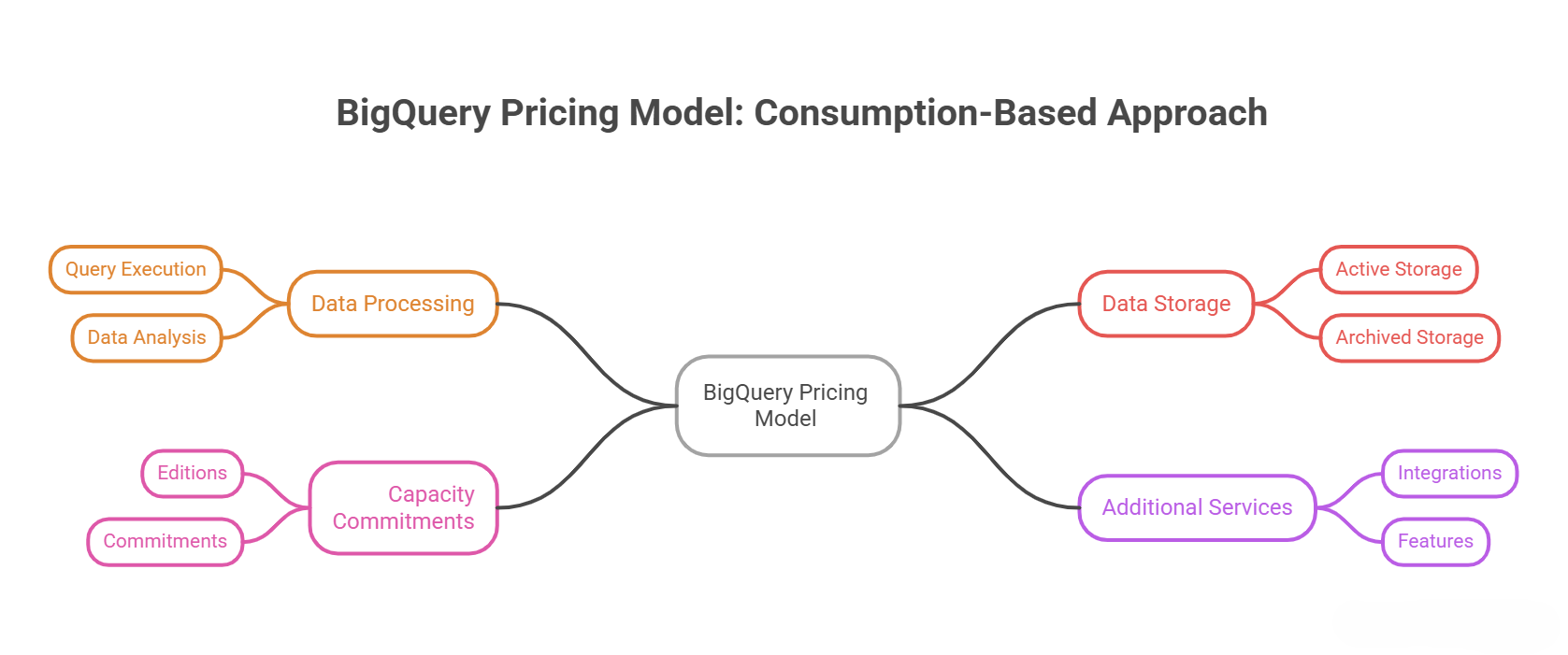
Broadly speaking, Big Query costs are influenced by four areas:
- Data processing
- Data storage
- Capacity commitments or editions
- Additional services and integrations
While the mechanics behind each category are different, the principle remains the same: usage influences spend.
This approach provides flexibility, particularly for organizations with changing workloads. However, it also means that decisions made by analysts, engineers, and business teams can directly influence cost outcomes.
That isn't necessarily a disadvantage.
It simply requires a different mindset.
Instead of asking whether the platform is expensive by default, organizations need to understand what drives consumption.
Big Query Cost Per Query: Why Query Design Matters
When people search for "Big Query cost per query," they're usually trying to answer a practical question:
How much will it cost every time someone runs an analysis?
The honest answer is that there isn't a universal number.
Two queries can produce similar reports while consuming dramatically different amounts of resources.
Consider a simple example.
Imagine a sales dashboard designed to update every morning.
The first version scans an entire 500 GB dataset because no filters have been applied.
The second version retrieves only the latest 5 GB of partitioned data relevant to that day's reporting requirements.
The business outcome is identical.
The cost profile is not.
The first approach processes substantially more information than necessary. The second limits processing to only what is needed.
Over time, these differences compound.
This is why query design often becomes one of the most important aspects of BigQuery cost optimization.
The goal isn't to restrict analysts from asking questions.
It's to help organizations build reporting practices that remain efficient as usage scales.
Big Query Storage Pricing: Growth Is Usually Gradual Until It Isn't
Compared to processing costs, Big Query storage pricing is often easier to understand.
Organizations pay to retain data.
What catches many teams off guard isn't the pricing structure itself. It's how quickly storage requirements evolve.
At the beginning, data volumes tend to be manageable.
A few operational systems feed the warehouse.
Historical data is limited.
Reporting requirements remain focused.
Then growth happens.
New applications are introduced.
Additional teams begin contributing data.
Compliance requirements encourage longer retention periods.
Business users request broader access to historical trends.
Before long, datasets that once seemed modest become significantly larger.
Storage growth rarely happens through a single dramatic event.
It accumulates quietly.
For this reason, organizations benefit from thinking about data lifecycle management early.
Questions such as:
- How long should certain datasets be retained?
- Which information requires frequent access?
- Which datasets serve archival purposes?
can influence long-term efficiency just as much as technical optimizations.
On-Demand vs Capacity-Based Pricing: Which Approach Makes Sense?
One of the most frequently searched topics around Big Query is the difference between on-demand pricing and capacity-based pricing.
At a high level, the distinction reflects how organizations prefer to manage consumption.
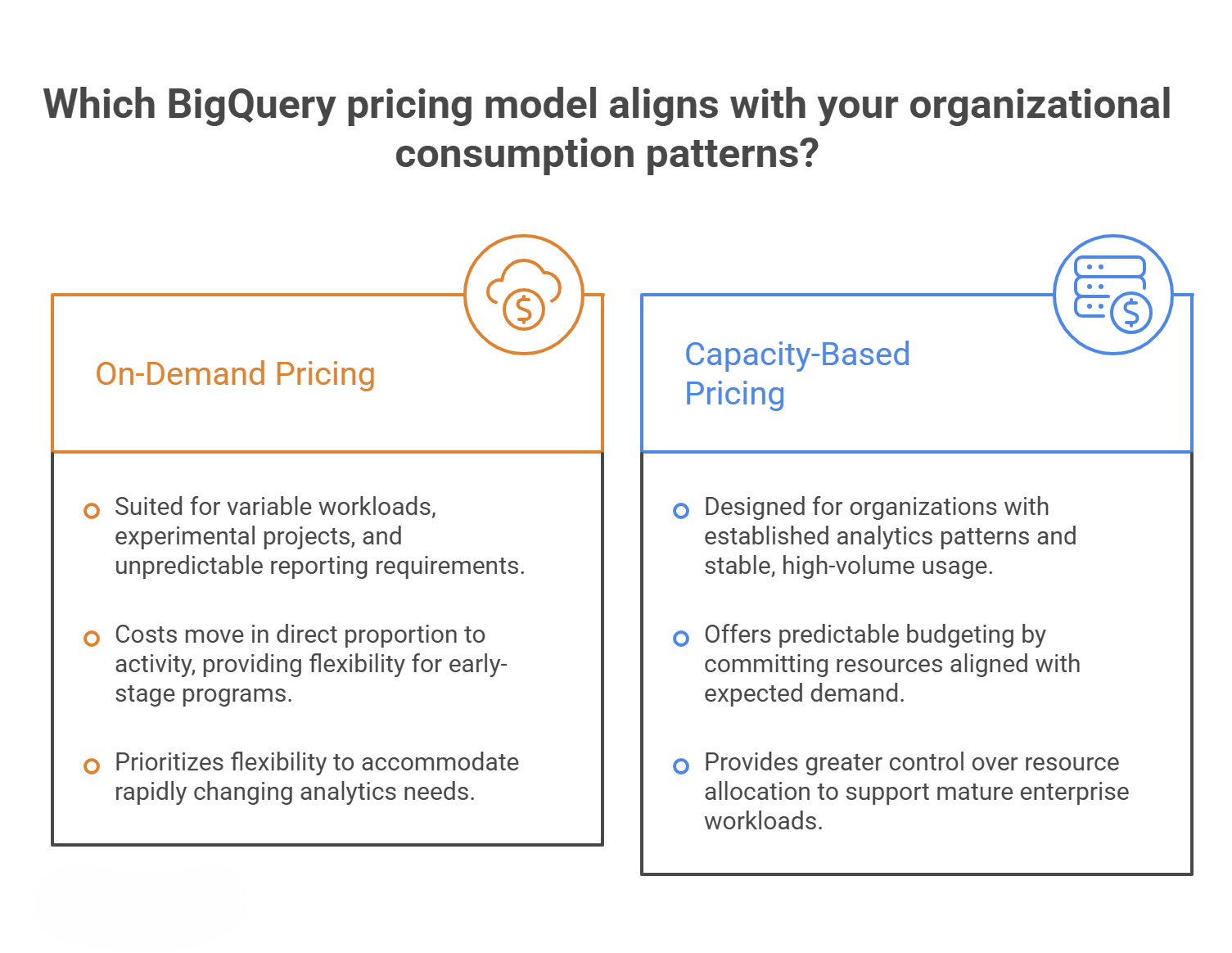
On-Demand Pricing
On-demand pricing aligns closely with actual usage.
Organizations pay based on the amount of processing performed.
This model often appeals to teams with:
- Variable workloads
- Early-stage analytics programs
- Unpredictable reporting requirements
- Experimental projects
It provides flexibility because costs generally move in proportion to activity.
However, highly active environments may eventually seek greater predictability.
Capacity-Based Pricing and Editions
Capacity-oriented approaches are designed for organizations with more established analytics patterns.
Instead of focusing solely on individual workloads, organizations commit resources aligned with expected demand.
This can offer advantages such as:
- More predictable budgeting
- Greater control over resource allocation
- Alignment with mature enterprise workloads
Recent Big Query editions pricing models provide additional flexibility, allowing organizations to align capabilities and commitments with operational needs.
The right choice depends less on the platform itself and more on how the business consumes analytics.
Organizations with rapidly changing workloads often prioritize flexibility.
Organizations with stable, high-volume usage frequently prioritize predictability.
Neither approach is universally better.
The objective is alignment.
Why Two Organizations Can Experience Very Different Costs
One of the most fascinating aspects of Big Query is that two organizations operating at similar scale can have very different experiences.
Both organizations may support hundreds of users.
Both may analyze large datasets.
Both may rely heavily on dashboards and reporting.
Yet one team considers Big Query highly efficient, while another struggles with cost visibility.
The difference is often operational rather than technical.
Organizations that maintain clear standards tend to achieve greater consistency.
They establish practices around:
- Query efficiency
- Dataset ownership
- Monitoring and visibility
- Data governance
- Reporting standards
Organizations that evolve without those guardrails often encounter challenges.
For example, it isn't uncommon for separate departments to maintain independent copies of the same datasets.
Marketing builds its own reporting layer.
Finance creates another version.
Operations develops a third.
Over time, duplication increases storage requirements and makes it harder to understand where resources are being consumed.
The platform hasn't changed.
The operating model has.
And in many cases, that distinction explains the difference in outcomes more effectively than pricing documentation ever could.
The Conversation Doesn't End With Pricing
Understanding what drives Big Query costs is only the first step.
Most organizations don't struggle because they misunderstand the pricing model. They struggle because seemingly small decisions—how queries are written, how data is organized, and how workloads are managed—begin influencing costs as analytics adoption grows.
In the next blog, we'll look at the operational side of the equation: the common mistakes that increase spending, practical cost optimization strategies, and the habits that help teams scale analytics efficiently without losing visibility into costs.