

Salesforce
From Tracking to Predicting: How Salesforce Is Redefining Intelligent Logistics
Smarter logistics operations powered by Salesforce AI and automation
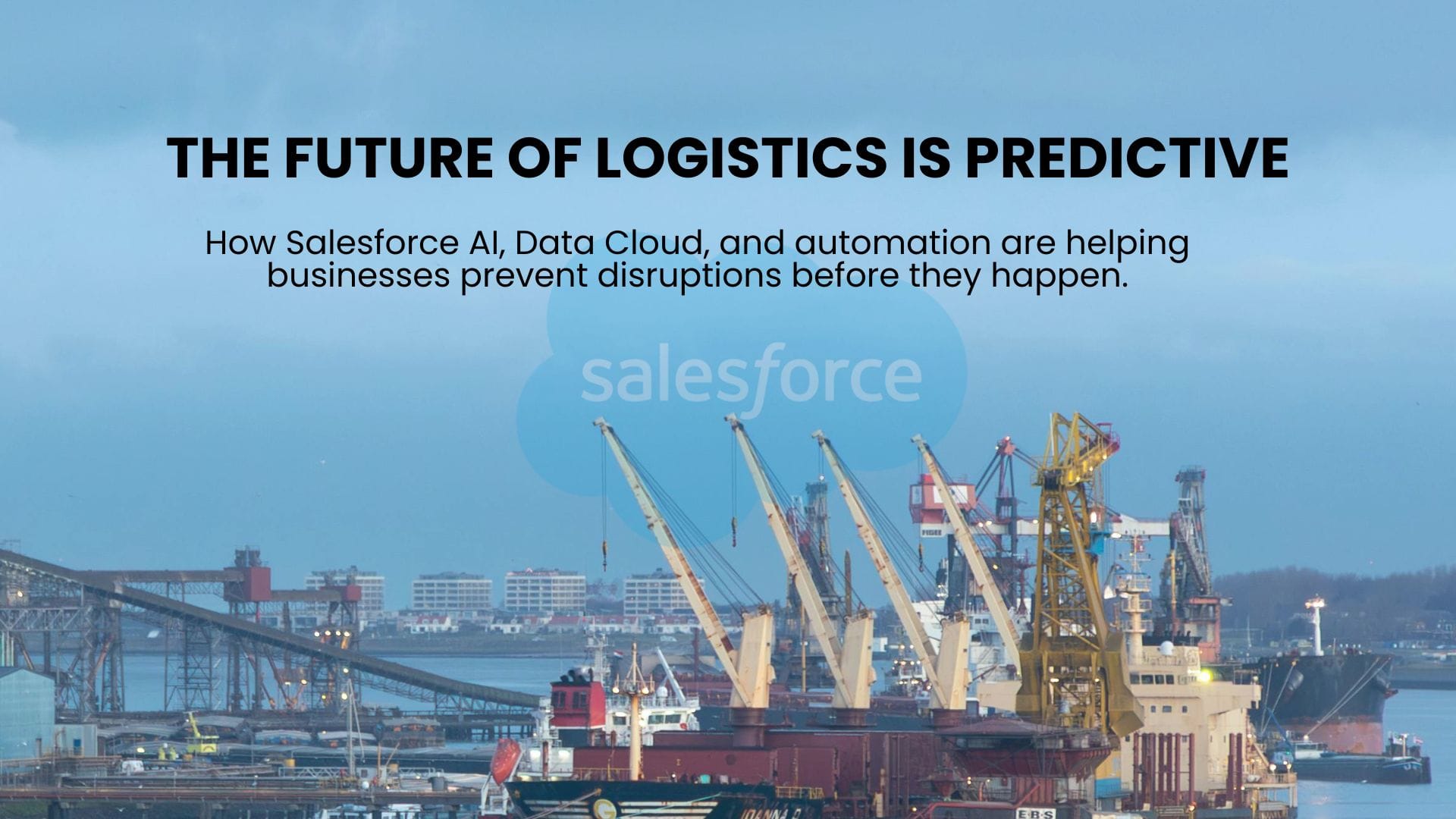
Introduction: Visibility Is No Longer the Competitive Edge
In today's logistics environment, visibility is no longer a competitive advantage—it's the baseline.
For years, logistics transformation focused heavily on one objective: gaining better visibility into operations. Enterprises invested in transportation management systems, GPS tracking, warehouse monitoring tools, and customer communication platforms to answer one important question:
Where are my goods right now?
That level of visibility once represented operational maturity. Businesses that could track shipments, monitor fleet movement, and provide delivery updates were seen as digitally advanced.
But the logistics landscape has changed.
Today's supply chains operate under constant pressure. Delivery timelines are tighter. Customers expect real-time updates and seamless service experiences. Operational disruptions—from weather delays and labor shortages to inventory gaps and route inefficiencies—can impact revenue within hours.
In this environment, simply knowing what is happening is no longer enough.
Organizations now need systems that can anticipate disruptions before they occur, recommend the next best action, and automate operational decisions at scale.
This is where Salesforce is becoming increasingly important in logistics transformation.
What was once viewed primarily as a CRM platform has evolved into a connected ecosystem that combines real-time data, AI-driven intelligence, workflow automation, and operational visibility. Through technologies such as Data Cloud, Einstein GPT, and Agentforce, Salesforce is helping logistics organizations move beyond tracking toward predictive and intelligent operations.
The shift is significant.
Logistics leaders are no longer asking:
"How do we track operations better?"
They are asking:
"How do we predict issues before they impact customers and business outcomes?"
That transition—from reactive visibility to predictive intelligence—is shaping the next generation of logistics operations.
The Real Problem: Visibility Without Action Creates Delays
Most enterprises today already have some level of tracking infrastructure in place.
They can identify where a shipment is located, receive notifications when a delivery is delayed, and monitor field assets in real time. Customer support teams can access delivery statuses, and operations teams can view transportation data across systems.
On paper, this sounds efficient.
However, many organizations still struggle with operational delays, rising logistics costs, SLA violations, and inconsistent customer experiences.
The reason is simple:
Knowing something has gone wrong is not the same as preventing it.
A delayed shipment identified at 6 PM still creates a poor customer experience if the promised delivery window was 5 PM. A field technician rerouted manually after an issue occurs still results in wasted operational hours. A stockout detected in real time still affects sales if inventory adjustments could not happen earlier.
Traditional tracking systems are primarily descriptive.
They explain what is happening now or what already happened.
But modern logistics operations require predictive capabilities that help businesses understand:
- What is likely to happen next
- Which operations are at risk
- How disruptions can impact business outcomes
- What actions should be taken immediately

This gap between visibility and decision-making is where many logistics operations lose efficiency.
In fragmented environments, logistics data often exists across multiple systems:
- ERP platforms manage inventory and orders
- Transportation systems handle shipment tracking
- CRM systems store customer interactions
- Warehouse systems manage fulfillment operations
- Field service platforms track technician activity
When these systems operate independently, organizations face delayed decision-making, inconsistent information, and limited operational coordination.
As a result, teams spend valuable time reacting to problems instead of preventing them.
This is why enterprises are shifting toward a more intelligent operational model:
From:
"What is happening?"
To:
"What will happen, and what should we do about it?"
That transition is redefining how logistics organizations approach technology, operations, and customer service.
How Salesforce Is Powering Predictive Logistics
The transformation from tracking to predictive logistics is not driven by a single technology layer.
It requires connected data, operational intelligence, automation, and continuous decision-making.
Salesforce brings these capabilities together through an integrated ecosystem that enables organizations to build smarter and more responsive logistics operations.
Data Cloud: Building a Real-Time Operational Foundation
Predictive logistics begins with data.
However, data alone is not enough if it remains isolated across disconnected systems.
One of the biggest operational challenges in logistics is fragmentation. Shipment updates, customer interactions, inventory data, warehouse operations, and field activity often exist in separate platforms with limited synchronization.
This creates operational blind spots.
Salesforce Data Cloud addresses this problem by creating a unified, continuously updated operational view.
Instead of relying on batch-based reporting or delayed updates, Data Cloud enables organizations to connect and synchronize data streams across systems in near real time.
This includes:
- Order management systems
- Warehouse management platforms
- Transportation and fleet systems
- IoT devices and tracking applications
- Customer service platforms
- Partner and supplier ecosystems
The result is not just centralized visibility.
It is operational awareness.

Teams can understand the current state of logistics operations instantly while also identifying trends, risks, and performance patterns across the supply chain.
For example, if transportation delays begin increasing in a specific region due to weather conditions or route congestion, operations teams can identify the issue early and take corrective action before SLAs are impacted.
Similarly, warehouse bottlenecks can be identified faster, allowing teams to rebalance workloads or reroute fulfillment operations.
This level of connected visibility helps organizations:
- Reduce decision latency
- Improve shipment coordination
- Accelerate operational response times
- Minimize manual reconciliation across systems
- Improve cross-functional collaboration
In many logistics environments, reducing operational response delays by even a few hours can significantly improve customer satisfaction and delivery performance.
Data Cloud creates the foundation that makes predictive logistics possible.
But connected data alone does not create intelligence.
That requires AI.
Einstein GPT: Turning Operational Data Into Predictive Intelligence
Once logistics data is unified, the next challenge is making sense of it quickly and accurately.
Most organizations already have access to reports, analytics tools, and operational interfaces. The problem is not lack of information.
The real challenge is identifying risks early enough to act.
This is where Einstein GPT changes the operational model.
Instead of relying entirely on teams to manually analyze trends and identify disruptions, Einstein GPT continuously evaluates operational patterns across logistics workflows.
The platform can:
- Predict delivery delays
- Identify route inefficiencies
- Detect unusual operational patterns
- Recommend corrective actions
- Generate contextual insights for operations teams
- Support faster decision-making across logistics workflows
For example, rather than waiting for a delivery to fail, the system can identify a high probability of delay based on:
- Traffic conditions
- Weather disruptions
- Driver schedules
- Historical route performance
- Warehouse processing delays
- Supplier dependencies
The system can then recommend proactive actions such as:
- Rerouting shipments
- Prioritizing specific deliveries
- Adjusting warehouse workflows
- Escalating high-risk orders
- Notifying customer support teams in advance
This changes logistics operations from reactive management to predictive coordination.
More importantly, it improves business outcomes.
Organizations using predictive intelligence can:
- Reduce shipment delays
- Improve SLA compliance
- Increase operational efficiency
- Improve customer communication
- Reduce escalation handling costs
- Optimize transportation planning
AI-driven operational intelligence also reduces the burden on logistics teams.
Instead of spending time manually monitoring systems and identifying issues, teams can focus on strategic decisions, exception handling, and operational optimization.
This becomes increasingly valuable as logistics operations scale.
As shipment volumes grow, manual coordination becomes harder to sustain. Predictive intelligence helps organizations maintain operational efficiency without proportionally increasing operational complexity.
Agent force: From Recommendations to Automated Action
Insights alone do not solve operational problems.
The real value comes from execution.
This is where Agent force plays a critical role in Salesforce's logistics ecosystem.
Agent force enables organizations to automate operational responses based on real-time conditions and AI-driven insights.
Instead of waiting for manual intervention, workflows can trigger automatically when specific risks or conditions are detected.
For example:
- Deliveries can be rescheduled automatically
- Customers can receive proactive updates
- Internal stakeholders can be notified instantly
- Field technicians can be reassigned dynamically
- Escalation workflows can activate automatically
- Service teams can receive contextual recommendations
This level of automation helps logistics organizations reduce operational friction significantly.
It also improves consistency.
In traditional environments, operational response quality often depends on individual teams reacting quickly under pressure. Automated workflows reduce dependency on manual coordination and ensure that critical actions happen faster and more reliably.
The business impact is substantial.
Organizations can achieve:
- Reduced manual workload for operations teams
- Faster issue resolution
- Improved customer satisfaction
- Better workforce productivity
- Lower operational costs
- Higher scalability across logistics operations
Automation also improves customer experience.
Customers no longer need to wait until after a disruption occurs to receive communication updates. Instead, proactive notifications and automated service actions create more transparency and trust.
This becomes especially important in industries where delivery reliability directly affects customer retention and revenue.
The combination of Data Cloud, Einstein GPT, and Agentforce creates a connected operational framework where organizations can:
- Capture real-time operational data
- Predict risks before disruption occurs
- Trigger automated responses instantly
- Continuously optimize logistics workflows
That is the foundation of predictive logistics.
Why Real-Time Tracking Still Matters
Predictive logistics does not eliminate the importance of real-time tracking.
In fact, predictive systems become ineffective without accurate operational data.
Mobile-based tracking applications, field updates, IoT integrations, GPS systems, and operational monitoring tools still form the backbone of intelligent logistics environments.
Without reliable data streams, AI models cannot generate accurate predictions or recommendations.
This is why many organizations continue investing in real-time tracking infrastructure while simultaneously building predictive capabilities on top of it.
A practical example can be seen in the
ðŸ'‰ Excellence with Goods Tracking Mobile App Case Study

where a mobile-driven tracking solution improved real-time shipment visibility and field coordination.
More importantly, the implementation created a stronger operational data foundation that supports future predictive capabilities.
This is an important distinction.
Real-time tracking is no longer the final goal.
It is the starting point.
Organizations that establish reliable operational visibility are better positioned to build predictive and automated logistics systems over time.
From Reactive Logistics to Predictive Operations
Traditional logistics systems generally follow a reactive operating model.
The workflow looks something like this:
Track â†' Monitor â†' Identify Issue â†' Inform â†' Fix
In this model, organizations react after a disruption has already affected operations.
Even when teams respond quickly, they are still operating in recovery mode.
Modern logistics operations on Salesforce follow a different approach:
Stream Data â†' Predict Risk â†' Trigger Action â†' Optimize Outcome
The difference may appear subtle, but operationally it is transformative.
With connected data environments powered by Data Cloud, organizations gain continuous operational awareness.
Einstein GPT evaluates patterns and identifies risks before disruptions escalate.
Agentforce then activates workflows automatically to minimize operational impact.
Instead of waiting for delivery failures, organizations can proactively reroute shipments.
Instead of responding to warehouse congestion after delays occur, operations teams can rebalance workloads earlier.
Instead of escalating customer complaints after missed SLAs, service teams can communicate proactively.
This creates measurable operational advantages.
Organizations moving toward predictive logistics are increasingly seeing:
- Faster decision cycles
- Improved asset utilization
- Reduced delivery delays
- Better workforce coordination
- Improved service reliability
- Higher customer satisfaction
More importantly, logistics operations become more resilient.
Predictive systems help organizations adapt faster during disruptions, demand spikes, seasonal fluctuations, and operational uncertainty.
That level of agility is becoming essential in modern supply chain environments.
What Predictive Logistics Looks Like in Practice
The impact of predictive logistics becomes most visible in day-to-day operations.
Delivery schedules become more dynamic and responsive instead of fixed and rigid.
Inventory planning becomes demand-aware instead of reactive.
Field service teams operate based on real-time operational conditions rather than static schedules.
Warehouse workflows can adjust based on shipment priorities and incoming operational signals.
Customer communication becomes proactive instead of reactive.
Across industries, organizations are using predictive logistics capabilities to improve both operational performance and customer experience.
For example:
- Retail organizations can predict fulfillment bottlenecks during seasonal demand spikes
- Manufacturing companies can identify supply chain risks before production delays occur
- Field service teams can optimize technician scheduling dynamically
- Transportation providers can reduce route inefficiencies using predictive recommendations
- Customer support teams can resolve service issues faster with AI-driven operational context
These improvements directly impact business performance.
Organizations implementing predictive logistics strategies are increasingly achieving:
- Lower operational costs
- Better SLA performance
- Faster issue resolution
- Reduced shipment delays
- Improved resource utilization
- Higher operational efficiency

In many cases, delay reductions of 20—30% and operational efficiency improvements exceeding 25% are becoming realistic benchmarks.
While results vary by industry and operational maturity, the direction is clear:
Predictive logistics is becoming a business necessity rather than a future innovation.
The Road Ahead: Moving Toward Autonomous Operations
Predictive intelligence represents a major shift in logistics transformation.
But the long-term direction goes even further.
The next evolution is autonomous operations.
In autonomous logistics environments, systems will not only predict disruptions but also execute operational decisions independently, continuously learn from outcomes, and optimize workflows automatically.
Human teams will still play a critical role.
However, their focus will shift from manual operational coordination toward strategic oversight, exception management, and continuous improvement.
This transition has already begun.
Organizations are increasingly exploring:
- AI-driven workflow orchestration
- Autonomous route optimization
- Intelligent field service coordination
- Automated customer engagement
- Self-optimizing logistics processes
Salesforce's ecosystem is evolving to support this future by combining connected data, AI intelligence, and workflow automation into a unified operational framework.
For logistics organizations, this creates opportunities to build systems that are not only responsive but continuously adaptive.
That capability will become increasingly important as supply chains grow more complex and customer expectations continue to rise.
Conclusion: Logistics Is Becoming an Intelligence-Driven Function
The shift from tracking to predicting is not simply a technology upgrade.
It represents a broader operational transformation.
Logistics organizations are moving:
- From monitoring to anticipating
- From reacting to optimizing
- From isolated systems to connected intelligence
- From manual coordination to automated execution
Enterprises that embrace predictive logistics early will not only improve efficiency and reduce operational disruptions—they will create more resilient, scalable, and customer-centric supply chains.
Salesforce is helping enable this transformation by bringing together real-time data, AI-driven intelligence, and automation into a connected operational ecosystem.
And in today's logistics environment, that combination is becoming far more valuable than visibility alone.
It is creating intelligence at scale.
FAQ's
1. What is predictive logistics in Salesforce?
Predictive logistics uses AI, real-time data, and automation to identify risks before disruptions occur. Salesforce enables this through Data Cloud, Einstein GPT, and Agentforce.
2. How does Salesforce Data Cloud help logistics operations?
Data Cloud unifies data from multiple systems into a real-time operational view. This improves coordination, visibility, and faster decision-making.
3. What role does AI play in modern logistics?
AI helps organizations predict delays, optimize routes, identify inefficiencies, and automate operational actions before issues impact customers.
4. Why is real-time tracking still important in predictive logistics?
Real-time tracking provides the operational data required for accurate AI predictions. Without reliable data, predictive systems cannot function effectively.
5. How does Agentforce improve logistics workflows?
Agentforce automates actions such as notifications, delivery updates, and workflow triggers. This reduces manual effort and improves operational efficiency.