

Azure
Why Every Enterprise Is Moving to Azure in 2026: The Ultimate Migration Playbook
Everything organization needs to plan, execute and optimize a successful microsoft azure migration - from assessment to full cloud maturity
In today's hyper-competitive digital economy, Azure Migration Services have become the strategic backbone for enterprises seeking agility, cost efficiency, and long-term scalability. Whether your organization is migrating legacy systems, re-architecting monolithic applications, or modernizing data warehouses, Microsoft Azure provides a comprehensive, enterprise-grade ecosystem to guide every step of that journey.
This guide is designed for IT decision-makers, CTOs, cloud architects, and digital transformation leaders who want a definitive, no-fluff resource on Azure cloud migration — covering strategy, cost planning, security frameworks, modernization paths, and concrete business outcomes that justify the investment.
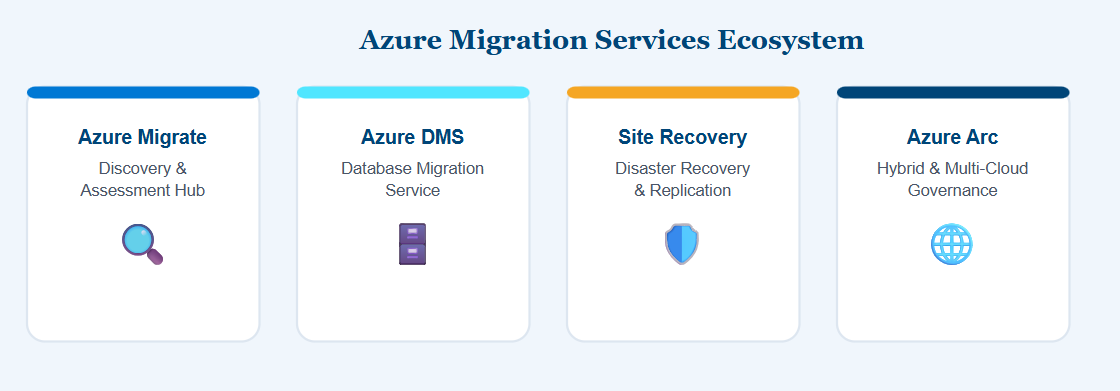
Azure Migration Services include Azure Migrate, Azure Database Migration Service, Azure Site Recovery, and the Cloud Adoption Framework — together forming a full-lifecycle solution for enterprise cloud transition.
What Are Azure Migration Services?
Azure Migration Services encompass a suite of Microsoft tools, methodologies, and professional services designed to help enterprises transition workloads, data, and applications from on-premises environments, other clouds, or hybrid setups to Microsoft Azure. At the core is Azure Migrate a unified hub for discovery, assessment, and migration supported by tools like Azure Database Migration Service (DMS), Azure Site Recovery, and Azure Arc for hybrid and multi-cloud governance.
More broadly, Azure Migration Services align with Microsoft's Cloud Adoption Framework (CAF) — a prescriptive set of documentation, best practices, and tools that guide organizations through five phases: Strategy, Plan, Ready, Adopt, and Govern/Manage. This structured approach transforms what could be a chaotic infrastructure overhaul into a methodical, risk-managed program with clear milestones and measurable outcomes.
Building Your Enterprise Cloud Migration Strategy
No two enterprise migrations are identical. A successful strategy begins with a thorough discovery and assessment phase cataloging existing workloads, mapping dependencies, identifying compliance requirements, and evaluating total cost of ownership (TCO). Azure Migrate's built-in assessment tools automatically profile on-premises VMs, SQL databases, and web applications, generating right-sizing recommendations and Azure cost projections.
Choosing the Right Migration Strategy: The 6 R's Framework
The most successful Azure migrations begin with a clear-eyed strategy. Microsoft and Gartner jointly popularized the 6 R's of Cloud Migration — a decision framework that maps each workload to its ideal migration path based on business value, technical complexity, and time-to-cloud requirements.
ðŸ"„Rehost (Lift & Shift)
Move workloads to Azure VMs with minimal changes. Fastest path, lowest initial cost. Ideal for commoditized infrastructure with tight migration windows.
ðŸ"§Replatform
Move to Azure PaaS (e.g., Azure SQL, App Service) with minor optimizations. Captures cloud efficiencies without full rearchitecting.
ðŸ—ï¸Refactor / Re-architect
Redesign applications for cloud-native patterns — microservices, containers (AKS), serverless (Azure Functions). Highest ROI over time.
ðŸ›'Repurchase (Replace)
Move to SaaS alternatives on the Azure Marketplace (e.g., replacing a legacy CRM with Dynamics 365 or Salesforce).
🗄ï¸Retire
Decommission workloads with no business value. Often reveals 10—20% of infrastructure is redundant, delivering immediate cost savings.
ðŸ"'Retain
Keep certain workloads on-premises (regulatory, latency, or dependency reasons) while connecting them to Azure via hybrid networking.
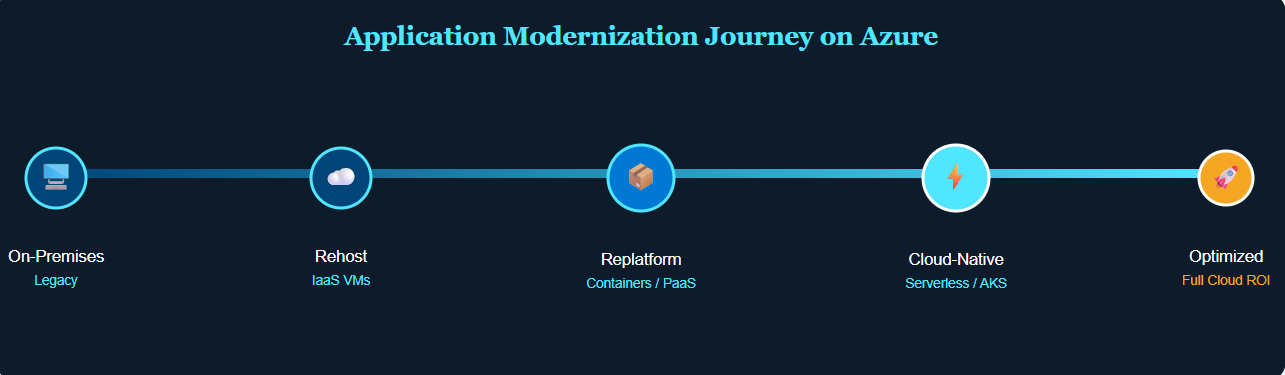
Most enterprise migrations are not a single-strategy exercise. A well-designed wave plan typically combines Rehost for legacy VMs, Replatform for databases, and Refactor for customer-facing applications executed in prioritized waves over 6—18 months.

Application Modernization on Azure
While lift-and-shift migrations deliver immediate infrastructure savings, true cloud value is unlocked through application modernization. Azure provides an unmatched modernization toolkit: Azure Kubernetes Service (AKS) for containerized workloads, Azure App Service for PaaS-hosted web applications, Azure Functions for event-driven serverless computing, and Azure API Management for microservices architectures.
Enterprises modernizing legacy .NET or Java monoliths typically follow a strangler fig pattern — gradually extracting services into microservices while keeping the core monolith running. This approach reduces risk, maintains business continuity, and allows teams to build cloud-native capabilities incrementally. Azure's DevOps integration, through Azure DevOps Pipelines and GitHub Actions, ensures that modernized applications are delivered with CI/CD best practices from day one.
Azure Migration Cost Planning and Optimization
One of the most critical and often underestimated aspects of Azure migration is cost management. Enterprises that migrate without a financial governance strategy frequently encounter unexpected cloud bills that negate anticipated savings. Azure provides robust cost management capabilities through Azure Cost Management + Billing, Azure Advisor recommendations, and the Azure Pricing Calculator for pre-migration TCO modeling.
Key cost optimization levers include: Azure Reserved Instances (up to 72% savings vs. pay-as-you-go for predictable workloads), Azure Hybrid Benefit (leverage existing Windows Server and SQL Server licenses), Azure Spot VMs for interruptible batch workloads, and auto-scaling policies that dynamically right-size compute based on demand. Organizations that adopt a FinOps culture where engineering, finance, and operations collaborate on cloud spending consistently outperform peers in cloud unit economics.
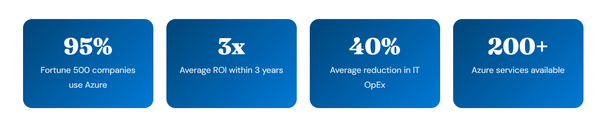
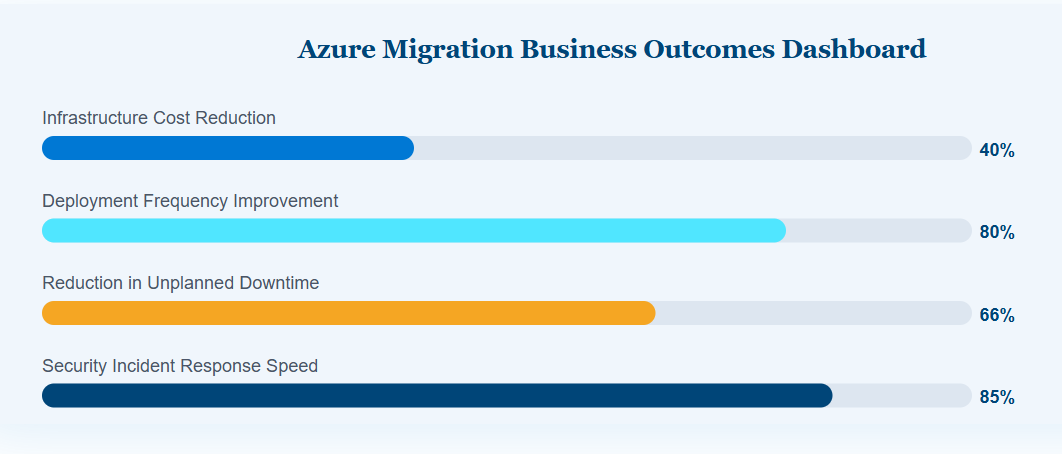
A Forrester Total Economic Impact study found that enterprises migrating to Azure realized an average 40% reduction in infrastructure costs, a 66% reduction in unplanned downtime, and a three-year ROI exceeding 300% when modernization was pursued alongside migration.
Enterprise Security and Compliance on Azure
Security is non-negotiable in enterprise cloud migration, and Azure's security posture is among the most comprehensive in the industry. Microsoft Defender for Cloud provides unified security management across hybrid and multi-cloud environments, offering continuous vulnerability assessment, threat detection, and regulatory compliance dashboards. Azure's identity foundation, built on Microsoft Entra ID (formerly Azure Active Directory), enables zero-trust architecture with conditional access policies, multi-factor authentication, and privileged identity management.
For regulated industries — healthcare, financial services, government. Azure holds over 90 compliance certifications, including HIPAA, PCI DSS, FedRAMP, ISO 27001, and SOC 2. Azure Policy and Azure Blueprints allow enterprises to codify compliance requirements as guardrails, automatically enforcing them across all subscriptions and resource groups. Data protection is ensured through Azure Key Vault for secrets management, Azure Confidential Computing for processing sensitive data in trusted execution environments, and encryption at rest and in transit across all Azure services by default.
ðŸ"' Security Insight: The Shared Responsibility Model means Azure secures the cloud platform itself, while enterprises remain responsible for data classification, identity governance, and application-level controls. A clear RACI matrix for cloud security is essential before go-live.
Azure Migration in Detroit: Powering the Comeback City's Digital Economy
Detroit's transformation from an industrial powerhouse to a diversified technology and manufacturing hub is being accelerated by Azure cloud adoption. Enterprises across the greater Detroit metro area from automotive OEMs and Tier 1 suppliers in the Warren-Troy corridor to financial services firms and healthcare systems in downtown Detroit are leveraging Azure Migration Services to modernize aging ERP systems, connect IoT-enabled factory floors to cloud analytics platforms, and meet evolving cybersecurity mandates from federal and state regulators.
Michigan's growing tech workforce, supported by institutions like Wayne State University and the Detroit Regional Chamber's talent initiatives, is producing Azure-certified engineers at an accelerating pace. Microsoft's partner ecosystem in Southeast Michigan includes established system integrators and boutique cloud consultancies that specialize in manufacturing-grade Azure implementations bridging the gap between Detroit's industrial legacy and its cloud-native future. For Detroit enterprises, Azure migration is not just a technology decision; it is the foundation of competitive resilience in a rapidly digitizing global economy.
Measuring Business Outcomes from Azure Migration
Successful enterprise cloud migrations are ultimately measured by business outcomes — not just technical milestones. The most meaningful KPIs for Azure migration programs span four dimensions: financial performance (TCO reduction, CapEx to OpEx shift), operational excellence (deployment frequency, MTTR, availability SLAs), business agility (time-to-market for new features, ability to scale infrastructure in hours vs. weeks), and innovation velocity (adoption of Azure AI, ML, and analytics capabilities that were not possible on-premises).
Azure's Well-Architected Framework provides a structured lens for continuously evaluating workloads across five pillars: reliability, security, cost optimization, operational excellence, and performance efficiency. Regular WAF reviews, combined with Azure Advisor recommendations, create a continuous improvement loop that compounds the value of migration over time. Enterprises that treat cloud migration as a one-time project — rather than an ongoing operating model consistently underperform against those that embed cloud optimization into their engineering culture.
Choosing the Right Azure Migration Partner
While Microsoft's native tooling is powerful, most enterprise migrations benefit significantly from experienced Azure Expert Managed Service Providers (MSPs) or Microsoft Solutions Partners with proven large-scale migration delivery capabilities. The right partner brings accelerators — pre-built landing zone templates, migration playbooks, workload-specific runbooks — that dramatically compress the time from assessment to production cutover.
When evaluating partners, prioritize those with demonstrated Azure Advanced Specializations in areas relevant to your workload mix (e.g., Windows Server and SQL Server Migration, Linux and Open Source Migration, SAP on Azure). Look for evidence of successful migrations of comparable scale, strong references in your industry vertical, and a FinOps-capable team that can model and optimize cloud spend from day one. The total cost of partnering correctly — in terms of accelerated time-to-value, risk reduction, and knowledge transfer — consistently outweighs the professional services investment.
The Future of Azure: AI, Hybrid Cloud, and What's Next
Azure migration is not just about moving the past to the cloud — it is about positioning your organization for the capabilities that come next. Microsoft's Azure AI platform, anchored by Azure OpenAI Service, Azure Machine Learning, and Copilot integrations across Microsoft 365 and Dynamics 365, is accessible only to organizations operating on Azure. Enterprises that have completed their cloud foundation are already building AI-powered applications — from predictive maintenance in manufacturing to AI-assisted customer service in retail — that would have required years of infrastructure build-out in an on-premises model.
The hybrid and multi-cloud future is equally important. Azure Arc extends Azure management, policy, and security to on-premises servers, edge locations, and other clouds — ensuring that organizations with regulatory or latency constraints are not forced into an all-or-nothing decision. As edge computing, sovereign cloud requirements, and AI workloads continue to mature, Azure's infrastructure investments in datacenter regions (now spanning 60+ regions globally) position it as the long-term platform of choice for global enterprises.
Azure migration, when approached strategically, is one of the highest-leverage investments an enterprise can make in its digital future. The organizations that lead their industries in the next decade will be those that built cloud-native foundations today — with Azure as their operating platform.
Frequently Asked Questions
1. How long does an enterprise Azure migration typically take?
Enterprise Azure migrations typically take 3 to 18 months depending on infrastructure complexity, data volume, compliance requirements, and the chosen migration strategy.
2. What is the cost of migrating to Azure?
Azure migration costs range from $50,000 to $500,000+ depending on workload scale, consulting needs, licensing models, and ongoing post-migration optimization requirements.
3. Is Azure secure enough for enterprise workloads?
Yes, Azure offers 90+ compliance certifications, built-in threat protection, zero-trust architecture, and enterprise-grade encryption for all sensitive workloads and enterprise data.
4. What is the difference between lift-and-shift and modernization on Azure?
Lift-and-shift moves existing workloads as-is to Azure virtual machines, while modernization refactors or rebuilds applications using cloud-native services like containers, serverless, or PaaS platforms.
5. How does Azure help reduce IT operational costs?
Azure reduces IT costs through pay-as-you-go pricing, auto-scaling, Reserved Instances, Azure Hybrid Benefit licensing, and eliminating on-premises hardware maintenance and capital expenditure.