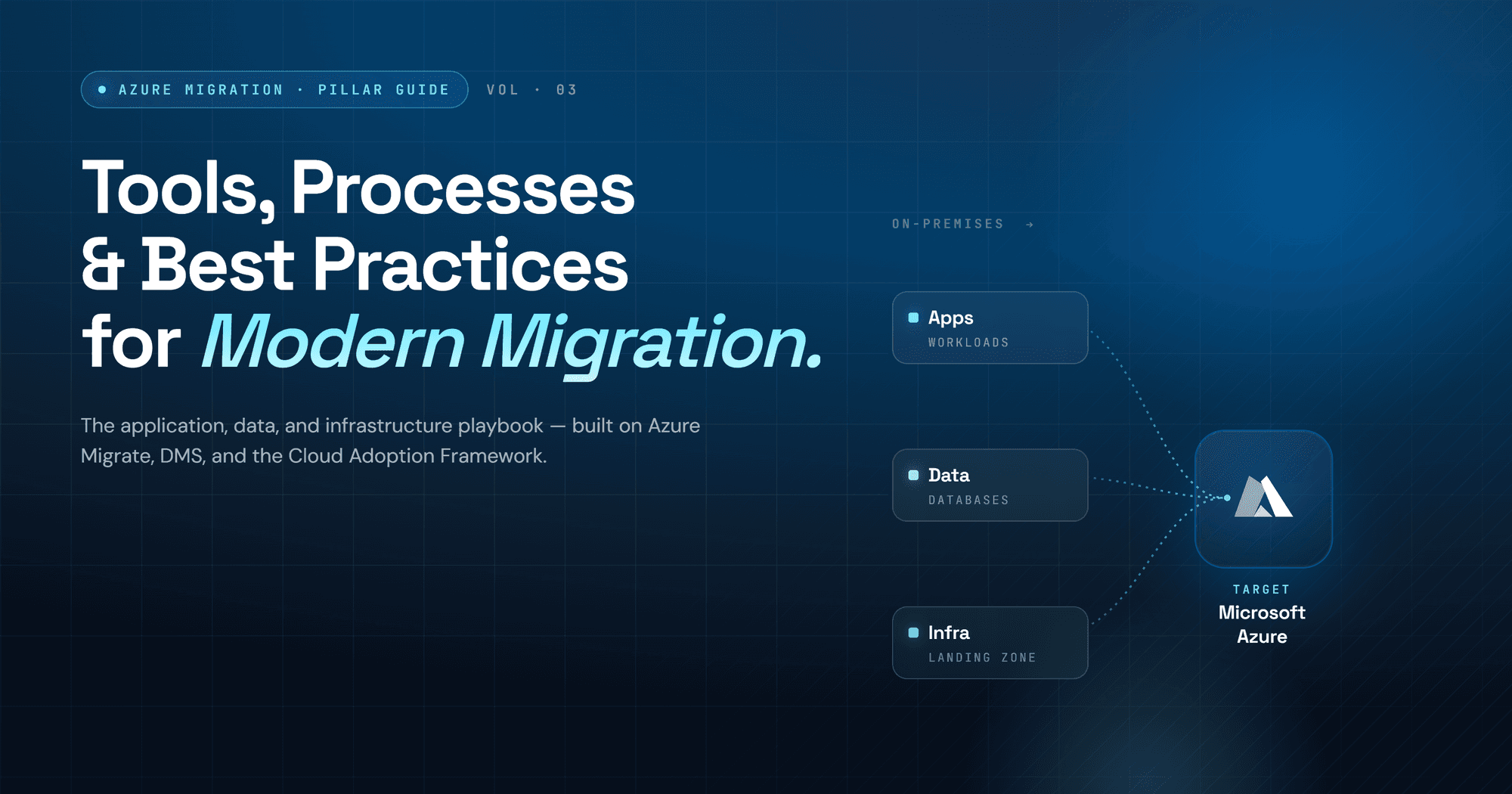
Enterprise Cloud Migration Playbook: Coordinating Applications, Data, and Infrastructure
Enterprise Azure migration playbook: three pillars, five phases, proven risk reduction strategies.
Successfully moving enterprise systems to the cloud demands more than just deploying infrastructure it requires a coordinated, multi-layered approach where application modernization, data platform transitions, and IT infrastructure work in lockstep. Organizations that view migration as a holistic business transformation rather than a series of disconnected technical projects achieve faster adoption, lower operational risk, and sustainable cost management. Microsoft's Azure ecosystem and structured governance models enable enterprises to approach cloud migration with confidence, repeatable processes, and measurable business outcomes.

The Three-Dimensional Migration Framework
Layer 1: Application Modernization and Migration
Application transition begins long before the first VM spins up in Azure. Teams must first develop a clear picture of their current application portfolio through systematic discovery and mapping of interdependencies. This visibility enables informed decisions about the right modernization strategy for each workload: whether to preserve existing architectures through infrastructure lift-and-shift, reimagine applications with containerization and microservices patterns, refactor code for cloud-native design, or replace legacy systems entirely with cloud-first solutions.
Azure's discovery and assessment capabilities help organizations document application characteristics, performance baselines, and business requirements. This intelligence supports rightsizing recommendations and identifies modernization opportunities that can be sequenced alongside initial migrations. Early-mover workloads set the pattern for subsequent waves, so selecting pilot applications thoughtfully—rather than arbitrarily—builds institutional confidence and refines processes before complex systems transition.
Layer 2: Data Platform and Database Migration
Data movement represents one of the highest-risk migration activities because databases are mission-critical, consistency is non-negotiable, and downtime directly impacts business continuity. Successful data migration requires upfront decisions about synchronization methods, acceptable outage windows, and the target Azure data platform that best supports each application's requirements.
Azure Database Migration Service provides managed orchestration for database transitions from on-premises systems to Azure's ecosystem of data platforms. The service handles platform compatibility checks, performance profiling, and low-disruption cutover workflows. For very large datasets or bandwidth-constrained environments, organizations may employ staged migrations, offline transfer methods, or phased synchronization rather than single-sweep cutovers. The critical insight is that data migration planning and application cutover planning are inseparable—validation criteria, synchronization windows, and rollback procedures must all be defined and tested before production transition occurs.

Layer 3: Infrastructure, Operations, and Hybrid Readiness
Cloud infrastructure migration encompasses far more than compute resources: networking design, identity and access management, security controls, operational tooling, and enterprise governance must all be designed and validated before workloads transition. A well-architected landing zone—with appropriate network segmentation, hybrid identity integration, security policies, and monitoring—is the foundation that allows migrated applications to perform reliably.
Organizations often operate in a hybrid state for weeks or months, with some workloads in Azure and others remaining on-premises. This split-environment period demands clear operational ownership, coordinated incident response, and unified visibility across both infrastructure domains. Region selection, backup and disaster recovery design, and connection redundancy between on-premises datacenters and Azure should be finalized before the first production workload transitions.

Cloud Adoption in Detroit and the Midwest
The Detroit metropolitan region has emerged as a hub for manufacturing technology innovation and digital transformation. Organizations across automotive, financial services, and industrial sectors are leveraging Azure migration to modernize legacy systems while maintaining deep integration with local IT operations and compliance requirements. Detroit Regional Chamber of Commerce and Michigan Economic Development Corporation provide resources for enterprises navigating digital transformation incentives. Additionally, Azure Region – East US 2 (located in Virginia) offers nearby data residency for Midwest organizations requiring low-latency connectivity and compliance with regional data governance. Local systems integrators and Microsoft partners in the Detroit area—searchable through Microsoft Partner Finder—can provide hands-on guidance for complex migration programs, particularly in automotive supply chain, manufacturing operations, and financial services verticals where compliance and integration complexity are highest.


The Migration Execution Roadmap
Phase 1: Foundation Building
Successful migration programs begin with deliberate preparation, not rushed execution. This phase includes organizational alignment across business, IT, and application teams; validation that the target landing zone meets security, governance, and operational requirements; clear role definition and skills assessment; and tool preparation. Microsoft guidance emphasizes selecting the target Azure region(s), establishing connection patterns between on-premises and cloud environments, and confirming that the cloud platform can support enterprise governance from day one. This preparation phase is where many programs prevent costly rework later.
Phase 2: Inventory and Readiness Assessment
A comprehensive discovery and assessment activity identifies all workloads, their performance profiles, data dependencies, and technical constraints. This is also where teams estimate cloud costs, evaluate opportunities for architectural modernization, and challenge existing assumptions about migration priority and sequencing. Assessment tools and services provide visibility into the current state while building a business case for cloud investment and documenting the gap between current operations and desired cloud state.
Phase 3: Workload Sequencing and Wave Planning
Migration waves should be planned around business dependencies, risk profiles, and readiness criteria—not around IT infrastructure silos or organizational boundaries. A well-designed wave plan groups workloads logically, defines entry and exit criteria for each wave, establishes cutover windows and rollback triggers, and coordinates communication across business and technical stakeholders. Early waves should include lower-risk pilot applications that help the team validate processes, uncover hidden assumptions, and build confidence before business-critical systems move.
Phase 4: Controlled Migration and Testing Cycles
Migration execution should treat replication, cutover, business validation, and optimization as a single controlled release cycle rather than a series of handoffs. Pilot or initial workloads provide opportunities to stress-test runbooks, validate timing assumptions, confirm communication protocols, and refine processes before large-scale execution. Comprehensive testing—including functionality validation, performance benchmarking, security verification, and disaster recovery drills—should occur before and immediately after cutover.
Phase 5: Post-Migration Optimization and Governance Transition
After cutover, the work intensifies rather than concludes. Performance tuning, cost optimization, security posture hardening, and operational monitoring are essential. Azure's management and governance tools—including Azure Monitor for infrastructure observability, Azure Advisor for optimization recommendations, and Azure Cost Management for expense management—should be operationalized as part of the "business as usual" cloud management model. Governance and security ownership transitions from migration teams to operations and compliance teams.

Guiding Principles for Migration Success
Adopt a phased approach. Pilot workloads validate tooling, build team confidence, and reduce the likelihood of major disruption when mission-critical systems transition. Phased execution also allows learning and continuous improvement throughout the migration program.
Map interdependencies comprehensively. Applications do not exist in isolation. Understanding how servers, databases, and services connect prevents sequencing errors and avoidable outages. Dependency mapping should be performed early and refreshed as applications are rationalized.
Define rollback and synchronization strategies before cutover. Every workload should have a documented rollback path, a definition of "synchronized state," and clear acceptance criteria for verifying successful cutover. These decisions should be made during planning, not during crisis management.
Align cloud infrastructure readiness with application migration timing. Network design, identity integration, security controls, and operational monitoring must be mature before large-scale application migration begins. A robust landing zone is the prerequisite for reliable cloud operations.
Select data transfer methods as architectural decisions, not afterthoughts. Online synchronization, offline bulk transfer, or hybrid approaches should be chosen based on dataset size, network capacity, business tolerance for downtime, and compliance requirements. This decision directly affects migration timeline and risk profile.
Build operational readiness into the migration plan. Backup, disaster recovery, incident response, and security monitoring should be planned and tested during hybrid operations—while workloads are split between on-premises and cloud environments. Operations readiness cannot be deferred to post-cutover.
Prioritize team enablement and organizational change management. Technical tooling is necessary but insufficient. Teams need clarity on architecture decisions, operational ownership, testing responsibilities, security controls, and escalation paths. Organizations that invest in structured training and change management execute migration waves more predictably and sustain cloud operations more effectively long-term.
Common Migration Obstacles and Proven Solutions
| Challenge | Root Cause | Recommended Response |
|---|---|---|
| Arbitrary or ineffective workload sequencing | Prioritization based on IT ownership rather than business dependencies and readiness | Adopt wave planning that considers business criticality, interdependencies, skill readiness, and risk tolerance. Use discovery data to inform sequencing. |
| Database cutover failures and extended downtime | Insufficient planning for synchronization, validation, and rollback; limited visibility into data consistency | Use structured database migration services, define acceptance criteria before cutover, perform extensive cutover testing, and document rollback procedures. |
| Poor visibility into on-premises environment | Lack of systematic discovery; reliance on institutional knowledge rather than tooling | Conduct comprehensive discovery and assessment using enterprise-grade tools. Document performance baselines, dependencies, and readiness gaps. |
| Governance breakdown during hybrid operations | Unclear roles, inconsistent processes, and poor communication across split environments | Establish clear operational governance using frameworks like CAF. Define roles, communication protocols, incident escalation, and rollback triggers. |
| Post-migration performance and cost issues | Migration treated as complete at cutover; insufficient testing and optimization before production | Extend migration activities to include performance validation, cost analysis, right-sizing, and continuous optimization post-cutover. |
| Team capability gaps | Underestimation of skills required for cloud operations; insufficient enablement | Conduct skills assessments early. Provide structured training and mentoring. Consider augmenting teams with vendor expertise for complex migrations. |

Conclusion
Cloud migration success isn't about perfect tools or flawless execution—it's about treating transformation as a business imperative where planning, people, and persistence matter equally. Organizations that coordinate application, data, and infrastructure decisions; build mature landing zones before production migration; and maintain discipline through phased waves and post-migration optimization achieve stable, scalable, cost-effective cloud adoption.
Azure provides powerful, battle-tested tools and frameworks, but the real competitive advantage comes from execution discipline. Your landing zone readiness, wave planning rigor, team enablement, and continuous post-migration optimization determine whether you realize cloud's promised benefits or struggle with performance and cost surprises.

Frequently Asked Questions
1: How do we decide whether to rehost, refactor, or replace each application?
Evaluate business value, technical debt, team capability, and timeline. Rehost for speed, refactor for modernization, and replace when SaaS solutions eliminate custom development and unlock competitive advantage through faster delivery.
2: What's the difference between Azure Migrate and Azure Database Migration Service?
Azure Migrate orchestrates infrastructure and server discovery, assessment, and migration. Azure Database Migration Service specializes in database transitions with minimal downtime. Both are essential for comprehensive enterprise migration programs.
3: How do we minimize downtime during database migration?
Use online migration for continuous synchronization, staged migration for offline bulk transfer plus shortened cutover, or phased migration for batched functional movement. Plan these approaches during assessment, not cutover, and conduct extensive dress rehearsals.
4: What's a landing zone, and why does it matter for migration success?
Landing zones provide pre-configured Azure infrastructure with security, identity integration, governance, monitoring, and operational tooling. Mature landing zones prevent application underperformance and reduce friction during hybrid operations, accelerating migration execution.
5: How do we manage costs after migration, and what should we optimize?
Right-size resources based on actual usage, purchase reservations for predictable workloads, archive infrequent data, optimize network patterns, and enforce governance. Continuous monitoring using Azure Cost Management delivers significant savings throughout the first year post-migration.

Related Posts
Azure Migration Checklist & Cloud Readiness Assessment 2026: The Definitive Guide
Everything You Need for a Seamless Cloud Transition
Why Every Enterprise Is Moving to Azure in 2026: The Ultimate Migration Playbook
Everything organization needs to plan, execute and optimize a successful microsoft azure migration - from assessment to full cloud maturity
Can Azure Managed Services Help with Predictive Maintenance?
From Reactive to Predictive with Azure