

Salesforce
Agentforce in the Enterprise: Strategy, Data, Architecture, and the Road to Autonomous Operations
A practical look at Agentforce, enterprise data, architecture, and governance.
Enterprise technology has always evolved in phases.
Organizations moved from paper-based processes to digital systems. They adopted ERP platforms to standardize operations, CRM platforms to strengthen customer relationships, and cloud technologies to improve agility and scalability. More recently, automation has helped eliminate repetitive work, enabling teams to focus on activities that create greater business value.
Artificial intelligence marks the next phase of this evolution—but not in the way many organizations initially expected.
For several years, the enterprise AI conversation revolved around copilots, assistants, and generative AI capabilities that helped employees work faster. While these technologies continue to deliver value, they largely operate as productivity enhancers. They assist people in making decisions rather than making or executing decisions themselves.
Agentforce introduces a different way of thinking.
Instead of simply responding to prompts or generating recommendations, AI agents are designed to understand business context, execute workflows, collaborate across systems, and complete tasks with increasing levels of autonomy. This represents a shift from AI as a productivity tool to AI as an operational participant.
That distinction has significant implications for enterprise technology strategies.
Deploying AI agents is no longer about adding another application to the technology stack. It requires organizations to rethink how customer data is managed, how enterprise systems communicate, how governance is enforced, and how business processes are designed.
In other words, Agentforce is not just an AI initiative.
It is an enterprise transformation initiative.
Organizations that recognize this shift early are more likely to build AI ecosystems capable of delivering long-term value. Those that focus only on AI capabilities without strengthening the underlying enterprise foundation may struggle to move beyond isolated pilots and disconnected use cases.
The next generation of enterprise competitiveness will not be determined solely by access to advanced AI.
It will be determined by an organization's ability to combine intelligent agents with trusted data, connected systems, and well-governed business operations.
Enterprise AI Is Entering a New Phase
The first wave of enterprise AI focused primarily on augmentation.
AI generated content, summarized documents, answered questions, and accelerated everyday work. Employees remained responsible for interpreting information, making decisions, and executing business processes.
Today, that model is beginning to evolve.
Organizations are exploring AI agents capable of handling more complex responsibilities—from qualifying sales opportunities and resolving customer service requests to orchestrating workflows that span multiple business systems.
This progression reflects a broader shift in enterprise technology.
Businesses are no longer asking:
"How can AI help employees work faster?"
Instead, they are asking:
"Which business processes can AI execute responsibly, consistently, and at scale?"
The distinction is subtle, but it fundamentally changes how organizations should approach AI adoption.
Productivity improvements alone rarely transform an enterprise.
Operational transformation does.
As AI agents become capable of participating in customer engagement, service delivery, and internal operations, enterprise leaders must prepare for an environment where humans and AI increasingly work together as part of the same operational ecosystem.
That future depends less on AI capability and more on enterprise readiness.
Why Agentforce Represents More Than Another AI Platform
Every major technology shift introduces new terminology.
Cloud computing transformed infrastructure.
CRM transformed customer relationship management.
Digital transformation reshaped business operations.
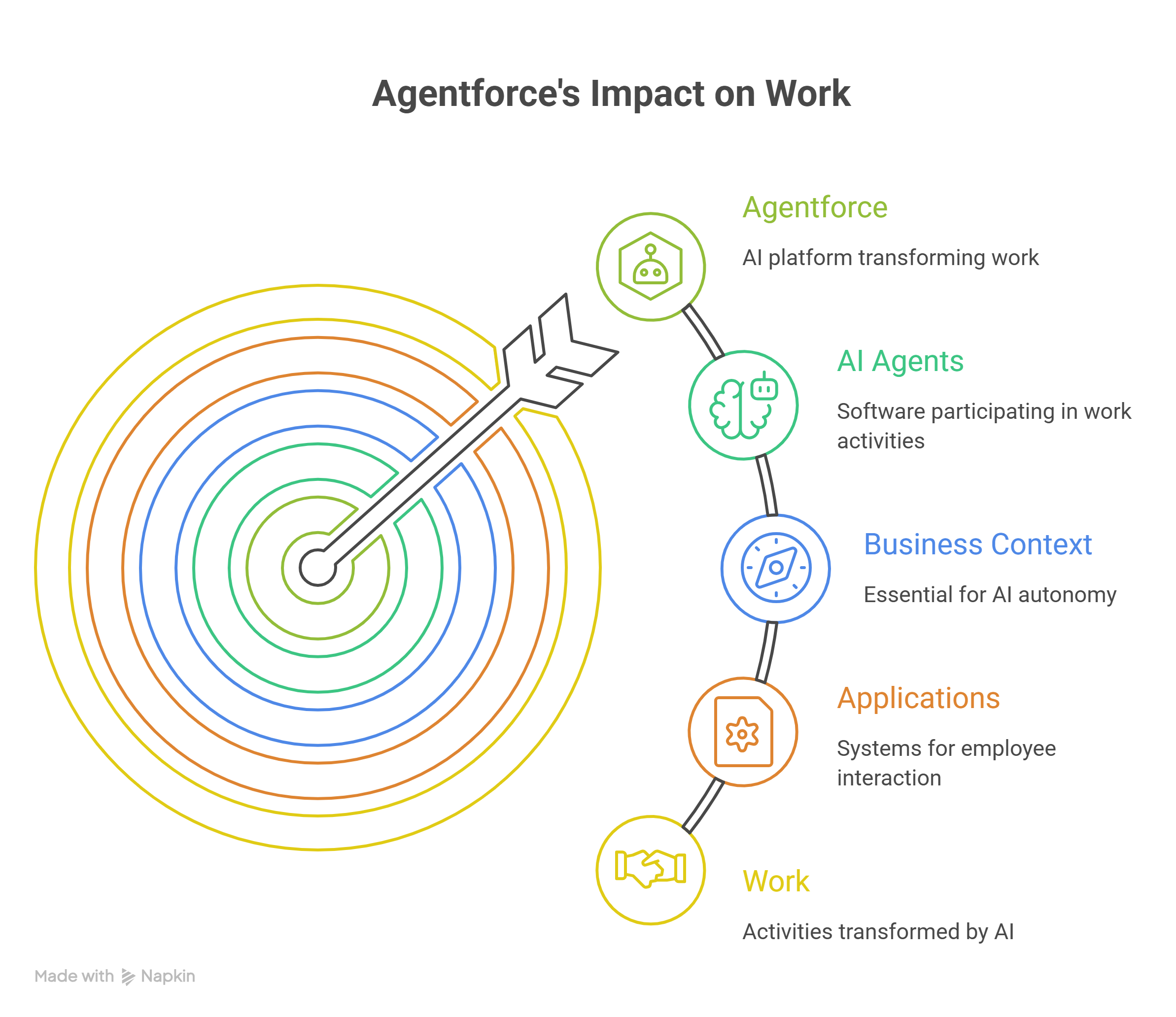
Agentforce represents another shift—not because it introduces artificial intelligence, but because it changes how organizations think about work itself.
Traditional enterprise software is largely transactional.
Employees interact with applications, retrieve information, make decisions, and initiate actions.
Agentforce introduces software capable of participating in those activities.
An AI agent can analyze customer interactions, retrieve relevant information, evaluate business context, trigger workflows, and collaborate with employees to achieve specific business outcomes.
This creates a significant change in operational design.
Instead of building systems solely for people to use, organizations are beginning to build systems that people and AI agents use together.
That evolution affects far more than customer service.
Sales organizations can use AI agents to support opportunity management and account planning.
Service organizations can automate issue resolution while maintaining customer context.
Operations teams can streamline internal workflows across departments.
Marketing teams can coordinate personalized engagement based on unified customer intelligence.
These capabilities are impressive.
But they also expose a fundamental reality.
AI agents require something traditional software applications rarely demanded to the same extent:
Business context.
Without it, autonomy becomes limited.
The Next Competitive Advantage Isn't AI - It's Context
Enterprise AI discussions often focus on models.
Which model performs better?
Which platform generates more accurate responses?
Which AI assistant offers the most advanced capabilities?
These questions are important.
They are not, however, the questions that will determine long-term competitive advantage.
Context will.
Business decisions are rarely made using isolated pieces of information.
A customer support representative resolving a service issue does not rely only on the customer's latest message.
They consider purchase history, previous interactions, contractual obligations, product ownership, service-level agreements, billing information, and ongoing business relationships.
That accumulated knowledge creates context.
AI agents require access to the same context if they are expected to make meaningful decisions.
This is where many enterprise AI strategies encounter friction.
Organizations often invest heavily in AI capabilities while underestimating the complexity of the enterprise environments those AI agents must operate within.
Customer information exists across CRM platforms.
Financial data resides within ERP systems.
Operational data is managed through supply chain applications.
Marketing engagement lives within separate platforms.
Knowledge articles, partner information, contracts, and support records are distributed across additional systems.
Each application contributes a piece of the business story.
Few provide the complete picture.
Without connected context, AI agents risk making decisions based on incomplete information.
The issue is rarely intelligence.
The issue is visibility.
Data Has Become Operational Infrastructure
Historically, enterprise data was treated primarily as an analytical asset.
Organizations collected information, stored it within warehouses, and generated reports to support decision-making.
While this model remains valuable, autonomous AI introduces new expectations.
Data must now support decisions as they happen.
An AI agent responding to a customer inquiry cannot depend on information refreshed overnight.
A sales agent recommending the next best action cannot operate using outdated opportunity data.
A service agent coordinating field operations cannot rely on disconnected operational systems.
Enterprise data is no longer serving reporting alone.
It is becoming operational infrastructure.
This shift requires organizations to reconsider how customer information, business processes, and enterprise systems interact.
Simply integrating applications is no longer sufficient.
Organizations must create environments where trusted information flows continuously across business functions, allowing AI agents to operate with current, consistent, and contextual intelligence.
The enterprises that succeed with Agentforce are unlikely to be those deploying the largest number of AI agents.
They will be the organizations that have invested in making enterprise data accessible, connected, and actionable.
Why Data Readiness Has Become a Strategic Priority
Many organizations still associate data readiness with migration projects, governance initiatives, or data quality programs.
While these efforts remain important, the rise of autonomous AI significantly expands their strategic value.
Data readiness is no longer a supporting IT initiative.
It is becoming a business capability.
For Agentforce to operate effectively, organizations must answer several critical questions.
Can AI agents access trusted customer information regardless of where it resides?
Are business definitions consistent across systems?
Can operational data be consumed in real time rather than through delayed reporting cycles?
Can enterprise policies govern how AI agents access and use business information?
Perhaps most importantly, can data provide sufficient business context for AI agents to make responsible decisions?
These questions move the discussion beyond technology implementation.
They position data as the foundation upon which enterprise AI strategies are built.
Yet data readiness extends far beyond cleansing records or removing duplicate customer profiles.
It requires organizations to rethink the relationship between data architecture, business processes, and enterprise decision-making.
That relationship becomes even more significant as AI agents begin operating across multiple business systems rather than within individual applications.
.png)
Why Enterprise Architecture Is Now an AI Conversation
For years, enterprise architecture has focused on connecting applications, modernizing infrastructure, and improving operational efficiency. Integration projects were often driven by business requirements such as improving reporting, reducing manual effort, or creating a more consistent customer experience.
Agentforce changes the purpose of enterprise architecture.
Instead of simply enabling data exchange between systems, architecture must now enable AI agents to understand business context, execute workflows, and collaborate across multiple applications.
This is a fundamental shift.
A traditional workflow may move information from one system to another based on predefined rules. An AI agent, however, must interpret information, determine the appropriate course of action, and initiate the next step based on business policies and customer context.
That level of autonomy requires more than connected applications. It requires connected intelligence.
Consider a global manufacturer using Salesforce for customer relationship management, SAP for enterprise resource planning, Service Cloud for customer support, and separate platforms for inventory management and logistics.
When a customer requests an update on a delayed order, the answer is rarely found in a single application.
An effective response may require order status from SAP, shipment information from logistics systems, customer history from Salesforce, active service cases from Service Cloud, and contractual commitments stored elsewhere.
For an employee, navigating these systems is time-consuming.
For an AI agent, fragmented information limits the ability to deliver accurate and timely outcomes.
Organizations that approach Agentforce as an architectural capability rather than an isolated AI initiative are better positioned to scale autonomous operations across the enterprise.
Why Data Cloud Is Becoming the Foundation for Enterprise AI
As organizations begin preparing for AI-driven operations, many discover that integration alone is not enough.
Moving data between systems does not automatically create meaningful business context.
AI agents require a unified understanding of customers, products, interactions, and operational events that continuously reflects what is happening across the enterprise.
This is where Salesforce Data Cloud plays an increasingly strategic role.
Rather than functioning as another data repository, Data Cloud helps unify customer and operational information from multiple enterprise systems into a consistent and continuously updated view.
For Agentforce, this provides several important advantages.
First, AI agents gain access to richer business context. Instead of relying on isolated records, they can interpret customer interactions based on historical engagement, purchase behavior, service history, and operational data.
Second, decision-making becomes more reliable. When AI operates using trusted and current information, recommendations and actions become more relevant to both customers and employees.
Third, organizations can deliver more consistent experiences across sales, service, marketing, and commerce because every interaction is informed by the same customer context.
The relationship between Agentforce and Data Cloud is therefore not simply technical.
It is strategic.
One provides autonomous capabilities.
The other provides the trusted enterprise context required for those capabilities to operate effectively.
Governance Will Define Successful AI Adoption
Every major technology shift introduces new governance challenges.
Cloud computing required new security models.
Remote work demanded stronger identity management.
Enterprise AI introduces a different set of questions.
How should AI agents access enterprise information?
Which decisions should remain human-led?
How are AI-generated actions monitored?
How can organizations ensure transparency and accountability?
These questions are becoming increasingly important as AI moves beyond content generation and into operational execution.
Governance should not be viewed as a constraint on innovation.
It should be viewed as an enabler of responsible scale.
Organizations that establish clear governance frameworks early are more likely to accelerate AI adoption because employees, customers, and leadership teams have greater confidence in how AI is being used.
Effective governance extends beyond security.
It includes data ownership, access controls, compliance policies, auditability, human oversight, and clearly defined operational boundaries.
As enterprises adopt Agentforce, governance becomes an essential component of business transformation rather than an afterthought.
Enterprise AI Looks Different Across Industries
Although the principles of Agentforce remain consistent, the business context differs significantly across industries.
Logistics
A logistics provider manages thousands of shipments, customer inquiries, and operational updates every day.
Customer information may reside in Salesforce, shipment details in transportation management systems, and inventory data in ERP platforms.
An AI agent responding to a delayed shipment request must understand the complete operational picture before recommending the next action.
Without connected enterprise data, the response is limited.
With unified context, the same AI agent can proactively identify delays, notify customers, coordinate internal teams, and recommend alternative delivery options.
Healthcare
Healthcare organizations manage patient interactions across clinical, administrative, and operational systems.
An AI agent supporting patient engagement must consider appointment history, care plans, communication preferences, and organizational policies while protecting sensitive information.
Here, governance and trusted data become just as important as AI capability.
Financial Services
Banks and financial institutions operate in highly regulated environments where customer trust and compliance are non-negotiable.
AI agents may assist relationship managers, automate service requests, or streamline onboarding processes, but every interaction must adhere to regulatory requirements and organizational policies.
In each of these industries, success depends less on AI sophistication and more on enterprise readiness.
Preparing the Enterprise for Autonomous Operations
Organizations often ask whether they are ready for Agentforce.
The better question is whether they are ready for autonomous operations.
Technology is only one part of that equation.
Enterprise readiness requires alignment across strategy, data, architecture, governance, and business processes.
Before expanding AI initiatives, leadership teams should evaluate several critical areas.
Business Strategy
Is there a clear understanding of where AI agents create measurable value?
Data Readiness
Can AI access trusted, consistent, and contextual information across the enterprise?
Architecture
Are systems connected in a way that supports real-time collaboration between applications and AI agents?
Governance
Are policies in place to ensure transparency, security, compliance, and accountability?
Operational Processes
Have workflows been standardized sufficiently for AI agents to execute them reliably?
Organizations that approach these questions systematically are more likely to transition from isolated AI experiments to enterprise-wide transformation.
The Future of Enterprise Operations
Enterprise software has evolved from recording business activity to supporting business decisions.
The next stage of that evolution is software capable of participating in business execution.
That does not mean AI will replace employees.
Rather, it changes how work is distributed across organizations.
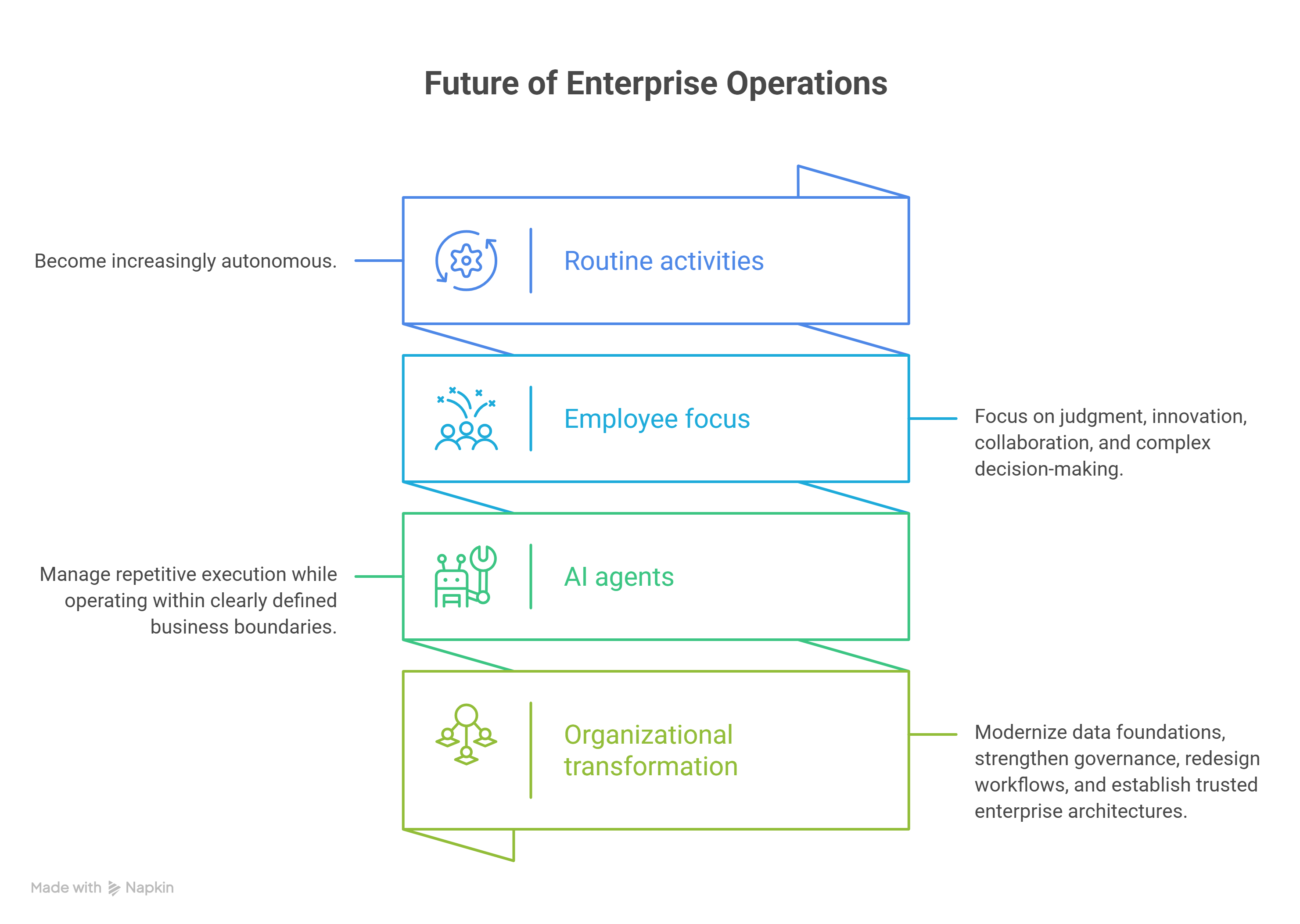
Routine activities become increasingly autonomous.
Employees focus on judgment, innovation, collaboration, and complex decision-making.
AI agents manage repetitive execution while operating within clearly defined business boundaries.
This transformation will not occur overnight.
It will happen incrementally as organizations modernize data foundations, strengthen governance, redesign workflows, and establish trusted enterprise architectures.
The organizations that begin preparing today will be better positioned to adapt as autonomous operations become a defining characteristic of modern enterprises.
Final Thoughts
Much of the current conversation around Agentforce focuses on what AI agents can do.
That is an important discussion, but it is not the one enterprise leaders should start with.
The more important questions are foundational.
Is enterprise data connected?
Can AI access trusted business context?
Are systems designed to support autonomous decision-making?
Do governance frameworks enable responsible AI adoption?
These questions determine whether AI initiatives remain isolated demonstrations or evolve into enterprise capabilities that create measurable business value.
Agentforce should therefore be viewed as more than another Salesforce innovation.
It represents a broader shift in how organizations think about work, decision-making, and operational execution.
The journey toward autonomous operations will not be defined by the number of AI agents an organization deploys.
It will be defined by the quality of the enterprise foundation that supports them.
Businesses that invest in connected data, modern architecture, responsible governance, and contextual intelligence today will be the ones best positioned to realize the full potential of Agentforce tomorrow.
Where Should Enterprise Leaders Start?
The move toward autonomous operations does not begin with deploying an AI agent. It begins with understanding the systems, data, and processes that already support the business.
For organizations exploring what this shift could mean for their own environment, the next useful step is to look closely at data readiness—particularly how customer information is connected, governed, and made available across the enterprise.
Continue reading: https://www.infoservices.com/blogs/agentforce-data-foundation-enterprise-ai