

Salesforce
Why Data Readiness Is the Missing Layer in Most Agentforce Strategies
The hidden key to successful Agentforce adoption
Many organizations are racing to deploy AI agents through Agentforce. Yet the biggest obstacle to success is rarely the AI itself—it's the strength of the data foundation that powers it.
Organizations are moving quickly to evaluate Agentforce as they look to automate customer interactions, accelerate service operations, and unlock new levels of workforce productivity.
Yet beneath the excitement surrounding enterprise AI agents lies a less visible challenge.
Many organizations are preparing their AI strategy while overlooking the data architecture required to support it.
The assumption is understandable. If Agentforce represents the intelligence layer, then deploying the technology should be the primary focus.
In reality, the opposite is often true.
For most enterprises, the success of Agentforce will be determined long before the first AI agent is deployed. It will be determined by the organization's ability to unify customer data, connect operational systems, establish governance models, and provide trusted business context at scale.
The next phase of enterprise AI will not be defined by who has access to Agentforce.
It will be defined by who is ready for it.
The Enterprise AI Conversation Is Missing a Critical Layer
Much of the discussion around Agentforce centers on capabilities.
Can AI agents resolve customer inquiries?
Can they support sales teams?
Can they automate workflows?
Can they execute tasks across business functions?
The answer is increasingly yes.
However, these conversations often focus on what AI agents can do while overlooking what they need to operate effectively.
An AI agent is only as capable as the context available to it.
To provide meaningful outcomes, an agent must understand customer history, business rules, operational processes, account relationships, service interactions, transactional records, and organizational policies.
That context lives in data.
And for most enterprises, that data is fragmented across multiple systems.
This is where many Agentforce initiatives encounter their first challenge.
The technology may be ready, but the data environment often is not.
Why Agentforce Changes Enterprise Data Requirements
One of the biggest misconceptions surrounding enterprise AI is that agents can operate effectively within the same data environment that supports traditional CRM workflows.
Agentforce changes that assumption.
Traditional CRM users consume information and make decisions. Agentforce agents are increasingly expected to participate in decision-making, trigger workflows, and execute actions across business processes.
This shift significantly increases the importance of contextual data.
Consider a customer service interaction.
A support representative can often compensate for fragmented information by manually navigating multiple systems, validating records, and applying business judgment.
An AI agent does not have that luxury.
To resolve an issue effectively, it may need access to:
- Customer profile information
- Purchase history
- Contract details
- Service records
- Order status
- Product information
- Loyalty data
- External operational systems
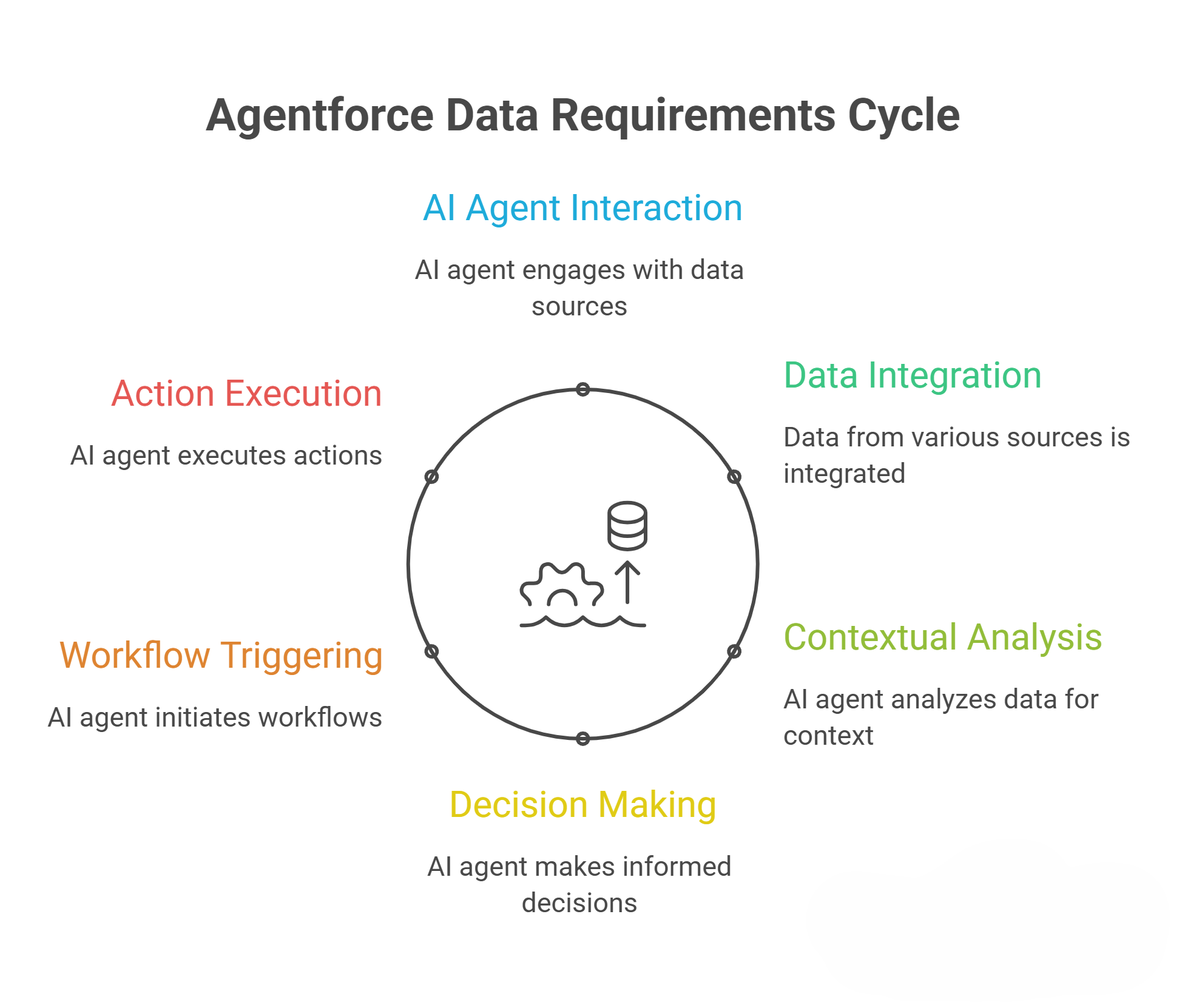
If that information is incomplete or inconsistent, the quality of the outcome deteriorates rapidly.
As organizations move from AI-assisted work toward AI-driven execution, data maturity becomes a strategic differentiator rather than a technical consideration.
The Enterprise Data Reality
Most organizations do not operate within a single technology environment.
Customer information is distributed across:
- CRM platforms
- ERP systems
- Customer service applications
- Marketing automation platforms
- Data warehouses
- Legacy applications
- Industry-specific solutions
- Partner ecosystems
Over time, these environments evolve independently.
Data definitions change.
Customer records become duplicated.
Processes diverge across departments.
Information becomes isolated within business units.
This fragmentation may be manageable for traditional business applications.
For AI agents, however, it creates a significant challenge.
Agentforce depends on context to make decisions, execute workflows, and deliver personalized interactions.
When that context is fragmented, autonomy becomes difficult to achieve.
Organizations often assume AI can compensate for disconnected systems.
In practice, AI exposes those weaknesses faster than any previous technology initiative.
Why Enterprise Architecture Has Become an Agentforce Conversation
Many Agentforce discussions focus on user experience.
Few focus on architecture.
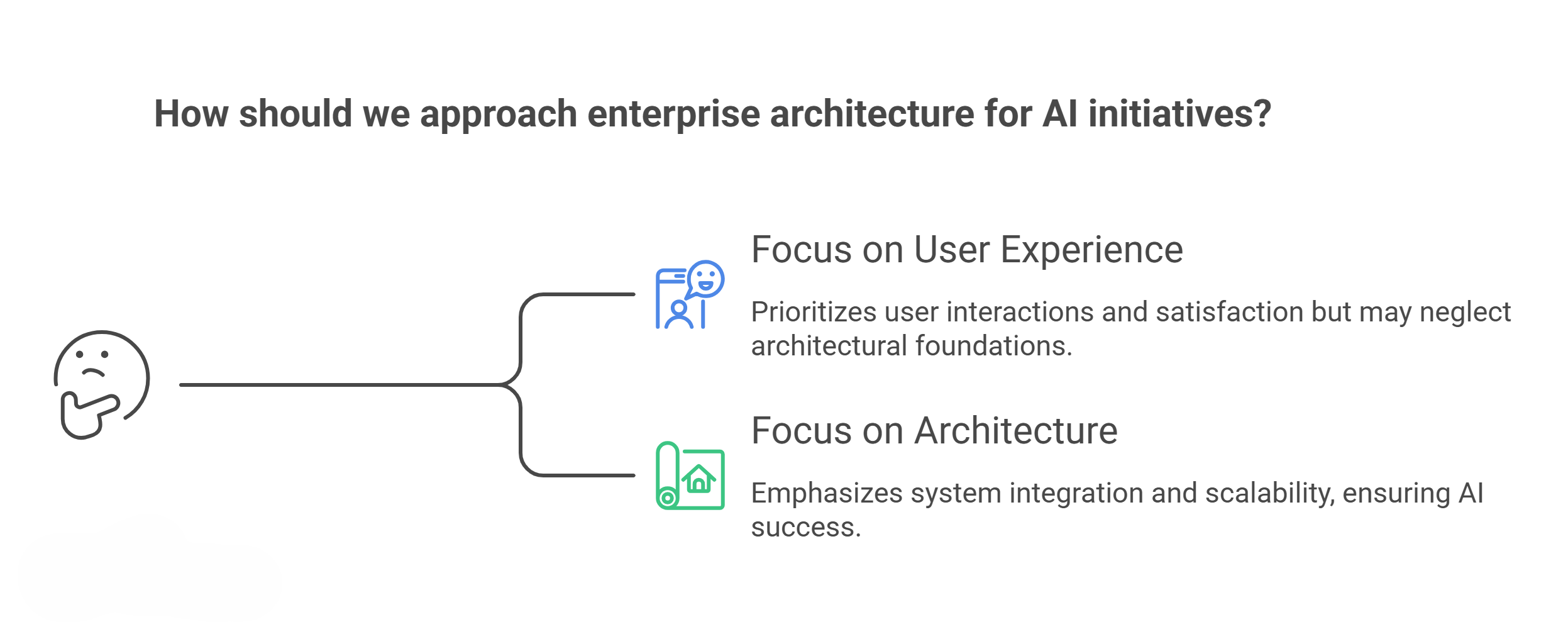
Yet architecture is often where the success or failure of enterprise AI initiatives is determined.
A typical enterprise environment may include:
- Salesforce CRM
- SAP ERP
- Service Cloud
- Marketing Cloud
- Data warehouses
- Supply chain systems
- Industry-specific applications
- External partner platforms
Each environment contains valuable business context.
Customer interactions may exist within Salesforce.
Order information may reside within ERP systems.
Product availability may originate from supply chain platforms.
Support history may be stored within Service Cloud.
When these systems operate independently, AI agents receive fragmented views of customers and operations.
The result is not simply inaccurate recommendations.
It is limited autonomy.
Organizations that approach Agentforce as an architecture initiative rather than a standalone AI deployment are better positioned to scale AI capabilities across business functions.
The conversation is no longer about connecting systems for reporting purposes.
It is about creating a connected enterprise capable of supporting intelligent, autonomous decision-making.
A Strong Data Foundation Is More Than Data Quality
When discussing AI readiness, organizations often focus on data quality.
While quality remains important, readiness extends far beyond data cleansing initiatives.
An AI-ready data environment consists of several interconnected capabilities.
Unified Customer Context
AI agents require a consolidated understanding of customers across touchpoints.
Without unified profiles, agents operate with incomplete information.
Organizations must move beyond isolated records and establish connected customer views that span sales, service, marketing, commerce, and operations.
Real-Time Accessibility
AI agents operate within moments, not reporting cycles.
An agent responding to a customer inquiry cannot depend on information that is several days old.
Real-time access to operational data becomes increasingly important as organizations adopt autonomous workflows.
Consistent Business Definitions
Different systems frequently define business concepts differently.
Customer status, account ownership, revenue calculations, and service categories may vary across platforms.
These inconsistencies create confusion for both employees and AI agents.
Consistency becomes essential for trusted decision-making.
Governance and Trust
AI agents must operate within organizational boundaries.
Data ownership, security controls, compliance policies, auditability, and accountability frameworks become foundational requirements.
Without governance, autonomous operations introduce unnecessary risk.
Cross-System Connectivity
The most valuable Agentforce use cases rarely exist within a single application.
Organizations must create connected ecosystems that enable agents to access information and execute actions across systems.
Disconnected environments inevitably produce disconnected intelligence.
Why Salesforce Data Cloud Is Emerging as the Operational Foundation for Agentforce
As organizations evaluate Agentforce adoption, many are discovering that traditional integration approaches are not enough.
AI agents require more than access to information.
They require context.
This is where platforms such as Salesforce Data Cloud can help organizations create a unified and continuously updated view of customer and operational data. Rather than relying solely on traditional integrations, these platforms bring together data from multiple systems into a connected, real-time foundation that AI agents can trust. This allows Agentforce to access the context it needs to deliver accurate recommendations, automate workflows, and execute business processes more effectively.
For Agentforce, this creates several advantages:
- Unified customer profiles
- Real-time accessibility
- Reduced data fragmentation
- Improved personalization
- Better decision quality
- Enhanced operational visibility
The relationship between Agentforce and Data Cloud is therefore strategic rather than optional, providing a connected enterprise data foundation for AI.
Organizations pursuing autonomous business operations without addressing customer data unification may find themselves constrained by the quality of the information available to their AI agents.
Simply put, Agentforce becomes significantly more powerful when it operates on top of connected enterprise data.
A Logistics Example: Where Agentforce Meets Operational Complexity
Consider a logistics organization managing thousands of customer interactions each day.
Shipment information resides within ERP systems.
Customer engagement history exists within Salesforce.
Support interactions are managed through Service Cloud.
Partner updates originate from external transportation platforms.
A customer contacts support requesting an update on a delayed shipment.
To provide a meaningful response, an AI agent must understand:
- Shipment status
- Customer history
- Service commitments
- Previous support interactions
- Partner updates
- Delivery timelines
If those systems remain disconnected, the agent can only provide partial information.
The interaction becomes another escalation point requiring human intervention.
However, when enterprise data is unified and accessible, the same AI agent can understand the complete context, identify root causes, recommend next actions, and proactively resolve concerns.
The difference is not the sophistication of the AI.
The difference is the maturity of the underlying data environment.
The Hidden Cost of Weak Data Foundations
Organizations frequently measure AI initiatives through the lens of technology investments.
The more significant costs often emerge elsewhere.
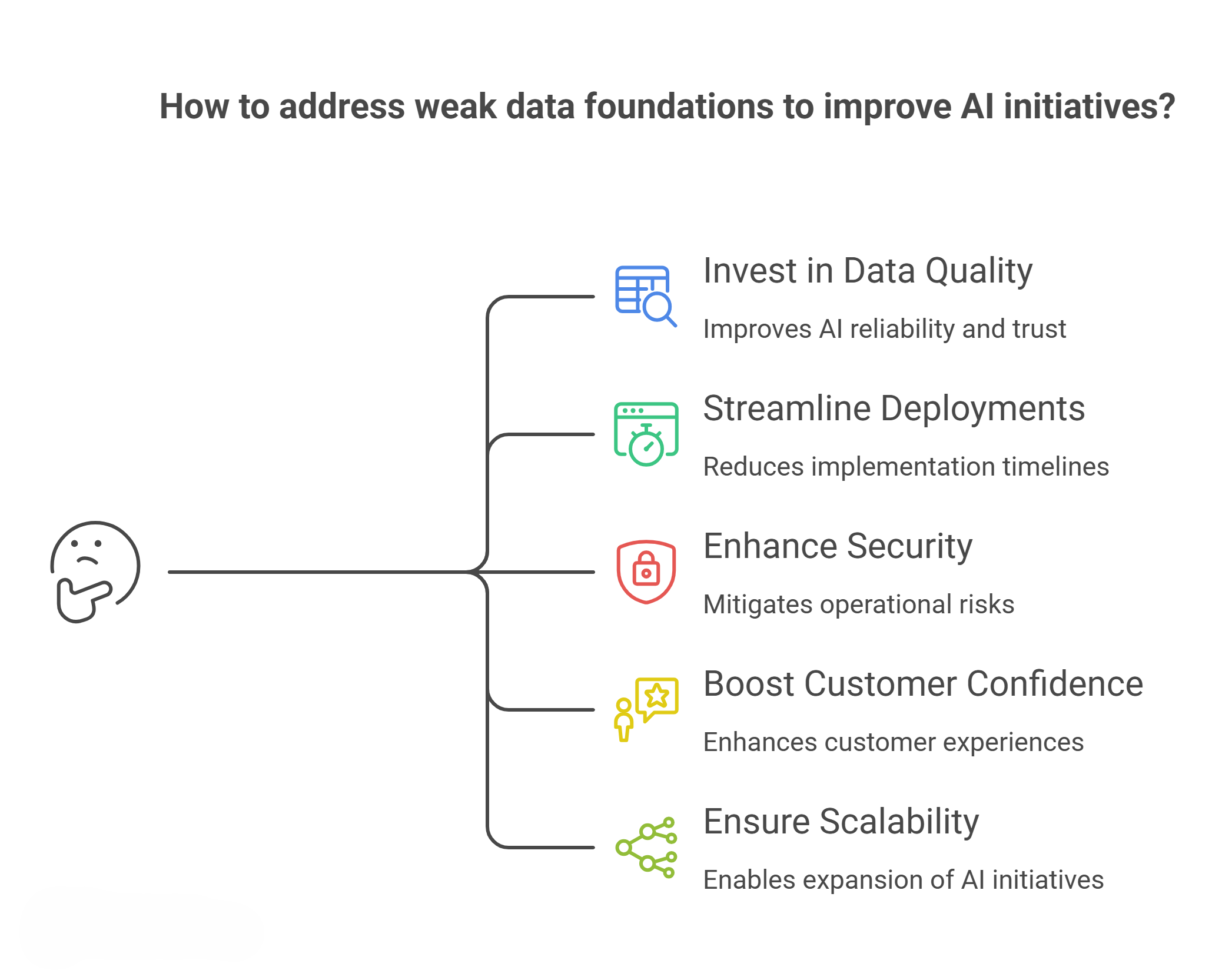
Slower Deployments
Implementation timelines extend as teams spend months addressing data issues that should have been resolved earlier.
Lower Trust
Employees become hesitant to rely on AI-generated recommendations when outputs appear inconsistent.
Increased Operational Risk
Security, compliance, and governance concerns become more difficult to manage when data environments lack clear ownership and controls.
Reduced Customer Confidence
Incorrect recommendations and incomplete responses negatively impact customer experiences.
Limited Scalability
Organizations struggle to expand AI initiatives beyond pilot programs because foundational challenges remain unresolved.
In many cases, the greatest barrier to scaling Agentforce is not technology.
It is the strength of the enterprise data foundation.
Five Questions Every Leadership Team Should Answer Before Deploying Agentforce
Before scaling Agentforce initiatives, organizations should evaluate their enterprise data maturity across five critical areas.
1. Do We Have a Unified Customer View?
AI agents rely on a complete understanding of each customer. Organizations should ensure customer information is unified across sales, service, marketing, and operational systems rather than existing in isolated silos.
2. Can AI Agents Access Trusted Real-Time Information?
Real-time access to accurate business data enables AI agents to make informed decisions. Relying on outdated or incomplete information can lead to incorrect recommendations and poor customer experiences.
3. Are Core Business Systems Connected?
AI delivers the greatest value when it can access information across CRM, ERP, service, and operational platforms. Connected systems allow agents to execute end-to-end business processes rather than isolated tasks.
4. Do Governance Policies Support Autonomous Operations?
Organizations should establish strong governance, security, compliance, and auditability before allowing AI agents to operate autonomously. These controls help build trust while reducing operational risk.
5. Have We Identified High-Value Processes for Agent Execution?
Not every business process should be automated immediately. Organizations should prioritize use cases where AI agents can deliver measurable improvements in efficiency, customer experience, or productivity.
Agentforce Is Ultimately a Data Strategy Conversation
The market often treats Agentforce as an AI conversation.
Increasingly, it is becoming a data conversation.
Organizations that view Agentforce purely as a technology deployment may achieve isolated successes.
Organizations that view Agentforce as part of a broader data modernization strategy will be better positioned to scale autonomous operations across the enterprise.
The distinction matters.
One approach focuses on deploying AI.
The other focuses on enabling business transformation.
Conclusion
The conversation around Agentforce often begins with what AI agents can do.
Enterprise leaders should begin elsewhere.
They should begin with the data, architecture, governance, and operational foundations that enable AI agents to perform effectively.
Because the next generation of competitive advantage will not come from deploying more AI.
It will come from deploying AI on top of data environments capable of supporting autonomous decision-making at scale.
Agentforce has the potential to reshape customer engagement, service operations, sales productivity, and business execution.
However, the organizations that realize that potential will not necessarily be the first to deploy AI agents.
They will be the ones that invested in enterprise data maturity first.
In the years ahead, Agentforce will not simply be another technology initiative.
It will become a reflection of an organization's overall digital maturity.
And that maturity starts with enterprise data maturity.