

Databricks
Data Platform Modernization Delays: 5 Risks for Modern Enterprises
Delaying data platform modernization increases operational costs, security risks, inefficiencies, and limits scalability, analytics performance, and AI-driven innovation
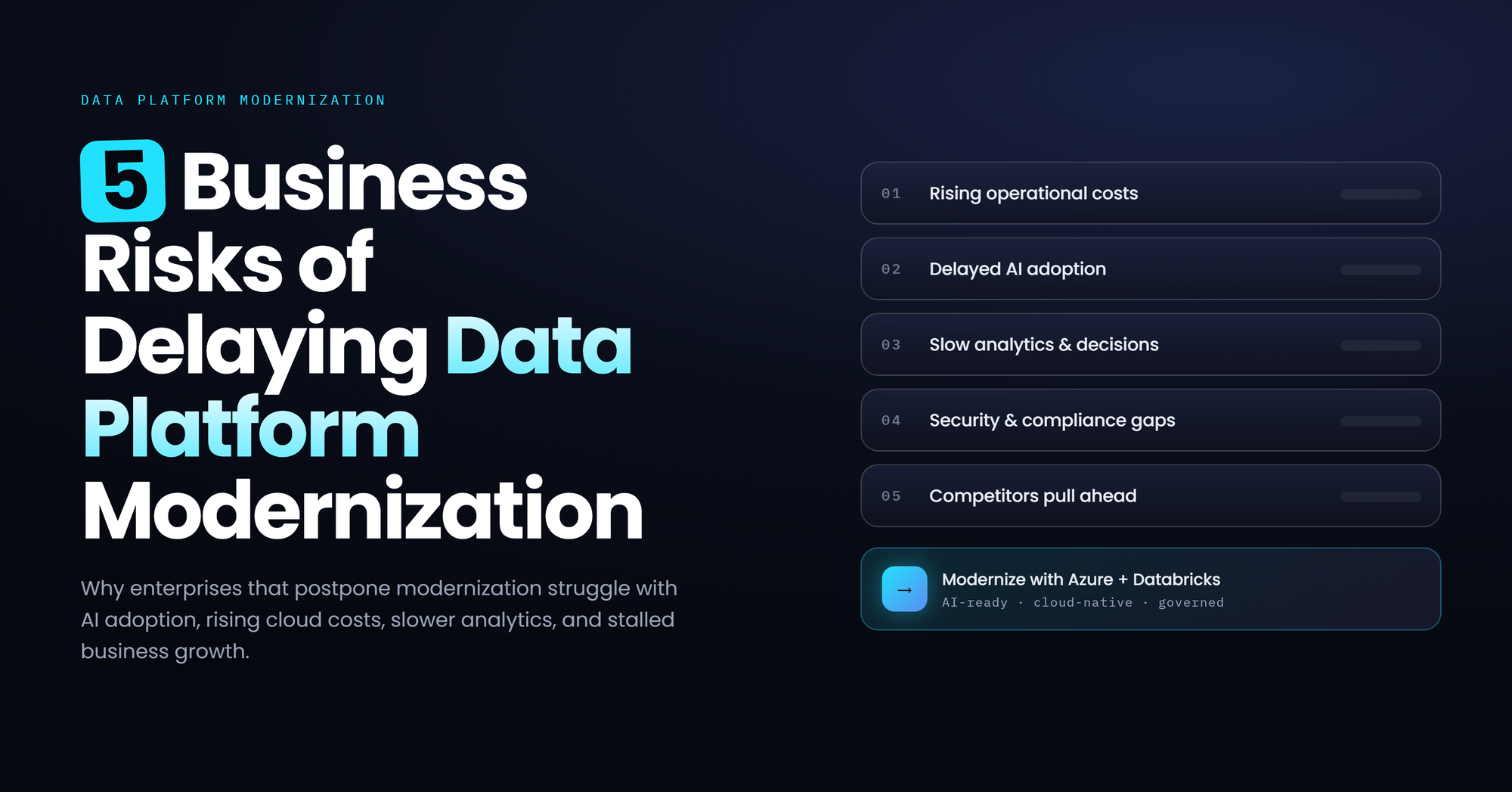
Modern enterprises are generating more data than ever before. Yet many organizations across the United States still rely on fragmented legacy systems, outdated data warehouses, siloed analytics environments, and aging ETL pipelines that were never designed for modern AI-driven business operations.
As customer expectations, AI adoption, and real-time analytics demands accelerate, delaying data platform modernization is no longer just a technology issue — it has become a major business risk.
Organizations that continue operating on legacy data infrastructure often experience:
- rising operational costs
- slower reporting cycles
- poor data visibility
- compliance risks
- failed AI initiatives
- limited scalability
- delayed decision-making
This is why enterprises are increasingly investing in modern cloud-native platforms like Databricks and Microsoft Azure to build scalable, AI-ready data ecosystems.
If your organization is still evaluating modernization, this article explores the five biggest business risks of delaying data platform modernization — and how modern lakehouse architectures help enterprises stay competitive.
Why Data Platform Modernization Matters in 2026
Data is now the foundation of:
- AI and machine learning
- business intelligence
- predictive analytics
- automation
- customer personalization
- operational efficiency
However, legacy data architectures create barriers between systems, teams, and insights.
Traditional environments often include:
- disconnected databases
- expensive on-premises infrastructure
- rigid ETL pipelines
- duplicate analytics tools
- inconsistent governance models
As a result, enterprises struggle to:
- scale AI initiatives
- enable real-time reporting
- optimize cloud spending
- unify enterprise data
Modernization solves these challenges by enabling:
- centralized governance
- real-time analytics
- scalable AI workloads
- cloud-native processing
- unified data engineering and analytics
Businesses modernizing with lakehouse architecture gain significant advantages in agility, cost optimization, and AI readiness.
Risk #1: Legacy Systems Increase Operational Costs
One of the biggest hidden risks of delaying modernization is escalating infrastructure and maintenance costs.
Many enterprises still operate:
- legacy Hadoop clusters
- expensive enterprise data warehouses
- duplicate analytics systems
- complex ETL orchestration layers
These environments require:
- continuous maintenance
- specialized support teams
- hardware upgrades
- licensing renewals
- redundant storage
Over time, operational overhead becomes significantly more expensive than cloud-native modernization.

Common Cost Challenges
High Infrastructure Expenses
On-premises systems require physical hardware maintenance, power, storage expansion, and backup management.
Inefficient Resource Usage
Legacy environments often lack auto-scaling capabilities, leading to underutilized resources and wasted spend.
Multiple Tool Dependencies
Enterprises frequently manage separate platforms for:
- data engineering
- warehousing
- governance
- analytics
- machine learning
This fragmentation increases licensing and integration costs.
How Modern Lakehouse Platforms Reduce Costs
Modern platforms like Databricks unify:
- analytics
- engineering
- governance
- AI workloads
under a single architecture.
This reduces:
- infrastructure duplication
- ETL complexity
- operational overhead
- storage redundancy
According to Microsoft Azure Architecture Center, cloud-native data architectures improve scalability and operational efficiency while reducing long-term infrastructure management burdens.
Risk #1: Legacy Systems Increase Operational Costs
One of the biggest hidden risks of delaying modernization is escalating infrastructure and maintenance costs.
Many enterprises still operate:
- legacy Hadoop clusters
- expensive enterprise data warehouses
- duplicate analytics systems
- complex ETL orchestration layers
These environments require:
- continuous maintenance
- specialized support teams
- hardware upgrades
- licensing renewals
- redundant storage
Over time, operational overhead becomes significantly more expensive than cloud-native modernization.
Common Cost Challenges
High Infrastructure Expenses
On-premises systems require physical hardware maintenance, power, storage expansion, and backup management.
Inefficient Resource Usage
Legacy environments often lack auto-scaling capabilities, leading to underutilized resources and wasted spend.
Multiple Tool Dependencies
Enterprises frequently manage separate platforms for:
- data engineering
- warehousing
- governance
- analytics
- machine learning
This fragmentation increases licensing and integration costs.
Risk #2: Delayed AI Adoption and Innovation
AI initiatives depend heavily on clean, governed, accessible data.
Unfortunately, many enterprises attempt to implement generative AI and advanced analytics on fragmented legacy systems that cannot support modern AI workloads.
This creates:
- inconsistent model outputs
- poor data quality
- slow processing
- governance gaps
- failed AI deployments
Why AI Projects Fail on Legacy Platforms
Siloed Data Sources
AI systems require unified enterprise data. Legacy environments store information across disconnected systems.
Slow Processing Pipelines
Real-time AI applications require scalable compute and streaming capabilities.
Poor Governance
Without centralized governance, organizations face compliance and security risks.
Inability to Scale
AI workloads demand elastic infrastructure that legacy systems cannot efficiently provide.
Modernization Enables AI Readiness
Modern lakehouse platforms support:
- real-time analytics
- AI model training
- unified governance
- scalable compute
- vector search integration
- RAG architectures
This becomes critical for enterprises adopting:
- generative AI
- predictive analytics
- intelligent automation
- customer personalization
Organizations exploring AI-driven modernization should also read:
Risk #3: Poor Decision-Making Due to Slow Analytics
Modern business decisions depend on real-time insights.
Legacy systems often produce:
- delayed reporting
- inconsistent dashboards
- duplicate data
- inaccurate forecasting
When leadership teams lack timely insights, businesses struggle to:
- respond to market changes
- optimize operations
- improve customer experience
- reduce risk exposure
Common Analytics Bottlenecks
Batch-Driven Architectures
Many legacy environments process data only at scheduled intervals.
Data Duplication
Different teams maintain separate datasets, creating inconsistencies.
Limited Scalability
As data volumes increase, reporting performance degrades.
Complex ETL Dependencies
Data pipelines become difficult to maintain and troubleshoot.
Modern Data Platforms Enable Real-Time Intelligence
Cloud-native lakehouse environments help enterprises:
- process streaming data
- centralize analytics
- reduce query latency
- improve dashboard accuracy
- accelerate reporting
Modernization improves agility across:
- finance
- healthcare
- retail
- manufacturing
- logistics
Risk #4: Increased Security and Compliance Risks
Data governance and compliance requirements continue growing across industries in the United States.
Legacy platforms often lack:
- centralized governance
- fine-grained access controls
- automated auditing
- modern security frameworks
This increases exposure to:
- data breaches
- compliance violations
- governance failures
Governance Challenges in Legacy Systems
Inconsistent Access Policies
Different systems enforce different security models.
Lack of Visibility
Organizations struggle to track data lineage and usage.
Manual Compliance Processes
Audit preparation becomes time-consuming and error-prone.
Limited Encryption and Monitoring
Older systems may not support advanced cloud security standards.
Why Modern Governance Matters
Modern platforms support:
- unified governance
- centralized identity management
- audit logging
- role-based access
- automated lineage tracking
Solutions like Unity Catalog improve governance consistency across enterprise environments.
For governance best practices, enterprises can also explore: Databricks Security and Trust Center
Risk #5: Competitors Innovate Faster
The most dangerous risk of delaying modernization is falling behind competitors.
Modern enterprises are already using cloud-native data platforms to:
- automate operations
- deploy AI faster
- personalize customer experiences
- optimize supply chains
- reduce operational costs
Businesses that delay modernization often struggle to compete against organizations with:
- real-time analytics
- AI-driven decision-making
- scalable cloud infrastructure
- faster product innovation cycles
How Data Modernization Creates Competitive Advantage
Modernization enables:
- faster experimentation
- quicker reporting
- AI scalability
- operational efficiency
- better customer insights
Companies modernizing their platforms gain agility across every department.
This is why leading enterprises across the U.S. are investing heavily in:
- lakehouse migration
- AI-ready architectures
- cloud-native analytics
- unified governance frameworks

Real Business Impact of Modernization
Organizations adopting modern lakehouse platforms frequently achieve:
- reduced infrastructure costs
- faster analytics performance
- improved governance
- scalable AI deployment
- streamlined operations
Case Study: Enterprise Cloud Modernization Success
Infoservices has helped enterprises modernize cloud and data ecosystems across multiple industries.
Explore our case studies here:
You can also showcase relevant migration and cloud modernization success stories within your sales outreach and ABM campaigns to improve enterprise conversion rates.
Why Enterprises Choose Azure and Databricks for Modernization
Many enterprises across the United States are adopting Azure-based lakehouse architectures because they provide:
- enterprise-grade scalability
- integrated AI capabilities
- cloud security
- hybrid support
- governance frameworks
- cost optimization
Azure + Databricks combinations help organizations modernize:
- data engineering
- machine learning
- analytics
- AI workloads
Organizations evaluating modernization strategies should also explore:
- Azure Data Architecture Guide
- Databricks Lakehouse Platform

CTA Section
Ready to Modernize Your Data Platform?
Modernizing your data architecture is no longer optional for enterprises pursuing AI, scalability, and operational efficiency.
Infoservices helps organizations across the U.S. accelerate:
- Azure modernization
- Databricks migration
- AI-ready architecture implementation
- Cloud optimization
- Governance transformation