

Database
Multi-Model AI Strategy on Google Cloud: What Vertex AI's Expansion Signals for Enterprise Architecture
The architectural shift shaping how enterprises scale AI systems
When Google Cloud recently expanded Vertex AI to include advanced foundation models such as Claude, the immediate industry reaction focused on capability.
Better reasoning.
Improved coding performance.
Larger context windows.
But for enterprises building long-term AI strategies, the real significance goes beyond model performance.
The expansion signals an architectural shift. Vertex AI is evolving into a platform where organizations can orchestrate multiple models, modalities, and workflows within a single governed environment.
That changes the strategic conversation.
The question is no longer which model an organization should adopt. The more important question is how to design AI systems that can intelligently coordinate multiple models while maintaining performance, governance, and cost stability as the AI ecosystem evolves.
This is where enterprise AI architecture becomes critical.
When AI Ambition Outpaces Architecture
Many enterprise AI journeys begin with focused experimentation.
A generative assistant for internal knowledge search.
A tool to summarize operational reports.
A system supporting developer productivity.
Early deployments are usually successful. A single model, connected to internal data, demonstrates immediate productivity gains. Leaders approve further experimentation.
Then adoption accelerates.
Additional departments request access. New workflows depend on AI outputs. Systems that were originally designed for limited pilots must now operate across larger operational environments.
At this point architectural friction often emerges.
Infrastructure costs increase as usage grows.
Latency becomes unpredictable during peak demand.
Security teams require stronger controls over model interactions.
Business units begin requesting specialized capabilities.
The challenge is rarely the model itself.
It is the architecture supporting it.
Single-model deployments can perform well in early pilots. As AI adoption expands, however, enterprises require systems capable of managing a broader range of workloads and requirements.
Why Enterprises Are Moving Toward Multi-Model Architectures
Large organizations operate across a wide spectrum of operational needs.
Customer service teams require fast conversational responses.
Engineering teams depend on structured reasoning and code generation.
Finance teams need deterministic outputs and explainability.
Marketing teams often value creativity and flexible language generation.
Expecting one foundation model to consistently excel across all these contexts is unrealistic.
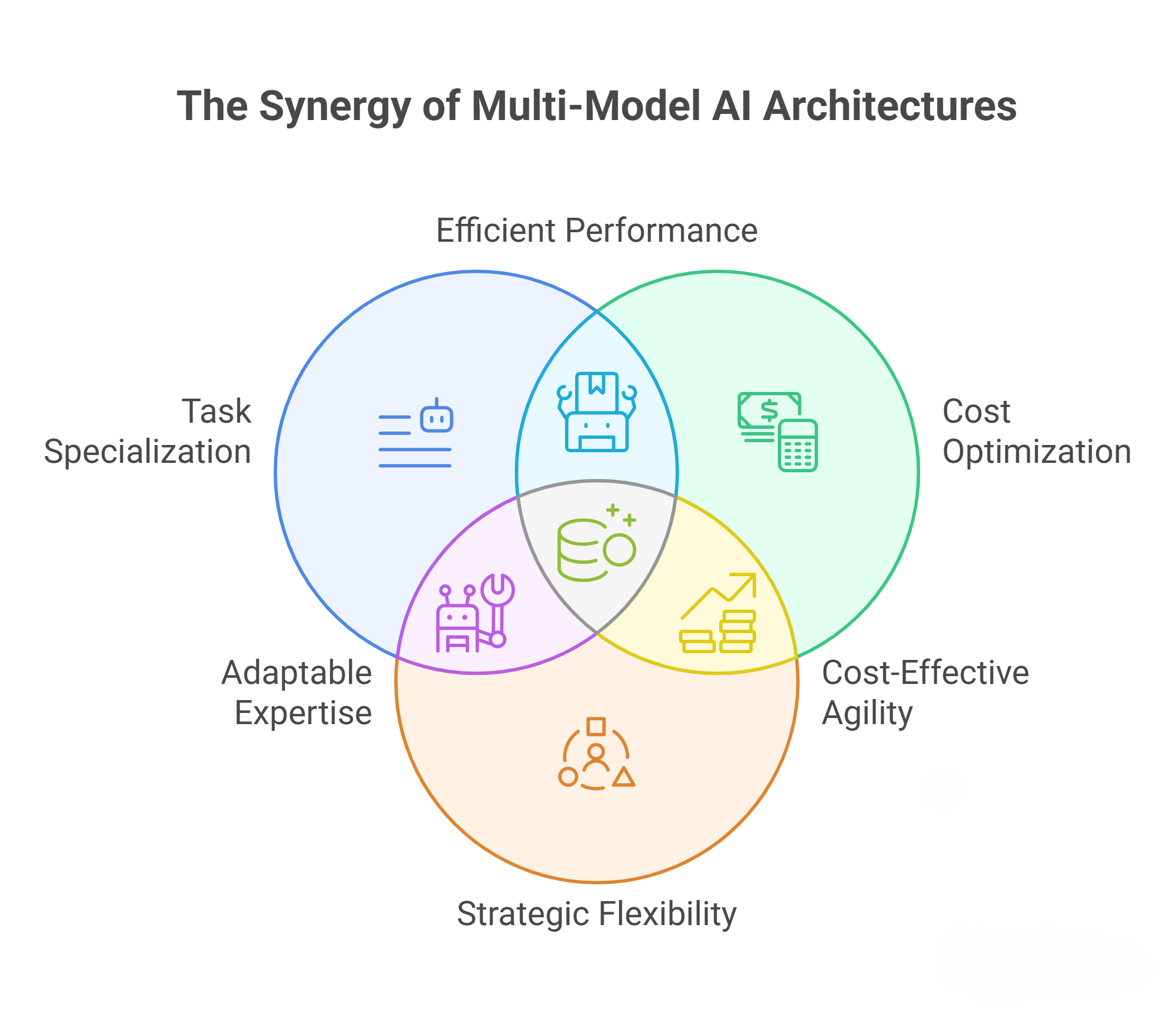
As AI adoption grows, enterprises begin to recognize three practical reasons for adopting multi-model strategies.
Task specialization
Different models perform better on different tasks. Matching the right model to the right workload improves reliability and output quality.
Cost optimization
Premium reasoning models deliver powerful results but carry higher inference costs. Using them for simple classification or summarization tasks quickly becomes inefficient.
Strategic flexibility
The generative AI ecosystem evolves rapidly. Enterprises benefit from architectures that allow them to integrate new models without rebuilding entire systems.
Google Cloud's expansion of models within Vertex AI reflects this reality. But access to multiple models alone does not create enterprise readiness. Architecture determines whether those models function cohesively.
Vertex AI as an Enterprise Control Layer
Vertex AI is increasingly positioned as the coordination layer for enterprise AI deployments on Google Cloud.
Rather than interacting directly with individual models, organizations can build systems where Vertex AI manages the lifecycle of AI workloads.
This environment allows enterprises to:
- Access multiple foundation models through consistent interfaces
- Integrate custom-trained models alongside foundation models
- Standardize pipelines for deployment and monitoring
- Apply governance controls across AI workloads
- Track performance centrally across models
This centralized coordination becomes especially important as AI environments become more complex.
Without orchestration, model diversity creates fragmentation.
With orchestration, it creates architectural flexibility.
The Emerging Shift Toward Multi-Modal and Agent-Driven Systems
Another important signal from Vertex AI's evolution is the move beyond purely text-based AI systems.
Generative AI is increasingly becoming multi-modal, capable of working with text, images, video, and structured data simultaneously. At the same time, AI workflows are becoming more automated through agent-driven architectures that coordinate multiple tasks within a pipeline.
A recent example of this shift is VEO 3, Google's generative video model available within Vertex AI. VEO 3 enables organizations to generate high-quality video content directly from AI-driven workflows.
More importantly, the technology demonstrates how AI systems can orchestrate multiple agents across a workflow. One component may generate a script, another verify compliance requirements, and another produce video output or automate distribution.
This illustrates how Vertex AI is evolving beyond simple model hosting. It is becoming an orchestration environment where different models and agents collaborate to execute complex processes.
Enterprises building AI systems today must anticipate this level of coordination.

Routing Intelligence: The Core of Multi-Model Systems
Once multiple models are introduced into an AI environment, routing logic becomes essential.
Routing determines how requests move through the system and which model handles each task.
For example, an enterprise knowledge assistant might follow several stages:
A lightweight model first classifies incoming queries.
Enterprise data is retrieved through a BigQuery-based retrieval pipeline.
Complex reasoning tasks are routed to a higher-capacity model.
A validation layer ensures policy compliance before responses are delivered.
This layered architecture allows enterprises to balance performance, reliability, and cost efficiency.
Routing intelligence transforms AI systems from isolated tools into coordinated platforms.
Data as the Stabilizing Layer
Multi-model AI systems depend heavily on strong data architecture.
Without centralized data governance, different models may operate on inconsistent or outdated information, leading to unreliable outputs.
On Google Cloud, BigQuery frequently serves as the foundation for enterprise AI data environments. It allows organizations to combine structured data, unstructured documents, and real-time streams within a single analytics platform.
When retrieval pipelines, embeddings, and metadata management align within this unified data layer, multiple models can operate with consistent context.
Without this foundation, scaling AI becomes significantly more difficult.
Governance in Multi-Model AI Environments
Introducing multiple models increases both capability and operational risk.
Different models may interpret prompts differently, produce varied output structures, and interact with sensitive information.
Governance frameworks must therefore extend beyond individual models and operate across orchestration layers.
Enterprises typically implement:
- Role-based access controls for AI interactions
- Prompt injection protection
- Centralized logging and monitoring
- Output validation frameworks
- Cross-model compliance enforcement
Google Cloud provides infrastructure-level capabilities—such as IAM policies, encryption, and monitoring tools—but architectural integration determines their effectiveness.
Governance maturity becomes a key factor in scaling enterprise AI.
Cost Engineering in Multi-Model Architectures
Cost control is often the defining constraint in enterprise AI deployments.
Premium reasoning models produce high-quality outputs but require greater computational resources. Lightweight models provide efficiency but may lack depth.
Without structured routing, organizations often rely too heavily on high-capacity models, causing infrastructure costs to escalate.
A multi-model architecture allows enterprises to allocate tasks strategically.
Routine summarization or classification tasks can be assigned to efficient models, while complex reasoning tasks can be directed to more advanced models.
This approach enables AI systems to scale while maintaining predictable infrastructure spending.
A Real-World Scaling Pattern
One enterprise engagement illustrates how architectural redesign enables sustainable AI expansion.
The organization initially deployed a generative AI knowledge assistant designed to help employees navigate large internal document repositories. The pilot used a single foundation model and quickly demonstrated productivity improvements.
Within three months, more than 2,000 employees were actively using the system. Manual document search time decreased by nearly 40 percent, significantly improving operational efficiency.
However, as adoption increased, several challenges emerged.
Inference costs rose sharply as usage scaled.
Latency exceeded acceptable thresholds during peak hours.
Compliance teams required detailed auditability of AI outputs.
Engineering teams needed more advanced reasoning capabilities than the original model provided.
Rather than replacing the model, the organization redesigned its architecture.
A centralized BigQuery data foundation unified document retrieval and analytics. Retrieval-augmented generation pipelines were standardized across workflows. Vertex AI became the orchestration layer, allowing multiple models to be benchmarked and routed dynamically.
Routine queries were handled by lightweight models, while complex reasoning tasks were routed to higher-capacity models. Governance controls were embedded across orchestration workflows, and monitoring dashboards tracked cost, performance, and model utilization.
Within six months of the redesign:
Average query latency improved by 30 percent.
Infrastructure cost growth stabilized, reducing projected spend by 25 percent.
New AI use cases could be deployed in less than half the previous development time.
The improvement was not driven by adopting a stronger model. It was enabled by better architecture.
At this stage, organizations often engage AI & ML consulting services to help design orchestration frameworks, governance policies, and cost optimization strategies that allow AI initiatives to scale without creating operational complexity.
Strategic Implications for Enterprise AI Architecture
The evolution of Vertex AI reflects a broader shift in enterprise AI design.
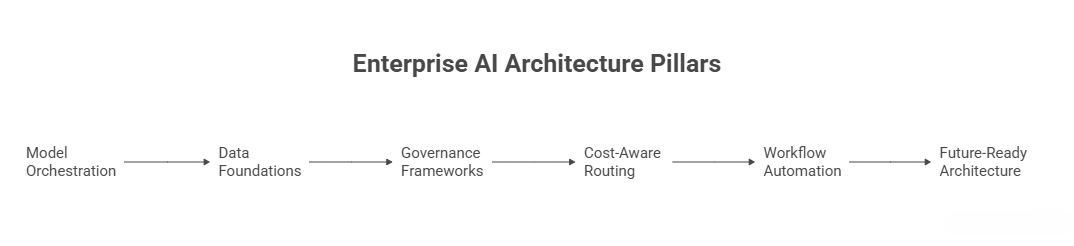
Future-ready architectures increasingly rely on several key pillars:
Model orchestration
Systems must intelligently coordinate multiple models rather than rely on a single provider.
Data foundations
Unified data environments ensure consistent context across models.
Governance frameworks
Security, compliance, and monitoring must extend across AI workflows.
Cost-aware routing
Task-based model allocation enables predictable infrastructure investment.
Workflow automation
Agent-driven systems allow AI to coordinate complex operational processes.
Organizations that design around these architectural pillars can adopt new AI capabilities without repeatedly rebuilding their systems.
A Closing Perspective
The expansion of foundation models within Vertex AI is not simply a feature upgrade. It reflects a broader transition toward orchestrated, multi-model enterprise AI environments.
As generative AI evolves—from text generation to multi-modal automation and agent-driven workflows—the systems supporting it must evolve as well.
Organizations that approach AI as an architectural capability rather than a standalone tool will be better positioned to adapt as technology advances.
For organizations looking to scale AI on Google Cloud, it is important to understand how the right architecture, data foundation, and governance practices come together in real-world implementations. You can learn more about Google Cloud capabilities and services here:
https://www.infoservices.com/technology/gcp
Because sustainable AI capability is rarely defined by the model an organization selects.
It is defined by the architecture that allows intelligence to scale.
FAQ's
1. Why are enterprises moving toward multi-model AI architectures instead of relying on a single foundation model?
Different models excel at different tasks such as reasoning, summarization, or automation. A multi-model approach allows enterprises to optimize performance, cost, and reliability across diverse AI workloads.
2. How does Vertex AI help organizations manage multiple AI models in production?
Vertex AI provides a centralized environment to deploy, monitor, and manage different models through consistent APIs and governance controls. This helps enterprises orchestrate AI workloads without creating fragmented systems.
3. What role does data architecture play in scaling enterprise AI systems?
A strong data foundation ensures models access consistent, high-quality context for generating outputs. Platforms like BigQuery enable unified analytics and retrieval pipelines that stabilize AI performance across use cases.
4. How can enterprises control costs when deploying generative AI at scale?
Cost management is achieved by routing tasks to the most appropriate model based on complexity. Lightweight models can handle routine tasks while advanced models are reserved for deeper reasoning workloads.
5. What architectural capabilities are essential for enterprise-ready AI platforms?
Successful enterprise AI systems combine model orchestration, strong data governance, cost-aware routing, and workflow automation. These capabilities allow organizations to scale AI safely while adapting to evolving technologies.