

Generative AI
Comprehensive Databricks Implementation Checklist for Enterprises
Build scalable data platforms with Databricks
In today's data-driven world, many enterprises invest in Databricks—but fail to unlock its full potential.
Not because of the platform, but due to poor implementation strategy.
Databricks is not just a tool—it's a complete data ecosystem. Without a structured approach, organizations often face:
- Delays in delivery
- High cloud costs
- Poor data governance
- Underutilized platforms
The key to success: Plan strategically, implement carefully, and optimize continuously.
This guide walks you through a complete end-to-end Databricks implementation checklist to help you build a scalable, secure, and production-ready data platform.
Why Databricks Needs a Strategic Approach
Databricks combines:
- Data Engineering
- Data Science
- Machine Learning
- Analytics
All in a Lakehouse Architecture
However, without proper planning, enterprises struggle with:
- Fragmented data sources
- Inefficient pipelines
- Lack of ML production readiness
- Security and governance gaps
A structured approach ensures:
- Faster time to value
- Better scalability
- Cost optimization
- Secure data environment
End-to-End Implementation Phases
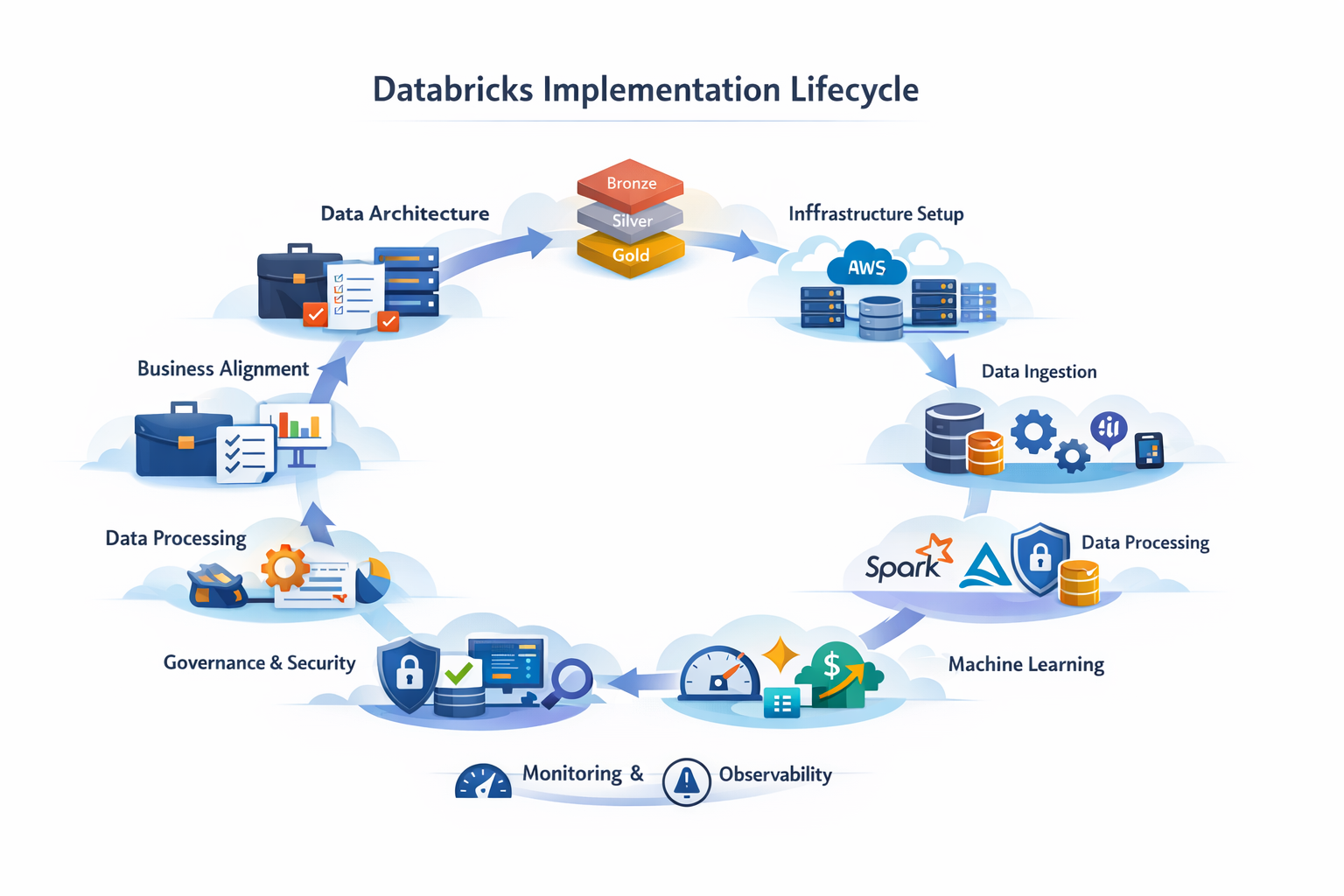
Phase 1: Business & Use Case Alignment
Before touching any technical setup, align Databricks with your business goals.
Key Checklist Items:
- Define primary use cases (e.g., predictive maintenance, customer analytics, fraud detection)
- Identify stakeholders (data engineers, analysts, business teams)
- Define success metrics (ROI, cost reduction, performance improvement)
- Prioritize workloads (batch, streaming, ML)
Pro Tip: Start with 1–2 high-impact use cases instead of trying to migrate everything at once.
Phase 2: Data Architecture Design
A strong foundation starts with the right architecture.
Key Checklist Items:
- Choose between Lakehouse architecture vs traditional warehouse
- Design Medallion Architecture:
- Bronze (raw data)
- Silver (cleaned data)
- Gold (business-ready data)
- Define data ingestion methods:
- Batch ingestion
- Real-time streaming (Kafka, Event Hubs)
- Plan storage (Azure Data Lake, S3, etc.)
Phase 3: Infrastructure & Environment Setup
This is where your Databricks environment comes to life.
Key Checklist Items:
- Set up Databricks workspace (Azure, AWS, or GCP)
- Configure clusters:
- Auto-scaling clusters
- Job clusters vs all-purpose clusters
- Enable networking:
- VNet injection (Azure)
- Private endpoints
- Set up CI/CD pipelines for deployment
- Configure role-based access control (RBAC)
Best Practice: Use Infrastructure as Code (Terraform) for repeatability.
Phase 4: Data Ingestion & Integration
Now it's time to bring data into Databricks.
Key Checklist Items:
- Connect to data sources:
- Databases (SQL Server, Oracle)
- APIs
- IoT devices
- Build ingestion pipelines:
- Use Auto Loader for scalable ingestion
- Handle schema evolution
- Ensure data validation during ingestion
Tools to Use:
- Databricks Auto Loader
- Delta Live Tables (DLT)
Phase 5: Data Processing & Transformation
This is where raw data becomes usable.
Key Checklist Items:
- Build ETL/ELT pipelines using Spark
- Implement Delta Lake for:
- ACID transactions
- Time travel
- Optimize data processing:
- Partitioning
- Caching
- Automate workflows using jobs
Optimization Tip:
✔ Use Photon engine for faster query performance
Phase 6: Data Governance & Security
One of the most critical (and often overlooked) steps.
Key Checklist Items:
- Implement Unity Catalog for centralized governance
- Define data access policies
- Enable data lineage tracking
- Encrypt data (at rest & in transit)
- Set up audit logging
Compliance Considerations:
- GDPR
- HIPAA
- Industry-specific regulations
Without governance, scaling Databricks becomes risky and chaotic.
Phase 7: Machine Learning & AI Enablement
Databricks shines when it comes to AI/ML workflows.
Key Checklist Items:
- Set up MLflow for:
- Experiment tracking
- Model versioning
- Build ML pipelines
- Automate model training
- Deploy models into production
- Monitor model performance (drift detection)
Use Cases:
- Predictive maintenance
- Demand forecasting
- Fraud detection
Phase 8: Performance Optimization & Cost Management
Many enterprises overspend due to poor optimization.
Key Checklist Items:
- Enable auto-scaling clusters
- Use spot instances where applicable
- Monitor usage with dashboards
- Optimize queries and workloads
- Implement caching strategies
Cost Optimization Strategies:
✔ Right-size clusters ✔ Schedule jobs efficiently ✔ Shut down idle resources
Phase 9: Monitoring, Logging & Observability
A production system without monitoring is a disaster waiting to happen.
Key Checklist Items:
- Set up monitoring dashboards
- Track:
- Job failures
- Cluster performance
- Data pipeline health
- Integrate with tools:
- Azure Monitor
- Prometheus
- Enable alerting mechanisms
Phase 10: Deployment, Testing & Scaling
Before going live, ensure everything is production-ready.
Key Checklist Items:
- Perform end-to-end testing
- Validate data accuracy
- Conduct performance testing
- Deploy using CI/CD pipelines
- Plan for scaling:
- Multi-workspace strategy
- Multi-region deployment
Common Mistakes to Avoid in Databricks Implementation
Even with a checklist, enterprises often make these mistakes:
- Skipping architecture planning
- Ignoring governance until later
- Over-provisioning clusters (high costs)
- Not aligning with business goals
- Lack of skilled expertise
Why Enterprises Choose Databricks Implementation Partners
While Databricks is powerful, implementation complexity often requires expert guidance.
A professional Databricks partner helps with:
- Architecture design
- Migration strategy
- Cost optimization
- Security and governance
- End-to-end deployment
This ensures faster implementation and better ROI.
Final Thoughts: From Implementation to Transformation
Databricks implementation is not just a technical project—it's a business transformation journey.
Enterprises that follow a structured, end-to-end approach can:
- Unlock real-time insights
- Scale AI initiatives
- Reduce operational costs
- Improve decision-making
The key is simple: Plan strategically, implement carefully, and optimize continuously.
For enterprises in Chennai, adopting Databricks is becoming a strategic priority as businesses accelerate their digital transformation initiatives. From manufacturing and automotive to fintech and SaaS companies, organizations in Chennai are leveraging Databricks to build scalable data platforms, enable real-time analytics, and drive AI innovation. However, successful implementation requires deep expertise in architecture design, governance, and cost optimization. Partnering with a local Databricks consulting team ensures faster execution, better alignment with regional business needs, and on-ground support to scale your data and AI initiatives efficiently.

Ready to Implement Databricks Successfully?
If you're planning to adopt Databricks or struggling with an existing setup, the right approach makes all the difference.
From architecture design to deployment and optimization, expert guidance can accelerate your success.
Talk to our Databricks experts today and build a scalable, future-ready data platform.

FAQ'S
1. What is Databricks implementation and why do Chennai businesses need it?
Databricks implementation involves setting up a scalable data platform for analytics and AI. In Chennai, businesses across manufacturing, fintech, and SaaS use it to enable real-time insights, improve decision-making, and scale AI initiatives.
2. How much does Databricks implementation cost in Chennai?
The cost depends on data volume, cloud provider (Azure/AWS/GCP), architecture complexity, and workloads. Chennai enterprises typically optimize costs through proper cluster sizing, governance, and FinOps strategies.
3. How long does it take to implement Databricks for enterprises?
A basic implementation can take a few weeks, while enterprise-scale deployments with data pipelines, governance, and ML workflows may take several months, depending on complexity.
4. Which industries in Chennai benefit most from Databricks?
Industries like automotive, manufacturing, healthcare, logistics, and fintech in Chennai benefit the most by leveraging Databricks for predictive analytics, demand forecasting, and fraud detection.
5. Do I need a Databricks consulting partner in Chennai?
Yes, working with a local partner helps with faster deployment, better cost optimization, and region-specific support. It also reduces risks related to architecture, governance, and scaling.
6. What are the common challenges in Databricks implementation?
Common challenges include poor data architecture, lack of governance, high cloud costs, and inefficient pipelines—issues highlighted in your implementation checklist .