

Cybersecurity
AI-Powered Code Security in 2026
From static analysis to semantic intelligence
Artificial intelligence is no longer just writing code. In 2026, AI-powered code security is transforming how organizations detect vulnerabilities, secure applications, and strengthen AI cybersecurity defenses. With the launch of Claude Code Security by Anthropic, the cybersecurity landscape has entered a new era, one where AI does not just scan for vulnerabilities but genuinely understands how software behaves in the real world.
For CTOs, CISOs, DevSecOps engineers, and security architects, this is not just another tool announcement. It is a fundamental shift in how application security works and understanding it could be the most important thing your organization does this year.
What Is Claude Code Security? A Quick Introduction
Claude Code Security is Anthropic's AI-powered application security capability designed to analyze entire codebases for vulnerabilities. Unlike traditional Static Application Security Testing (SAST) tools that rely on pattern matching and known signatures, Claude Code Security leverages large language model intelligence to understand the semantic meaning and behavioral context of code.
In simple terms: where old tools ask, "does this look like a vulnerability?", Claude Code Security asks "could this actually be exploited, and how?"
Currently in limited research preview, its direction signals a major transformation in AI-driven threat detection, secure coding automation, and intelligent vulnerability remediation, all critical pillars of modern DevSecOps.
Modern DevSecOps strategies often rely on integrated platforms and learning how Azure DevOps transforms software delivery provides valuable insight into automating build, test, and deployment pipelines.
The Drawbacks of Traditional Security Tools and How AI Fixes Them
Traditional application security testing tools often rely on rule-based scanning, while AI application security platforms analyze behavioral patterns and contextual vulnerabilities.
Security teams often reference the MITRE ATT&CK framework to understand attacker techniques and design stronger detection and response strategies.
To appreciate what AI-powered code security solves, we first need to understand what legacy tools consistently fail at. Here are the biggest drawbacks and how Claude Code Security addresses each one.
1. High False Positive Rates
Traditional SAST tools are notorious for flooding security teams with false positives, flagging harmless code as dangerous. This creates alert fatigue, wastes developer time, and erodes trust in security tooling. AI-driven security like Claude Code Security uses contextual reasoning to evaluate whether a flagged issue is genuinely exploitable, dramatically reducing noise and allowing teams to focus on real threats.
2. Inability to Detect Business Logic Vulnerabilities
One of the most dangerous blind spots in traditional security scanning is business logic flaws. These are vulnerabilities that exist not because of bad syntax, but because of flawed application design, misused trust boundaries, broken access control flows, or insecure API interactions. Claude Code Security understands how modules interact and can trace execution paths across entire systems, making it uniquely capable of surfacing these hidden risks that pattern-based tools simply cannot see.
3. Late-Stage Security Feedback
Most organizations still treat security as a final checkpoint before deployment. The result? Vulnerabilities compound across sprints, remediation becomes expensive, and release timelines suffer. AI-powered security embedded throughout the Software Development Life Cycle (SDLC) delivers real-time feedback during coding itself, shifting security left and catching issues at the moment they are introduced, not weeks later.
4. No Contextual Remediation Guidance
Traditional tools tell you what is wrong. They rarely tell you how to fix it in a way that makes sense for your specific codebase and architecture. Claude Code Security goes beyond detection, it recommends contextual remediation steps tailored to how your code actually works, accelerating resolution cycles and reducing the burden on already stretched security teams.
Industry frameworks such as the OWASP Secure Coding Practices continue to guide developers in building applications that are resilient against common attack vectors.
5 Powerful Ways AI-Driven Code Security Benefits Your Organization in 2026
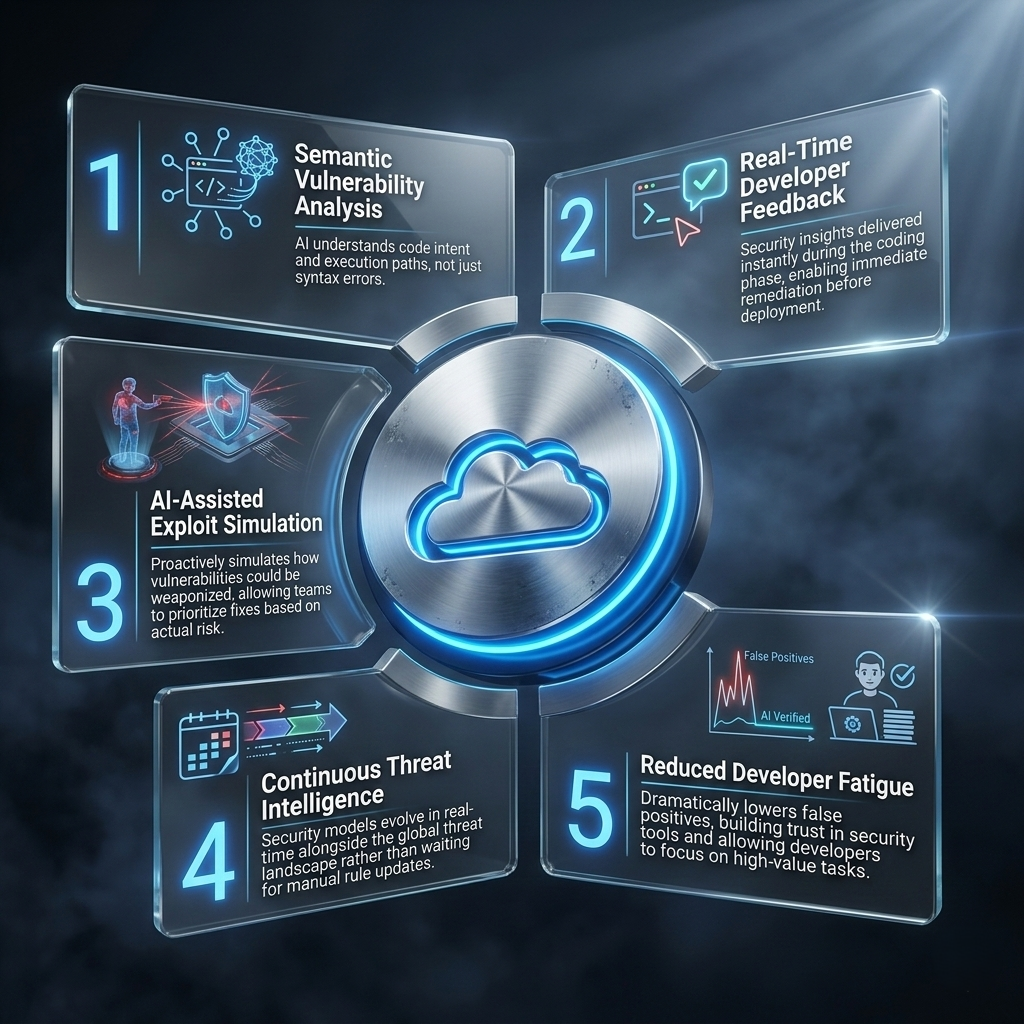
- Semantic vulnerability analysis — AI understands intent and execution paths, not just syntax errors
- Real-time developer feedback — security insights delivered during the coding phase, not after deployment
- AI-assisted exploit simulation — understanding how vulnerabilities could be used by attackers before attackers do
- Continuous threat intelligence — AI that evolves with the threat landscape, not just annual rule updates
- Reduced developer fatigue — fewer false positives mean more trust in security tooling and faster remediation
The AI Arms Race: Why Defensive Intelligence Must Match Offensive AI
Here is the uncomfortable truth that every security leader needs to hear in 2026: attackers are already using AI, and they are getting better at it every day.
Cybercriminals are leveraging generative AI to automate attacks, discover vulnerabilities, and bypass traditional defenses, making AI-powered vulnerability detection and AI threat detection tools essential. identify zero-day vulnerabilities at scale, automate highly targeted phishing campaigns, and analyze leaked repositories for exploitable weaknesses. The offensive capabilities of AI-powered threat actors have grown exponentially.
If your defensive tools are still operating at rule-based, pre-AI speeds, you are not in the same fight. This is why AI in cybersecurity defense is no longer a competitive advantage, it is a survival requirement.
Claude Code Security represents exactly this equilibrium: AI matching and anticipating AI. As offensive AI grows stronger, your security intelligence must evolve faster.
Integrating AI-Powered Security into Your Secure SDLC: What Leaders Need to Know
For CTOs and engineering leadership, the strategic question is not whether to adopt AI-driven security, it is how to integrate it intelligently into existing workflows without disrupting delivery velocity.
Here is what an AI-integrated secure SDLC looks like in practice:
- Plan phase — AI identifies security requirements and threat models before development begins
- Code phase — AI reviews in real time, surfacing contextual vulnerabilities as they are written
- Test phase — AI simulates attack scenarios that traditional testing would never replicate
- Deploy phase — AI monitors for behavioral anomalies and configuration risks at release
- Maintain phase — AI continuously learns from new threat intelligence and adapts detection accordingly
As AI-powered code analysis tools evolve, developers must also stay aware of risks highlighted in the OWASP LLM Top 10 real-world threats, which explain how attackers exploit vulnerabilities unique to large language model applications.
Key Questions Every CISO and Security Architect Should Be Asking Right Now
- Is our current SAST tooling capable of detecting contextual and logic-based vulnerabilities?
- How do we validate AI-generated security insights before acting on them?
- What governance framework do we need when AI participates in vulnerability assessment?
- Are our development teams equipped to act on AI-generated remediation guidance?
- How quickly can we shift from reactive security posture to anticipatory, AI-driven defense?
The Bigger Picture: Security Must Be Designed In, Not Bolted On
Perhaps the most important principle Claude Code Security reinforces is one that forward-thinking security leaders have advocated for years: security cannot be an afterthought. In the age of microservices, serverless architectures, API ecosystems, and AI-generated code, the attack surface is expanding faster than any team of human reviewers can track.
The organizations that will lead in the next phase of digital transformation are those that treat AI not just as a productivity engine, but as a strategic defense layer embedded at the core of how they build software.
AI-powered code security is not just about finding vulnerabilities faster. It is about building a culture where security and development are not two separate teams in conflict — but one intelligent, unified motion.
The rise of AI-powered code security, DevSecOps automation, and AI vulnerability detection is redefining modern application security strategies.
Final Thought: The Future of Cybersecurity Is Adaptive, Not Just Automated
Claude Code Security is not just a new feature from Anthropic. It represents a philosophical shift in how the industry thinks about application security — from scanning artifacts to understanding systems, from detecting known patterns to reasoning about unknown threats.
In 2026, the most secure organizations will not be the ones with the most security tools. They will be the ones with the most intelligent ones.
The question is not whether AI will become a core cybersecurity defense layer. It already is. The real question is: will your organization lead that transition — or react to it after a breach forces your hand?
FAQ's
1. What is Claude Code Security?
Claude Code Security is an AI-powered security capability developed by Anthropic that analyzes entire codebases to identify vulnerabilities using contextual and semantic understanding of code behavior.
2. How does AI-powered code security differ from traditional security tools?
Traditional tools rely on rule-based pattern matching, while AI-powered code security understands how code actually behaves. This allows it to detect complex vulnerabilities and significantly reduce false positives.
3. Can AI detect business logic vulnerabilities in applications?
Yes. AI-driven security tools can analyze how application components interact and identify vulnerabilities related to business logic, access control, and insecure API workflows.
4. Why is AI becoming important in DevSecOps?
AI helps security teams detect vulnerabilities earlier, provide real-time feedback to developers, automate remediation suggestions, and continuously adapt to emerging threats.
5. How does AI improve secure software development?
AI can review code during development, simulate attack scenarios, identify risky patterns, and recommend fixes — helping organizations integrate security throughout the software development lifecycle.
6. How can organizations adopt AI-powered security in their development lifecycle?
Organizations can integrate AI-powered security tools into their CI/CD pipelines, code review processes, and monitoring systems to detect vulnerabilities early and strengthen overall application security.