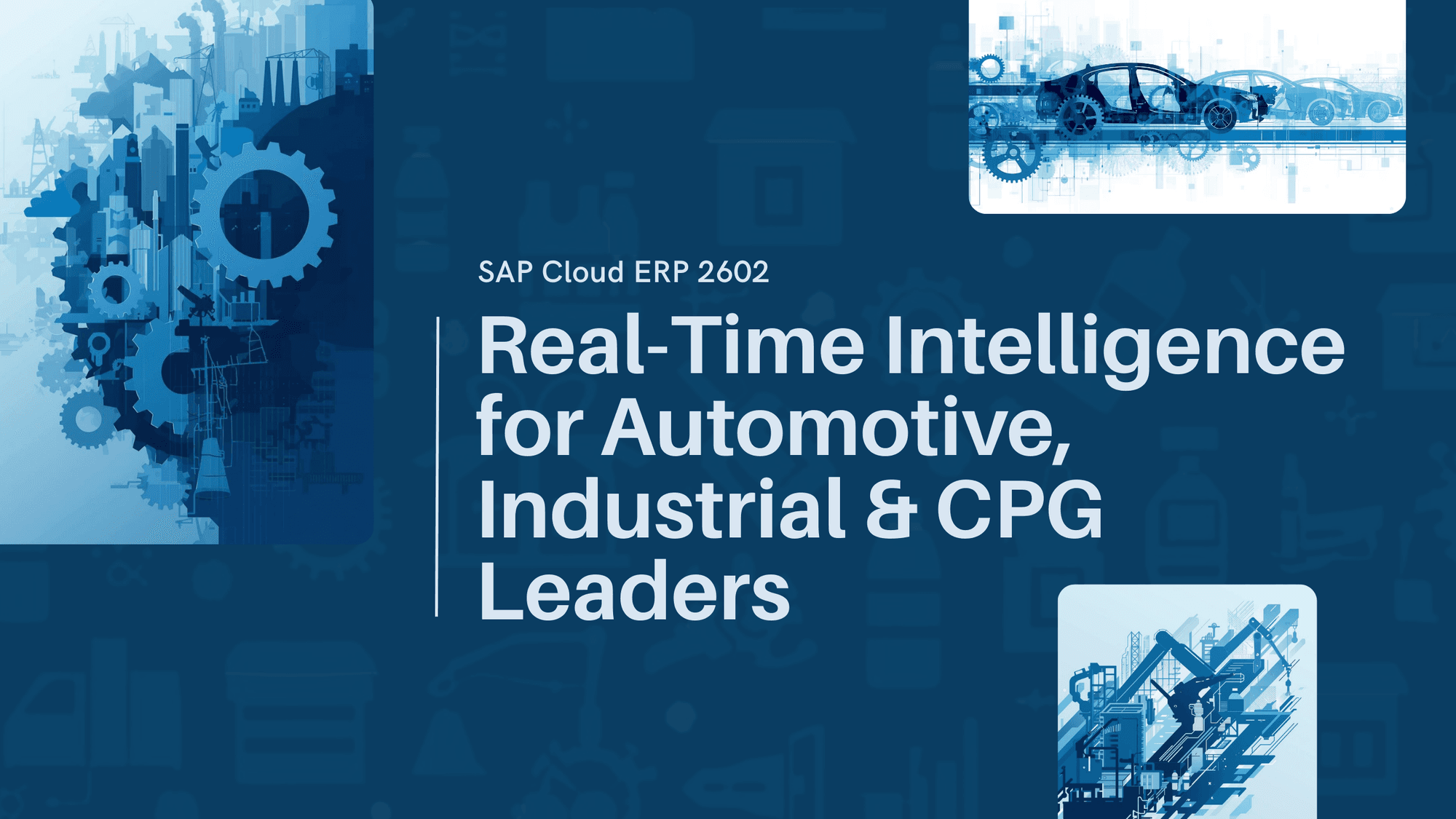
SAP Cloud ERP 2602 Manufacturing Solutions
Turn Manufacturing Complexity into Competitive Advantage
Manufacturing organizations are entering a defining phase of transformation. Cost pressures remain high, supply chains are volatile, customer expectations are rising, and regulatory demands continue to tighten. At the same time, many manufacturers are still operating on ERP landscapes designed for predictability, not constant change.
With the 2602 release of SAP Cloud ERP, SAP makes a clear statement: manufacturing must evolve from static execution to real-time, intelligent, and cloud-native operations.
This evolution looks different across industries. Automotive manufacturers face platform shifts and supply uncertainty. Industrial manufacturers manage complexity and long asset lifecycles. CPG companies operate at high speed and scale with razor-thin margins.
Understanding how SAP Cloud ERP 2602 impacts each of these sectors is key to making the right transformation decisions.
Automotive Manufacturing: Building Resilience in a Volatile Ecosystem
Automotive manufacturing is no longer linear. Electrification, software-defined vehicles, regionalized supply chains, and regulatory scrutiny have transformed how vehicles are designed, built, and delivered.
Traditional ERP systems struggle in this environment because they rely on delayed reporting and rigid process flows.
SAP Cloud ERP 2602 introduces a more event-driven manufacturing model, allowing automotive organizations to respond faster to change.
What This Enables for Automotive Manufacturers
Real-time disruption response
Material shortages, supplier delays, or quality issues can now trigger immediate adjustments across production planning, procurement, and logistics. This reduces line stoppages and limits cascading delays across plants.
Integrated quality and traceability
Quality events detected during production are surfaced instantly, enabling faster containment and improved traceability, critical for recalls, audits, and compliance with regional regulations.
Standardized core with controlled flexibility
Automotive organizations can standardize foundational manufacturing processes while extending functionality for EV platforms, variant complexity, and software integration, without locking themselves into heavy customizations.
Outcome:
Automotive manufacturers gain the agility and resilience needed to operate in an ecosystem defined by constant change rather than long planning cycles.
Industrial Manufacturing: Managing Complexity Without Losing Control
Industrial manufacturers face a different challenge. Many operate engineer-to-order or configure-to-order models, manage long asset lifecycles, and support highly customized products across global operations.
In these environments, fragmentation between planning, execution, and engineering data often leads to delays, rework, and cost overruns.
SAP Cloud ERP 2602 addresses this by strengthening integration, visibility, and standardization, without oversimplifying complex operations.
What This Enables for Industrial Manufacturers
Event-driven production planning
Engineering changes, capacity constraints, or material availability updates can dynamically adjust production plans, reducing delays in project-based manufacturing.
Embedded intelligence for decision-makers
Operational insights are delivered directly within workflows, helping planners and operations teams act quickly without relying on disconnected reports or manual coordination.
Consistent operations across regions
Cloud-native processes make it easier to standardize execution across plants while still supporting local regulatory and operational requirements.
Outcome:
Industrial manufacturers can scale complexity confidently maintaining control while improving responsiveness and predictability.
Consumer Packaged Goods (CPG): Speed and Precision at Scale
For CPG manufacturers, competitiveness depends on speed, accuracy, and cost efficiency. Demand volatility, shorter product lifecycles, and strict quality standards leave little room for inefficiency.
Legacy ERP systems often introduce friction through delayed updates, manual processes, and inflexible planning models.
SAP Cloud ERP 2602 strengthens cloud-native manufacturing capabilities that help CPG organizations stay agile at scale.

What This Enables for CPG Manufacturers
Faster response to demand signals
Event-driven manufacturing allows production schedules to adjust quickly based on sales trends, promotions, or supply constraints—reducing stockouts and excess inventory.
Built-in quality and compliance
Quality checks and traceability are embedded directly into manufacturing workflows, supporting food safety, labeling, and regulatory compliance without additional overhead.
Lower operational friction
Continuous cloud updates reduce downtime and maintenance effort, allowing teams to focus on optimization rather than system upkeep.
Outcome:
CPG manufacturers gain the ability to respond faster, reduce waste, and maintain consistent quality, without increasing operational complexity.
You can explore how enterprises are modernizing cloud infrastructure and data platforms in this detailed case study on Google Cloud implementations.
A Common Thread Across Industries: From Execution to Intelligence
While the challenges differ across automotive, industrial, and CPG manufacturing, a common pattern emerges:
Manufacturing success is no longer driven by execution alone.
It is driven by real-time visibility, embedded intelligence, and adaptive processes.
SAP Cloud ERP 2602 reinforces several critical shifts:
- From batch processing to event-driven operations
- From static reports to insights embedded in workflows
- From heavy customization to clean-core extensibility
- From periodic upgrades to continuous innovation
Organizations that approach Cloud ERP as a simple system replacement risk missing these benefits. Those that treat it as an opportunity to modernize manufacturing processes position themselves for long-term resilience.
Preparing for What Comes Next
Manufacturing leaders evaluating SAP Cloud ERP should look beyond features and ask deeper questions:
- Are our manufacturing processes designed for real-time decision-making?
- Where does standardization truly add value and where is flexibility essential?
- Is our data foundation ready to support event-driven operations?
- How do we modernize without disrupting production continuity?
The answers to these questions will determine whether SAP Cloud ERP becomes a strategic advantage or just another IT initiative.
Explore our automotive analytics solution case study to see real-world impact.
FAQ's
1.What's new in SAP Cloud ERP 2602 for manufacturing?
SAP Cloud ERP 2602 introduces event-driven manufacturing capabilities that enable real-time response to disruptions, embedded quality and traceability features, and cloud-native processes designed for continuous innovation. Key improvements include dynamic production planning that adjusts instantly to material shortages, supplier delays, or quality issues; integrated intelligence delivered directly within workflows; and clean-core extensibility that allows manufacturers to standardize processes while maintaining necessary flexibility. These capabilities are specifically designed to help automotive, industrial, and CPG manufacturers transition from static execution models to intelligent, adaptive operations.
2.How does SAP Cloud ERP 2602 benefit automotive manufacturers specifically?
SAP Cloud ERP 2602 addresses critical automotive manufacturing challenges including electrification complexity, supply chain volatility, and regulatory compliance. The platform enables real-time disruption response where material shortages or quality issues trigger immediate adjustments across production planning, procurement, and logistics—reducing line stoppages significantly. Automotive manufacturers gain integrated quality and traceability capabilities essential for recalls and audits, plus the ability to standardize core processes while extending functionality for EV platforms and software-defined vehicles without heavy customization. This event-driven approach helps automotive organizations operate in an ecosystem defined by constant change rather than traditional long planning cycles.
3.What are the key differences between SAP Cloud ERP 2602 for industrial vs. CPG manufacturing?
While both benefit from event-driven operations, the focus differs based on industry needs. Industrial manufacturers using SAP Cloud ERP 2602 gain capabilities for managing engineer-to-order complexity, long asset lifecycles, and project-based manufacturing with dynamic production planning that adjusts to engineering changes and capacity constraints. CPG manufacturers benefit from faster response to demand signals, with production schedules adjusting quickly based on sales trends and promotions to reduce stockouts and excess inventory. Industrial focus is on scaling complexity with control, while CPG emphasis is on speed, precision, and quality compliance at high volume. Both industries leverage embedded intelligence and cloud-native processes but applied to their unique operational challenges.
4.Is SAP Cloud ERP 2602 suitable for small to medium-sized manufacturers?
Yes, SAP Cloud ERP 2602 is designed to benefit manufacturers of all sizes through its cloud-native architecture and clean-core approach. Small to medium-sized manufacturers gain enterprise-grade capabilities without the heavy infrastructure investment traditionally required. The platform's event-driven operations, embedded intelligence, and continuous cloud updates reduce the need for dedicated IT resources while providing real-time visibility and adaptive processes. The clean-core extensibility model means manufacturers can standardize on SAP best practices while maintaining necessary flexibility—avoiding costly customizations. For growing manufacturers in automotive, industrial, or CPG sectors, SAP Cloud ERP 2602 provides a scalable foundation that evolves with business needs without requiring periodic upgrade projects.