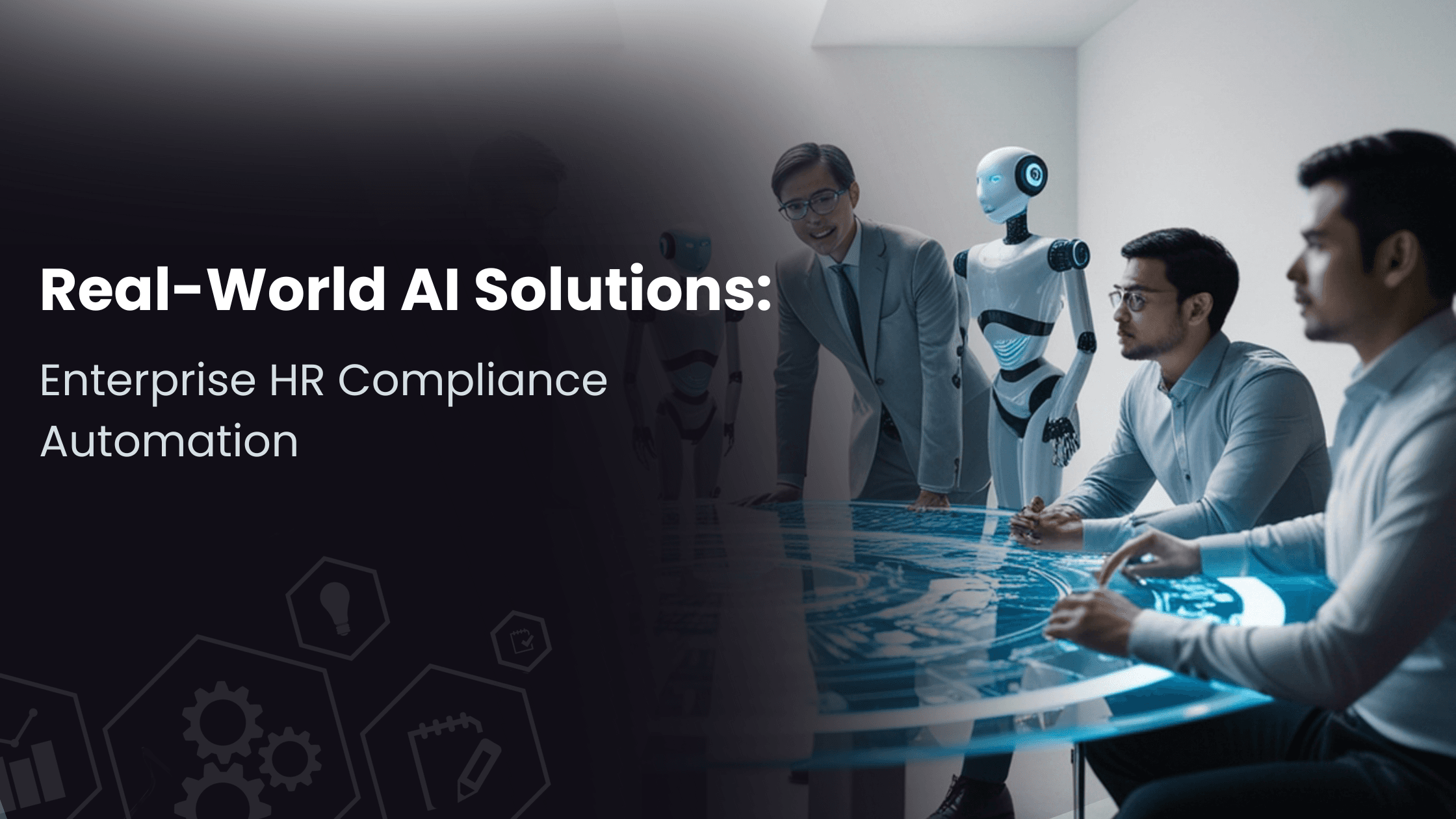
Automating Enterprise HR Compliance with Practical AI Solutions
Reducing HR compliance risk using intelligent AI-driven automation.
Introduction
Generative AI transforms enterprise HR compliance by automating complex approval processes such as promotion evaluations, performance appraisal reviews, and compensation decisions. By leveraging Azure AI Foundry, organizations can parse eligibility criteria—including employee tenure, performance metrics, certification status, and documented training—to deliver consistent, policy-aligned decisions at scale. This document outlines best practices, architectural approaches, and implementation strategies for deploying reliable AI-driven HR compliance automation.
Understanding the Use Case
HR policies for promotion approvals and performance-based decisions require evaluating multiple interdependent factors:
- Tenure Requirements: Years of service thresholds (e.g., minimum 3+ years)
- Performance Metrics: KPI scores and rating scales (e.g., 4.0+ on 5-point scale)
- Skill Certifications: Required professional credentials (Azure certifications, project management, etc.)
- Leadership Feedback: 360-degree reviews and manager assessments
- Training Interventions: Documented professional development completion
Systems must accurately interpret these thresholds to ensure fair, auditable, and compliant outcomes across global teams while reducing manual review bottlenecks.

Figure 1: HR Compliance Automation Workflow showing process stages from data intake through decision approval
Data Preparation Strategies
Quality data forms the foundation of reliable AI decisions:
- Input Quality: Use clean, current HR documents and policy guidelines preprocessed to remove inconsistencies and outdated information
- Augmentation: Enhance base documents with contextual metadata such as policy IDs, department codes, cost center information, and effective dates
- Structuring: Segment large policy documents into logical categories—tenure requirements, metric benchmarks, training proofs, compensation bands—enabling precise AI targeting
- Validation: Implement data cleansing routines to standardize employee records, removing duplicates and ensuring completeness
Clean data reduces hallucinations and ensures the AI engine references accurate policy information consistently.
Reference Architecture
The modular architecture ensures scalability and maintainability across enterprise deployments:

Figure 2: Enterprise AI Pipeline Architecture showing data ingestion, processing, model inference, and feedback loops
Core Components:
Component | Function | Technology |
Data Ingestion Layer | Connects to HR systems (ADP, Workday), cleans inputs | Azure Data Factory, Logic Apps |
Segmentation Module | Divides policies into eligibility, metrics, certifications | Custom Python processing |
Knowledge Base | Stores policy metadata, approval rules, thresholds | Azure Cosmos DB, Cognitive Search |
Prompt Engineering | Designs context-aware prompts for consistent outputs | Azure OpenAI, Prompt Flow |
GenAI Engine | Tests multiple models for accuracy and latency | Azure OpenAI (GPT-4, GPT-3.5) |
Post-Processing | Validates, formats responses, maps to approval forms | Azure Functions, Power Automate |
User Interface | Displays decisions in HR portals and workflows | Power Apps, SharePoint Online |
Feedback Loop | Captures user corrections for continuous refinement | Application Insights, Azure SQL |
Table 1: Reference Architecture Components and Technologies
Multi-Stage Process Breakdown
Rather than generating decisions in a single step, breaking the workflow into focused stages improves accuracy and troubleshooting:
Stage 1: Data Identification and Extraction
Extract employee records and policy data from integrated systems:
- Retrieve HR records from sources like ADP or Workday
- Identify applicable policies based on employee level and request type
- Execute data extraction and formatting routines
- Create structured JSON representations of employee qualifications and policy criteria
- Index and tag data for contextual retrieval
Stage 2: Data Analysis and Context Building
Analyze extracted data to build decision context:
- Segment employee records by tenure, department, and role level
- Parse policy sections into discrete criteria (age, BMI equivalent metrics, certs, ratings)
- Build contextual metadata linking employee attributes to policy thresholds
- Create a knowledge base mapping policy IDs to specific approval rules
- Identify dependencies and hierarchies within requirements
Stage 3: Automated Response Construction
Generate structured decisions with compliance validation:
- Craft targeted prompts incorporating extracted employee data
- Invoke Azure OpenAI model to generate draft responses
- Validate outputs against policy requirements and business rules
- Execute formatting routines to structure responses for approval forms
- Implement error handling for ambiguous or incomplete data
Prompt Engineering Essentials
Well-designed prompts are critical for generating relevant, policy-compliant responses:
Clear and Specific Prompts
Incorporate necessary employee details extracted in earlier stages:
You are an HR compliance officer evaluating promotion requests against company policy.
Analyze the employee profile against promotion criteria and provide a decision.
Policy Requirements:
- Minimum tenure: 3 years
- Minimum performance rating: 4.0 (5-point scale)
- Required certifications: Azure Administrator OR Azure Solutions Architect
- No disciplinary actions in past 12 months
Employee Profile:
- Name: John Smith
- Current Role: Senior Developer
- Tenure: 4.2 years
- Performance Rating: 4.3
- Certifications: ["Azure Administrator", "AWS Solutions Architect"]
- Disciplinary History: None
- Target Role: Technical Lead
Decision: APPROVE / REJECT / MORE INFO NEEDED
Explanation: Provide brief reasoning referencing specific criteria.
Contextual Coherence
Ensure prompt structure mirrors policy hierarchies:
- Reflect enumerated requirements in the same order as policy documents
- Preserve conditional logic (AND/OR relationships)
- Include policy version numbers and effective dates
- Reference specific policy sections for traceability
Handling Nuances
Equip systems to identify subtle variations:
- Recognize equivalent certifications across vendors
- Handle partial matches (e.g., "Azure cert-equivalent" training)
- Capture context around exceptional circumstances
- Flag edge cases for manual escalation
Quality Assurance and Compliance Validation
Ensuring accuracy and regulatory adherence is essential:
- Expert Verification: Subject outputs to HR specialist and compliance review to confirm alignment with policy intent
- Iterative Testing: Validate against real-world scenarios including edge cases (borderline performance ratings, competing certifications)
- Error Handling: Implement rules for escalation when data is ambiguous or incomplete
- Audit Trail: Maintain logs of all decisions, prompts used, and model versions for compliance auditing
- Bias Detection: Monitor for disparate impacts across demographics and department levels
Data Security, Privacy, and Compliance
Maintaining confidentiality and regulatory adherence is critical in HR contexts:
- Confidentiality: Process employee data according to privacy regulations (GDPR, CCPA) and company policies; implement role-based access controls
- Anonymization: Conduct testing and model evaluation on de-identified datasets
- Compliance: Ensure decisions are auditable and traceable; cite specific policy sections in outputs
- Data Retention: Implement retention policies for employee records and decision logs aligned with legal holds
- Encryption: Encrypt sensitive data at rest and in transit using Azure Key Vault

Figure 4: Azure AI Foundry Security and Compliance Features for regulated environments
Deployment, Monitoring, and Optimization
A successful rollout requires careful phasing and continuous improvement:
Controlled Rollout
- Pilot Phase: Deploy system in one department (IT or Finance) with 50-100 promotion requests
- Validation: Compare AI decisions against manual HR reviews; target 95%+ alignment
- Refinement: Adjust prompts and business rules based on discrepancies
- Expansion: Gradually scale to additional departments and decision types
Feedback Loop
- Establish channels for HR specialist feedback on decision quality
- Track false negatives (rejected deserving candidates) and false positives (approved unqualified candidates)
- Integrate insights into iterative prompt and rule refinements
- Conduct quarterly reviews with stakeholders
Performance Metrics
Monitor key indicators using Azure Application Insights and Power BI:
Metric | Target |
Decision Accuracy | 95%+ match with expert review |
Policy Compliance Rate | 100% adherence to documented criteria |
Processing Latency | <5 seconds per decision |
Error Rate | <2% requiring human escalation |
User Satisfaction | >4/5 HR team feedback score |
Table 2: Key Performance Metrics and Targets
Summary
Enterprise HR compliance automation via Azure AI Foundry delivers significant efficiency gains while maintaining policy adherence and fairness. By architecting the system into modular, clearly defined stages—from data extraction and contextual analysis to prompt-driven response generation and post-processing validation—organizations can build AI-powered decision systems that are both reliable and auditable. The integration of expert oversight, iterative testing, and continuous monitoring ensures sustained accuracy as policies evolve and organizational needs change.
Conclusion
Implementing these best practices enables organizations to transform HR operations through scalable, compliant GenAI automation. The combination of structured data pipelines, intelligent prompt engineering, rigorous quality assurance, and security-first design creates a foundation for trusted AI decision-making in regulated environments. As demonstrated through this framework, Azure AI Foundry provides the necessary tools and services to deploy enterprise-grade AI solutions that enhance efficiency while mitigating compliance risks and maintaining organizational values of fairness and transparency. Organizations ready to embrace AI-driven HR compliance gain competitive advantages in talent management, operational efficiency, and decision accuracy.
References
[1] Microsoft Azure AI. (2025). Trustworthy AI and Responsible Use Practices. https://learn.microsoft.com/en-us/azure/ai-foundry/responsible-use-of-ai-overview
Related Posts

7 RAG Mistakes & Production Fixes
Turn fragile RAG demos into reliable production systems
How to Build an AI Chatbot for Your Business Using Amazon Bedrock in 2026
From FAQs to AI Assistants with Amazon Bedrock
AWS AI Implementation Playbook 2026–2027
How to Build, Deploy & Scale AI on AWS Without Wasting Budget